With the onslaught of an administration characterized by media censorship, targeted persecution of minority groups and rising tension with foreign powers, it’s hard not to get existential about things. Nevertheless, our fascination with apocalyptic media has been a staple for as long as media has existed. If art is our way of reflecting on the current moment, then narratives about the end of the world reveal an interesting obsession with our own demise. Unlike other forms of thrillers, the idea of apocalypse touches a uniquely tangible fear, destruction that feels possible from any circumstance and is brought on to us, by us. That may be why Orson Welles's War of the Worlds radio program ignited an instance of mass hysteria. Unlike any other ghoul or disaster, an apocalypse is a distinctly human story. Over the summer, my friends and I indulged in a shared bout of political nihilism by enjoying movies with apocalyptic themes. While I left some of the films with a bigger hole in my heart than when I started, I was able to pull out new understandings of hope, advocacy and togetherness in the face of adversity. Consider some of these films the next time you feel a little horrible about everything, and notice where your hope depletes and where it returns.
If any movie hits “apocalypse” at its core, Children of Men takes the cake. Directed by Alfonso Cuaron, the film takes place in 2027 Great Britain, the last country standing in a world of destruction. In a freak mystery, mass infertility has struck the world, and the last standing population is tasked with figuring out how to reignite the ability to have children and save the human race. Cuaron brings an excellent perspective to what an apocalypse looks like, straying from a classic totalitarian narrative, showing a neoliberal system instead. Additionally, Cuaron exemplifies elements of intersectionality in this story, using hostility against immigration as the main driver of conflict, showing a persecution that is almost prophetic in accuracy. The horror in Children of Men, aside from the visceral scenes of war and political violence, is the monotonous, slow-moving trek to the end, the hopelessness that comes from the lack of new cultural production and the idea that even in the face of death, you have to keep working like nothing is new.
Keeping on the narrative of hopeless political systems, Terry Gilliam’s Brazil paints an Orwellian story in a neon, choreographed, candy colored dream. The film follows a lowly bureaucrat, captured by the love of a beautiful stranger. The man navigates his totalitarian environment to find his identity and fall in love with the girl, resulting in a series of misadventures revealing the corruption of his world. While the film doesn’t fully concern itself with an apocalyptic scene, it presents a destitute totalitarian world and brings the viewer along a never-ending, stressfully chaotic ride. The film is a masterclass in set and scenic design, making every single environment feel stifling and indoors. Additionally, the film is about an authoritarian government from the 1980s, exploring the question of what a dictatorship would look like with pre-modern technology. Whether you are watching for the story or the creativity, this film has exactly what you are looking for.
Now, you cannot talk about apocalypse movies without mentioning zombies. Whether it be a contagion, a mold spore or a consequence of nuclear fallout,the collective has determined that humankind will be ended by vicious, undead versions of ourselves. While the list is endless, my personal zombie pick is the first Resident Evil film, directed by Paul W.S. Anderson. The movie follows Milla Jovovich as she breaks into “The Hive,” an underground laboratory overrun with zombies. The team must eliminate all undead at the source before they leave The Hive and take over the world. Inspired by the iconic video game of the same name, this film sports a fantastic design of the sterile laboratory and some pretty freaky fight scenes. A staunch zombie recommendation, especially for fans of the original.
Another masterclass of fight scenes, The Matrix is a classic apocalyptic tale for the ages. Directed by the Wachowski sisters, the film follows Neo, an average man who quickly finds himself at the cusp of finding out the world he knows is a lie. He joins an underground resistance, determined to free the population from a world that has subdued them in a simulated reality, suspended for the entirety of their lives. The story is iconic for a reason, with striking costumes, otherworldly choreography and a world-building premise that will forever be referenced. The story of The Matrix has been extensively retold, perhaps serving as the most iconic apocalyptic tale of the modern day. The concept of “living in a simulation,” referenced both flippantly and as a legitimate expression of life in the current moment, originates from this film. It’s a story of subduing, of human connection in a non-human world, and one that ends with hope, a fascinating reflection of our own experience.
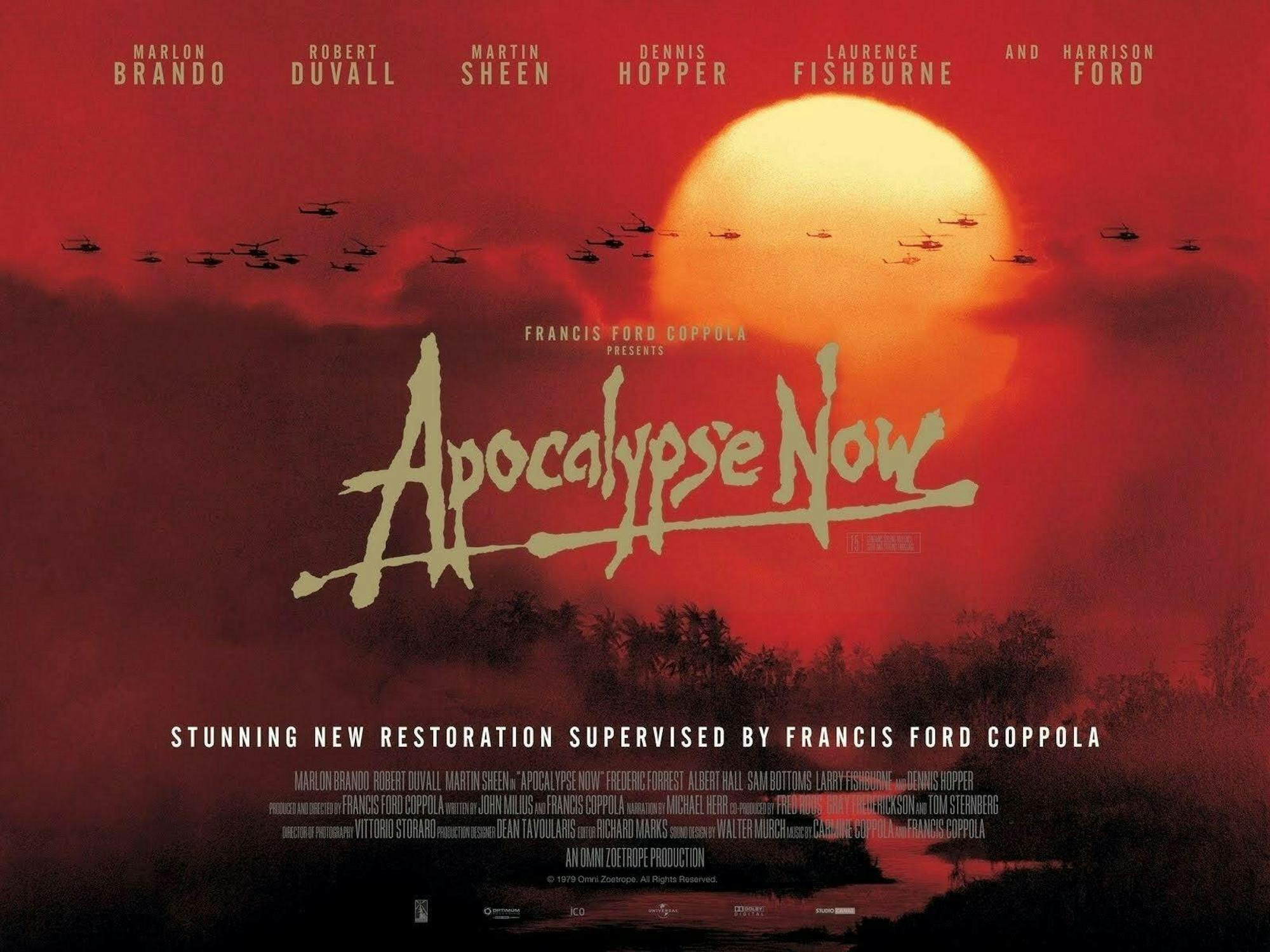
The final apocalyptic tale may not be an initial pick for some, but the namesake certainly introduces its apocalyptic ideas. Francis Ford Coppola’s Apocalypse Now is one of the most iconic war movies of our time, and while it doesn’t fully narrate an end of the world, its apocalyptic application to a real historical event makes its moral all the more chilling. The film follows Captain Willard, dispatched into Vietnam at the height of the Vietnam War. Willard is tasked with locating and eliminating Colonel Kurtz, a high-ranking officer who’s gone completely rogue from both his official mission and morality itself. The film is a surrealist and hallucinatory journey into the effects of war on the human mind, and how an understanding of morality can be completely dissected. The film raises the vital question, apart from any other, does the apocalypse truly have to be an ending of the human race, or is it an ending of human values? When a person has completely disconnected themselves from what is right and wrong, do they continue to be a person? These movies may narrate an end, but they never mark it as the true end. The question they all seem to answer, is what these events begin, and what type of life begins from it?
Caroline Murphy is a sophomore in the College of Arts and Sciences. She can be reached at cqm8@cornell.edu.