No matter how hard you try or how many issues you ignore, there can be no such thing as an apolitical campus.
Every space within a university — whether it’s a classroom, a research organization, a sports team, an a cappella group or even a bird-watching club — operates within broader political and social contexts. These spaces engage, either directly or indirectly, with issues that reflect larger societal structures. Academic activities like course selection, research funding and curricular design are shaped by political priorities and cultural values, whether acknowledged or not. In an isolated space such as Cornell (both physically and figuratively as reside high in our ivory tower), it is easy to believe that certain issues are external, irrelevant or avoidable. Not only does political neutrality outcast and invalidate the opinions and experiences of students and community members, but it also puts everyone at a social disadvantage once outside of campus.
The ongoing settlement negotiations between President Trump and the Cornell administration regarding frozen federal funds, hiring freeze, dramatic budget cuts and even the renaming of the now Office of Academic Discovery and Impact, are stark reminders that even if we, as an institution, try to stay above or outside of the political landscape, we are still participants, whether voluntary or involuntary, in political struggles. Recent moves by the Trump administration, aimed at punishing universities for perceived political bias and student activism, proves that politics will find its way into campus life whether we acknowledge it or not. Silence is not safety, and neutrality is not protection.
Nobody is unaffected by politics, and to present otherwise is naive and leaves students unprepared for the real world we will inevitably enter. The idea that a university can, or should, separate academics from politics ignores the fundamental truth that knowledge does not exist in a vacuum. It is shaped by and shapes the world around it.
Rather than resisting this reality, Cornell should embrace it as an opportunity to foster meaningful discourse and prepare students for civic life beyond college. As it stands, Cornell seems to attempt to stay out of a majority of social and political issues, but avoiding politics does not create neutrality, it simply upholds the status quo. Encouraging students to critically engage with the social and political elements of their interests leads to a more intellectually vibrant campus and a generation better equipped to navigate the complexities of contemporary life. If Cornell wants to live up to its mission as a university that promotes “any person, any study,” it must also commit to protecting the voices of those who challenge power, speak truth and engage deeply with the world they are inheriting. Academic freedom, student activism and institutional responsibility are not political liabilities, they are democratic imperatives.
But who am I to be making these huge claims? My name is Zara Cheek and I’m a student in the School of Industrial and Labor Relations, minoring in Law & Society and Crime, Prisons, Education and Justice. Throughout most of my life I’ve felt like I’ve constantly been in the middle, torn between perspectives on issues from petty disagreements between friends to hot political topics during classroom debates. This tendency likely came from my background as a mixed race student in different racial and ethnic demographics, particularly going to a school built on progressive education ideals, religiously diverse, but also happened to be a predominantly white institution; hearing one perspective from one side of my identity and a different one from the other side always made me feel like I had to pick sides rather than be just as I am, which in turn made me debate as many sides as possible. Perhaps that’s the curse of critical thinking. These experiences made me understand that things are more complicated than they seem, and there are always two sides to a story, if not more. Using the circumstances of my identity crisis, I’ve learned to look past the surface level of issues and encourage people to see another side. That’s why I write. I want you to think past the first news headline you see and think about things critically, empathetically and holistically.
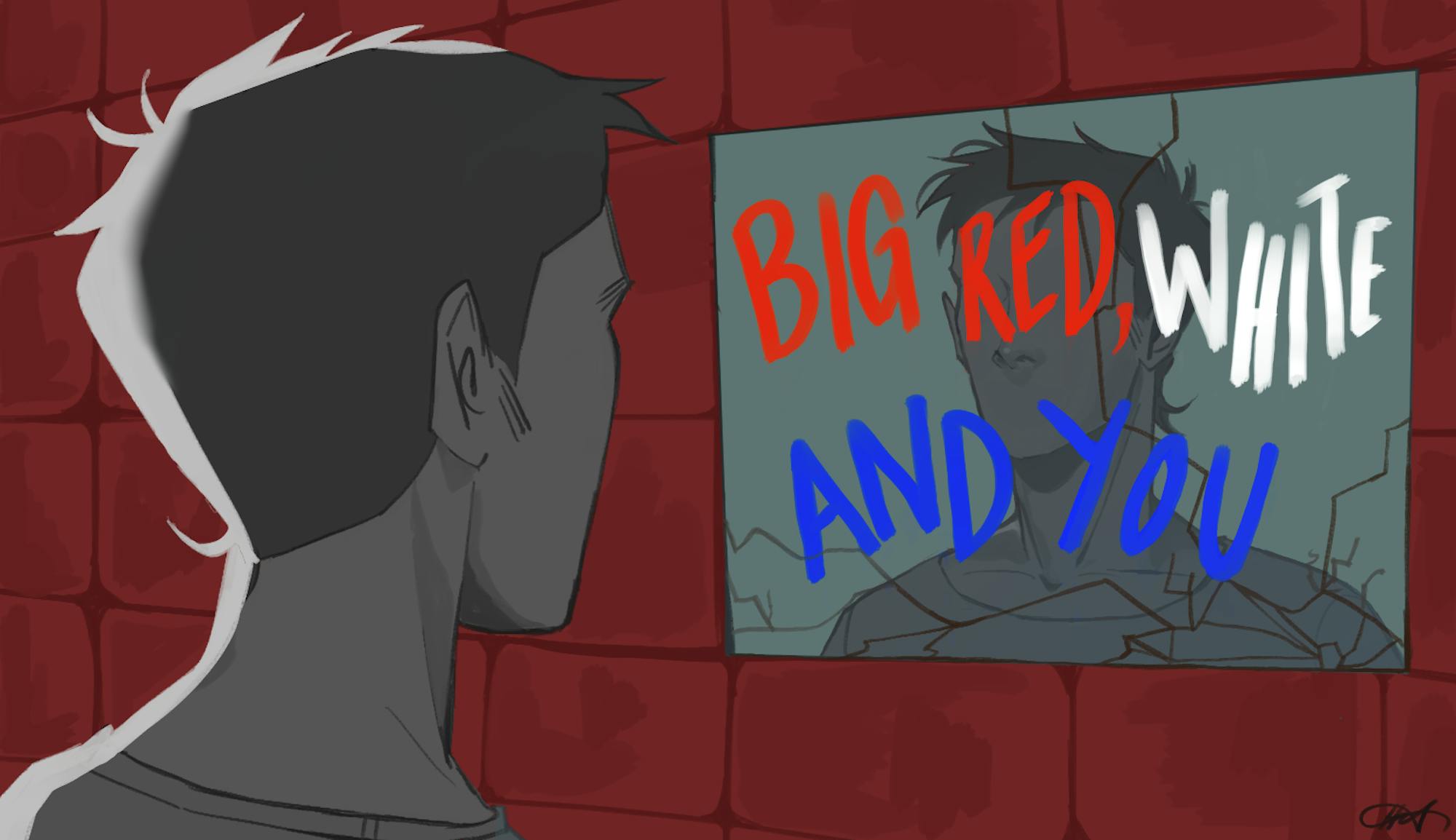
My hope is that this column, Big Red, White and You, can become a space where these interests and issues can be explored in the open without fear, dismissal, or the illusion that they don’t belong here. Too often, conversations about politics on campus are confined to specific departments or activist circles, when in reality, these issues affect everyone, regardless of area of study, background or ideology. Whether you're researching climate change, competing in athletics or performing in a student production, the work you do is entangled with larger cultural narratives, policy decisions and institutional values.
My goal is to encourage you to think about how current social and political issues impact and intersect with campus activities and culture. This column will not claim to speak for everyone, nor should it. My opinions are in no way to be taken as absolute truth but rather an invitation for further thought, dialogue and disagreement. I hope to encourage you to think critically about how social and political realities shape your experiences at Cornell, and how, in turn, our campus culture can shape the broader world. Engagement does not require full agreement but it does require the courage to care. In an era when educational institutions are increasingly politicized by external forces, creating internal spaces for reflection and discussion is not a luxury, it’s a necessity.

Zara Cheek '28 is an Opinion Columnist and a student in the School of Industrial and Labor Relations. Her fortnightly column, Big Red, White and You, focuses on the intersection of campus issues, diversity, and American politics. She can be reached at zcheek@cornellsun.com.