

In March 10, 2025, Cornell hosted “Pathways to Peace”, moderated by former U.S. ambassador Ryan Crocker and featuring Tzipi Livni, Salam Fayyad and Daniel B. Shapiro. The event was billed as a wide-ranging conversation on Israel, Palestine and “potential paths forward.”
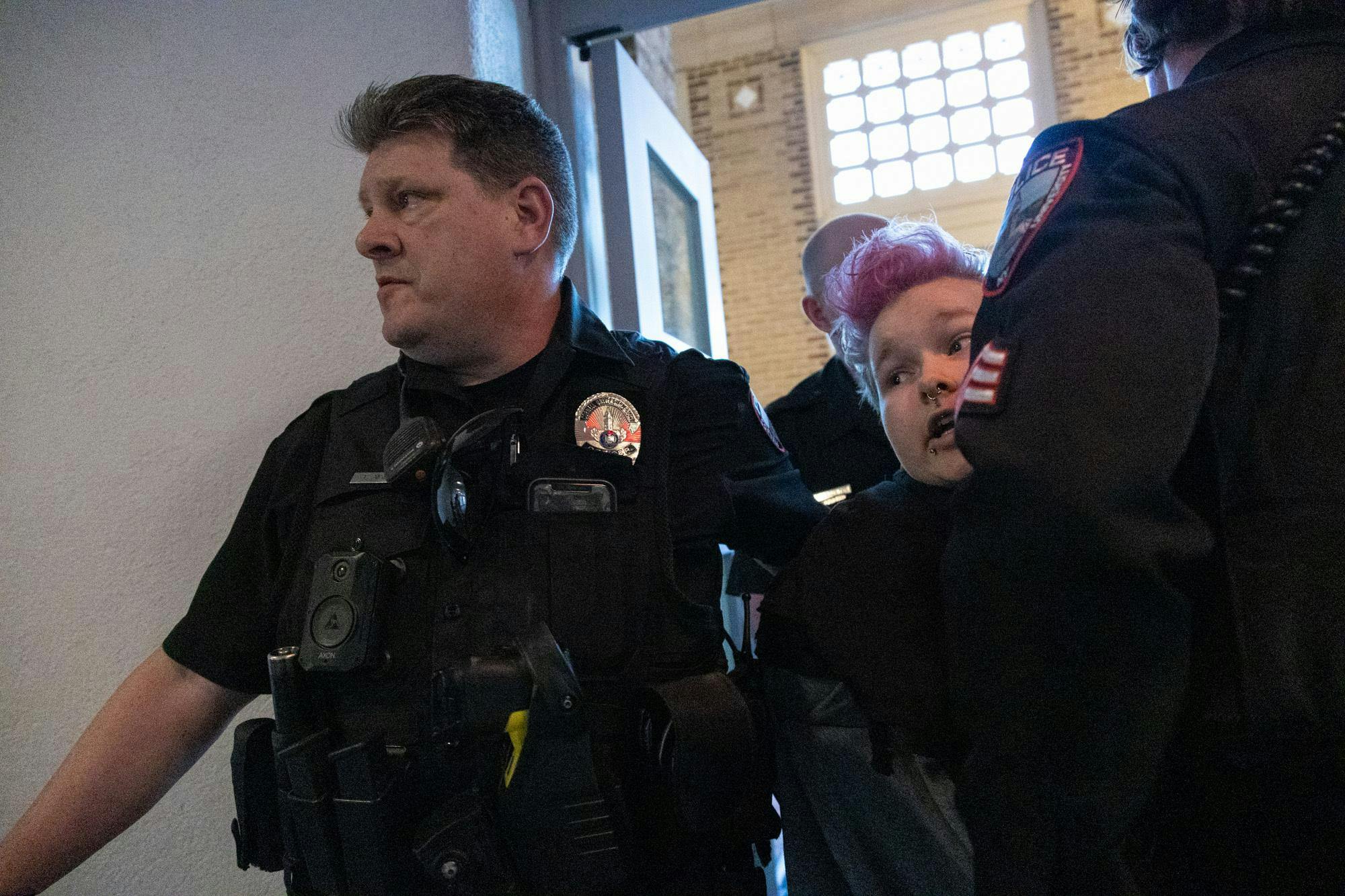
17 protesters, a mixture of students and Ithacan locals, were detained that evening after disrupting the panel with a walkout and chants, organized by Students for Justice in Palestine, that focused on Livni’s role during Operation Cast Lead in 2008-2009, a three-week war that human rights groups say killed about 1,400 Palestinians, including roughly 300 children. A role that earned her an arrest warrant in 2009 and ongoing interest from Belgian prosecutors in 2017. Though many of the arrests were later placed on paths to dismissal, the University maintained that the disruption had violated University policy. Kotlikoff had described the protest as “not freedom of speech,” and said that those involved had been “warned, warned again and then swiftly removed.”
But new reporting by The Sun, based on police body camera footage, casts doubt on the alleged neutrality of that night’s enforcement.
In the footage, Kristin Hopkins, chief administrator for the Office of the President and Provost, is seen asking officers how many IDs had been taken. When the officer replies, “probably eight,” Hopkins responds, “Mike’s asking,” and adds that he “was just hoping the number would be more than eight-ish.” Below is the footage:
Cornell declined to confirm whether “Mike” referred to President Michael Kotlikoff, who attended and facilitated the event. But the implications are claimed. If the University president was indeed checking for an arrest count and hoping it was higher, then this wasn’t about campus policy. It was about performance. How many students can you catch?
This moment on tape is not damning because it is dramatic, it is damning because it is dull, bureaucratic, routine. A senior official checking in with police to tally IDs like checking inventory. And this directly contradicts the image Cornell has tried to project to the rest of the nation.
Following this mired event, Kotlikoff published a national op-ed praising Cornell as an institution of “debate and dissent.” But what students experienced couldn’t be more polar: detention and dispersal. Hopkins’ monotonic exchange with police reveals what the administration actually wanted from that night: not dialogue, not de-escalation but numbers.
This is not your regular column. My aim is not simply to recount events or to convince you one way or another, but to contextualize them, to examine what the March 10 arrests and released footage really reveal about Cornell’s institutional priorities and how they reflect broader national dynamics.
This footage arrives amid Cornell’s quiet but sweeping expansion of surveillance infrastructure under Policy 8.1. A policy that centralizes control over campus cameras, including academic and research, and installs them across new construction zones, including common protest sites like the Arts Quad and Day Hall. When an administrator is caught on tape treating arrests like a quota, it reflects more than disciplinary impulse. It reflects something much more dangerous: surveillance logic. If campus officials are only counting IDs, what are the cameras counting? Pixels? Patterns? Faces filed away for future scrutiny? And if the federal government asks for those tapes, will Cornell hand them over? When protest is reduced to metrics and dissent is managed through a quiet yet boundless observation, the question is no longer “whether we are being watched” according to the news headline, it is how that footage will be used and more importantly, against whom.
To contextualize further, Cornell currently ranks 215th out of 257 universities in the Foundation for Individual Rights and Expression free speech rankings. The Council on America-Islamic Relations recently designated Cornell as a “‘hostile campus’ for systematic repression of pro-Palestinian students.” Hopkins' words only cement these damning criticisms. If our president is the “Mike” in question, then it becomes clear that Cornell’s objective is not “peace" but instead a tally that pleases some higher power, whether that be the Trump administration or our Board of Trustees.
Universities, especially those in the famed Ivy League, must push back against federal administrative oversight and the corporate university structure if they seek to truly promote discourse, diversity and free speech. Both Biden and Trump have extended consistent, sweeping support to Israel’s military campaigns in Gaza. That federal posture has shaped how institutions respond to pro-Palestinian speech, resulting in trickle-down complicity: national pressure translates into campus discipline, donor message and versions of risk mitigation frameworks disguised as restorative justice.
Cornell has not been exempt from this influence and, at key moments, has aligned itself with it. Cornell’s former Vice President of University Relations Joel Malina labeled student chants of intifada, an Arabic word in this context meaning shaking off occupation, as “antisemitic.” Yet months later, when the federal government came seeking to revoke federal funding on the grounds of antisemitism, Cornell reversed course, downplaying the same claims.
Our central administration may seem confused but in reality it’s ominously strategic. What looks like free speech enforcement to us, is truly liability control, furthering the real implications of the released footage. The University's original claims of antisemitism were overblown, calculated attacks on their students used to squash dissent. Cornell did not stumble into this moment. It engineered it. This is the corporate university at work. Protect the brand. Control the optics. Minimize legal exposure. Keep federal dollars flowing. Effectively creating the pretext used to freeze our funding, and the university is still in one of its most precarious moments in history.
It is now up to the University to implement real safeguards to stop the authoritarian tilt. Vice President for Student and Campus Life Ryan Lombardi’s promise to revise the Student Code of Conduct must go beyond appearances. Reforms must include an independent review of disciplinary actions, a clear separation between protest policy and government lobbying and transparent reporting of administrative decisions. Require a faculty governance supermajority to change speech rules. Concentrated, unreviewable discretion created this mess; only hard rules, transparent data and shared power can end it.
The first steps of this work could already be in motion. On Sept. 10, faculty at Cornell, through the Faculty Senate, are proposing a resolution to censure the central administration from enacting draconian disciplinary policies on their students. Our students have fallen, our administration has folded and now faculty, the responsibility is on your shoulders to protect the last vestiges of free speech on this campus before it’s lost forever.
If Cornell is to reclaim trust, it must not do so with slogans and insincere statements but with a consistent structure.

Yihun Stith '26 is an Opinion Columnist and a Computer Science and Government student in the College of Arts & Sciences. His fortnightly column, Stand Up, Fight Back, explores the political structures and power dynamics that shape life at Cornell. Through analysis, critique, and calls to action, the column challenges Cornellians to engage with the world beyond the campus bubble and to fight for a more just and accountable university. He can be reached at ystith@cornellsun.com.


