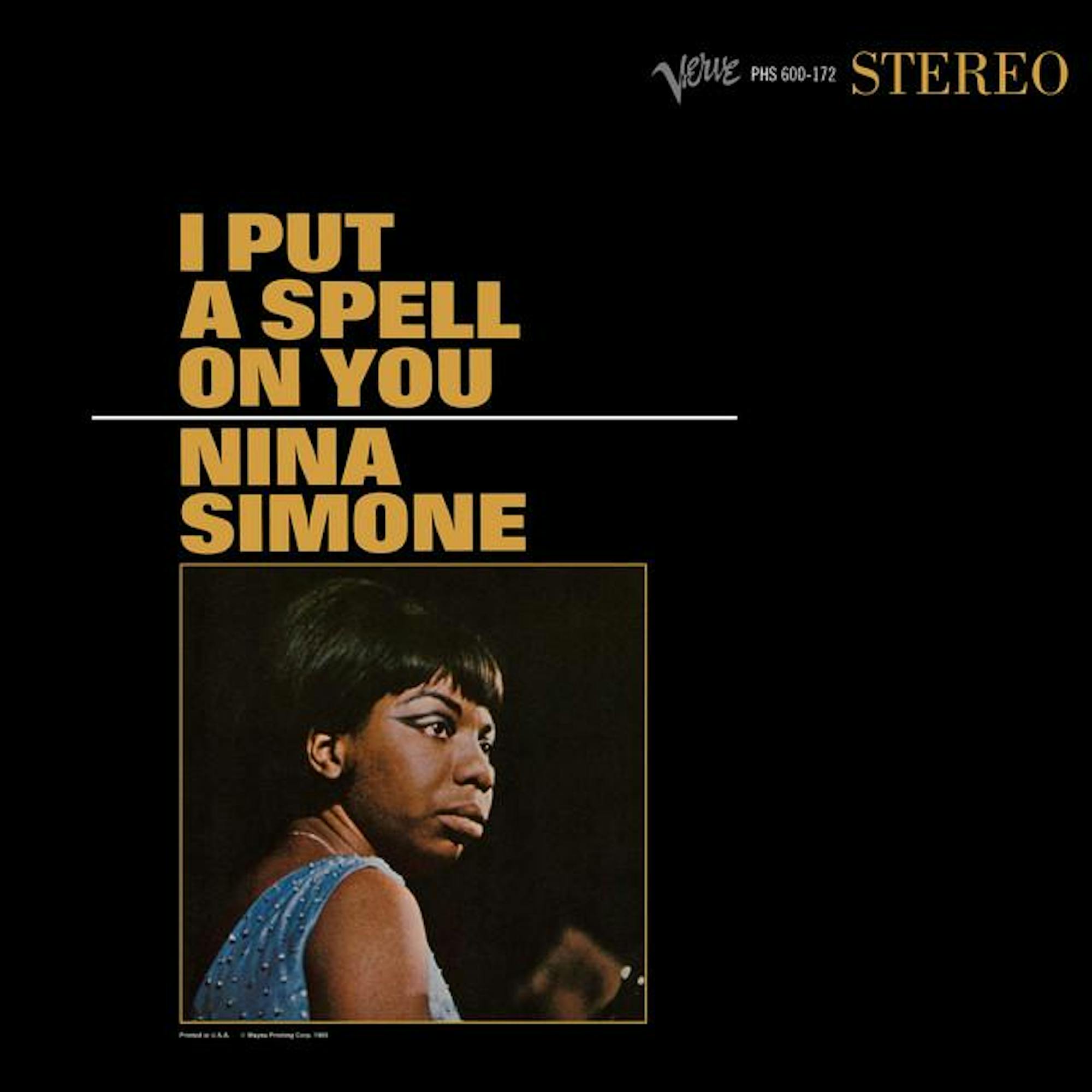
It seems like it was just a few months ago that I was writing about the Arctic Monkeys’ ‘AM’ being a quintessential October album, but alas, here we are again, with Halloween just a week away. The Arctic Monkeys may own October, but in my mind, Nina Simone is the queen of Halloween. It might be a tad on the nose for me to say that the song “I Put a Spell on You” is a beautiful, witchy tune, and there is no better song to encompass the vibe of Halloween, but I’m going to say it anyway. This doesn’t even begin to cover Simone’s haunting voice, which permeates even the most upbeat of her songs. Thus, this week I’m taking a closer look at the 1965 record I Put a Spell on You to get at how exactly Simone’s voice generates this effect.
First on the queue is, unsurprisingly, “I Put a Spell on You” itself, a chilling and compelling track where we see Simone stake her claim: “And I don’t care / If you don’t want me / I’m yours right now / Ah, you hear me / I put a spell on you / Because you’re mine.” Despite the clear possessiveness of the lyrics, Simone sends her warning through her tone and conveys her seriousness in the depth of her voice; the message is clear: she wants him, and she’ll have him. Next is “Tomorrow Is My Turn,” a turn for the jazzy and upbeat, and an English version of the 1962 Charles Aznavour track, “L’amour, c’est comme un jour.” She takes on the full-fledged French track in “Ne Me Quitte Pas,” where she begs her lover not to leave her in her typical swelling, melancholic fashion. Her emotions inevitably creep into her voice, making it plain that she’s willing to do just about anything to stay in her lover’s orbit. Although the song was originally written by Jacques Brel this is undeniably a Nina Simone song.
Simone then transitions to the fun, swingy “Marriage Is For Old Folks,” where she proclaims, “Marriage is for old folks / Old folks, not for me / One husband, one wife / Whaddya got? / Two people sentenced for life,” over some prominent flute. This is followed by the dreamy and underrated “July Tree,” where Simone sings of a romantic relationship coming to fruition: “True love blooms for the world to see / Blooms high upon the July tree.” In “Gimme Some,” Simone demands love against some powerful backing vocals. Her voice gets a lot grittier, and she infuses it with a bit of scatting action. “Gimme Some” is made of the same stuff as “I Put a Spell on You,” as it sees Simone asserting herself with a throatier quality to her voice.
While I might be unable to stop associating “Feeling Good” with Michael Bublé, it was Simone who set the stage — and it wasn’t even an original song of hers. Peppered with her signature scat, “Feeling Good” ended up being one of her most popular songs, featuring an incredible vocal build and richness in tone. Simone incorporates some vibrato into “One September Day” — a softer track where Simone reflects on the beginning and end of a relationship: “I used to reminisce / ‘Cause I thought that love was bliss / How did they know it would go astray? / It began, and it ended on one September day.” “Blues On Purpose” is an entirely instrumental track that is, as expected, bluesy. We hear Simone on the piano and it acts as a sort of interlude, but is just as engaging as the songs with lyrics.
Meanwhile, “Beautiful Land” is a bit more lyrically simplistic, and sees more tempered vocals from Simone and the reprise of the flute element. “You’ve Got to Learn” is a personal favorite. Simone’s voice is as deep as ever and evokes the bittersweetness of her words: You’ve got to learn to be much stronger / At times your head must rule your heart / You’ve got to learn from hard experience / And listen to advice / And sometimes pay the price / And learn to live with a broken heart.” Her voice gradually gains momentum as the song progresses, and the track is complete with powerful backing vocals and support on the keys. “Take Care of Business” concludes the record with some more killer Simone scatting and plays with the depth of Simone’s voice. It’s a call to action as much as it is a song, and she’s setting her expectations now.
I Put a Spell on You spotlights all that is unique about Nina Simone’s voice, but it also illustrates why her voice accomplishes what it does: her contralto voice commands attention, and she uses that to her advantage. She makes it very clear what needs and expects. In today’s world, a woman who knows what she wants scares some people. Well, Nina Simone says boo.
Test Spins is a fortnightly throwback column reviewing and recommending classic and underrated albums from the past. It runs every other Friday.
Sydney Levinton is a junior in the College of Arts and Sciences. She can be reached at slevinton@cornellsun.com.
Sydney Levinton is a member of the Class of 2027 in the College of Arts and Sciences. She is a senior editor specializing in music and was the arts and culture editor on the 142nd and 143rd Editorial Boards. She can be reached at slevinton@cornellsun.com.