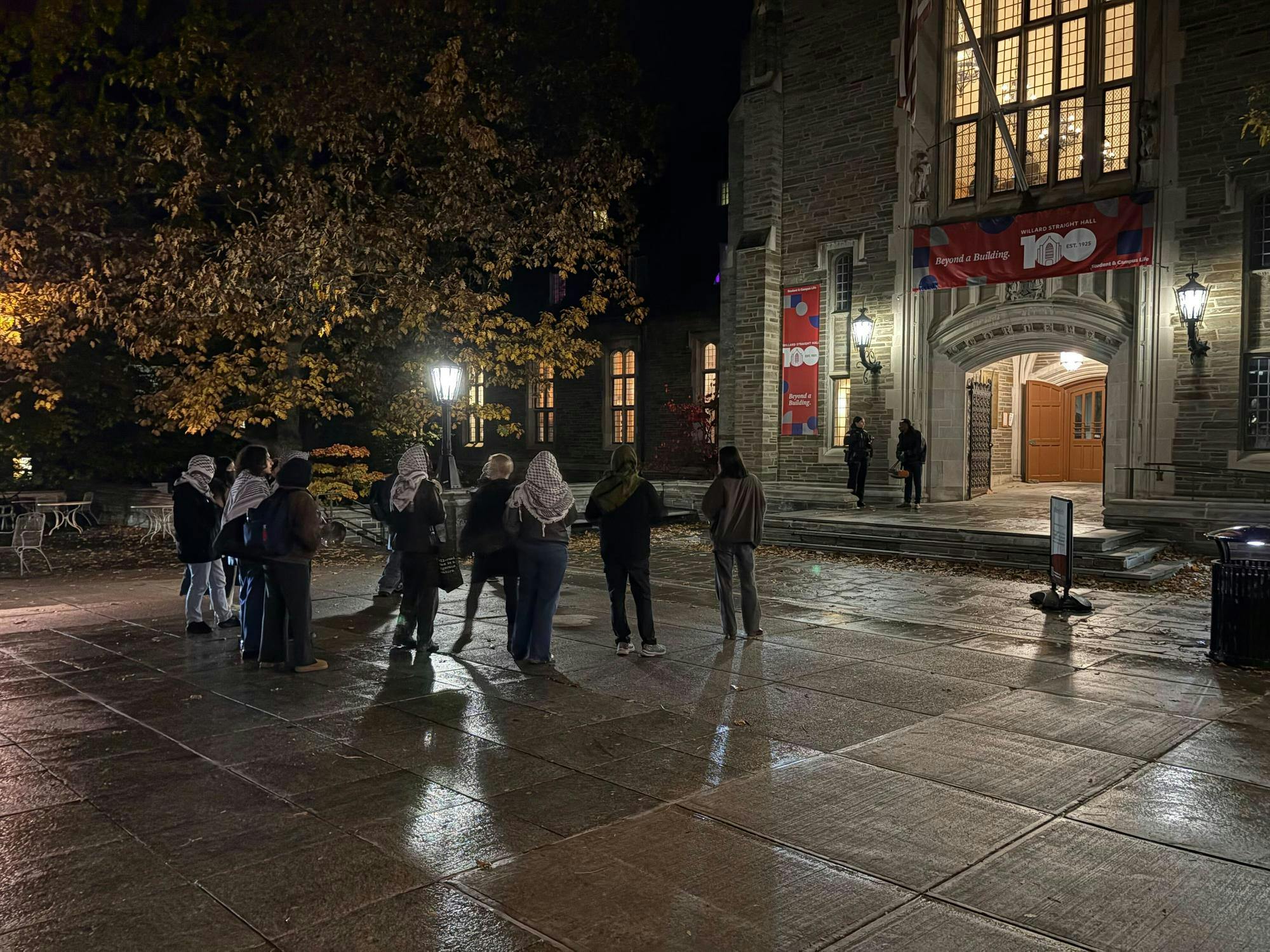
Approximately 15 pro-Palestinian protestors gathered outside Willard Straight Hall on Thursday evening, calling on University trustees to divest from arms manufacturers involved in the war in Gaza.
Board of Trustees members are in Ithaca this week for the 2025 Trustee-Council Annual Meeting. However, Thursday’s event was a 75th-anniversary celebration for the Cornell University Council, not an event specifically for the trustees, though attendance was opened to them.
Using bullhorns and banging drums, two small groups of protestors amassed at both the front and the rear of the building, chanting slogans such as “Globalize the Intifada ” and “Cornell trustees you can’t hide, we charge you with genocide.”
When asked by The Sun about their use of the word “intifada,” Sumitra Pandit ’26, an organizer for Cornell Progressives, described its meaning to her.
“When we reference the word Intifada, I think sometimes people unjustly characterize it as scary or violent because it's an Arabic word,” Pandit said. “Intifada means uprising … it means freedom from occupation.”
Throughout their protest, demonstrators conversed with exiting attendees and distributed flyers titled, “An open letter to Cornell’s trustees: Disclose. Divest. No Deals with Donald Trump.”
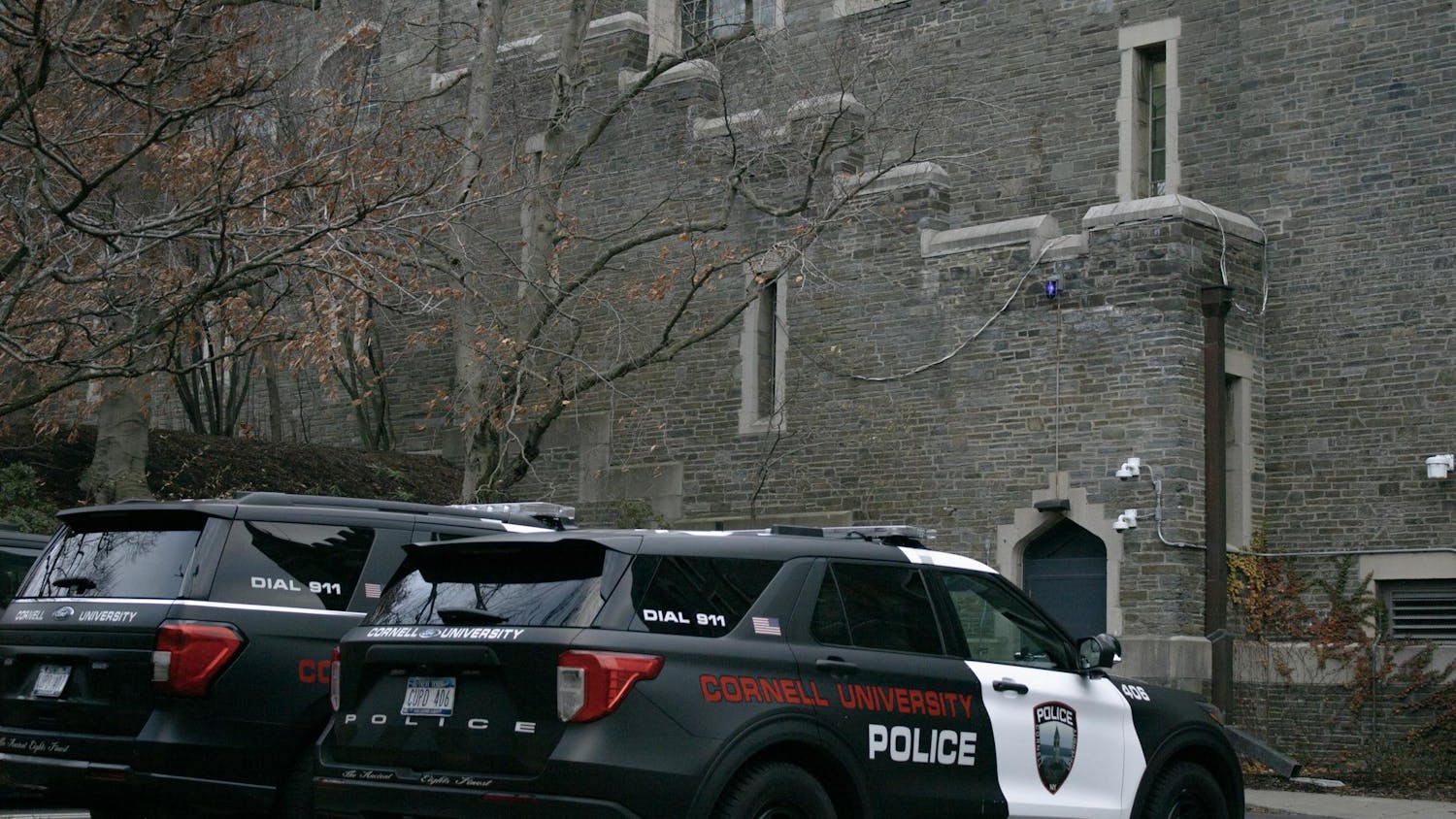
Several Cornell University Police Department vehicles were parked beside the protest. Five minutes before 9 p.m., a CUPD officer came outside to tell protesters that if they stayed past 9 p.m., they would be in violation of the Expressive Activity Policy.
According to the policy, amplified noise is permitted between 5 p.m. and 9 p.m. without prior approval.
Protestors dispersed without incident before the 9 p.m. deadline was invoked.
Lisa Barsanti Hoyt ’79, an alumna in attendance at Thursday's event, said that the topic of divestment from weapons manufacturers “is a very complicated issue,” but added that “it's important for students to reflect their viewpoints and present their viewpoints on all sides.”
Reflecting on tensions between the federal government and universities nationwide, Hoyt, who said she has worked in higher education fundraising for over 40 years, told The Sun that the relations between Cornell and the federal government are “like walking a tightrope between conflicting issues.”
For Laura Dake Roche ’81, an alumna who attended Thursday’s event, the protests outside reminded her of when demonstrators protested the Iranian Shah’s hospitalization at a Cornell-affiliated institution in 1980.
“The only thing I would say is that this reminded me of my freshman and sophomore years when every day when we would come into the street, there were protests because we had the Shah of Iran at Cornell Med,” Dake Roche said. “And so when I came in, hearing the drums and seeing the people and seeing the protests, just reminded me of when I was here.”
Dake Roche continued to add that listening to various voices is important to students and Cornell.
"I think that part of our ethos is listening to everyone's voices, and it’s absolutely Cornell's ethos [to] listen to people,” Dake Roche said.
Benjamin Leynse is a member of the Class of 2027 in the College of Arts and Sciences. He is a news editor for the 143rd Editorial Board and can be reached at bleynse@cornellsun.com.