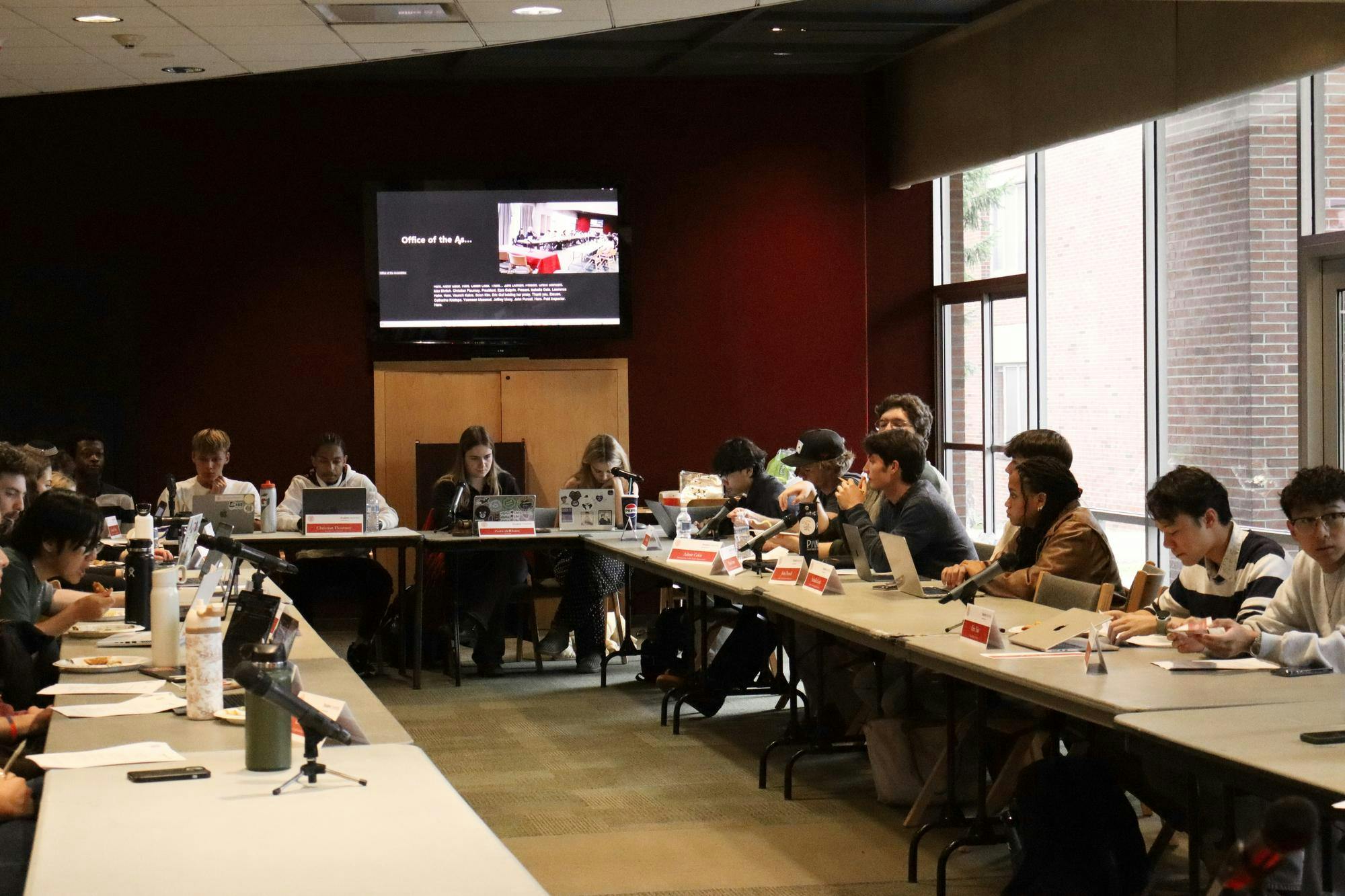
The Student Assembly unanimously passed a resolution requiring the transfer of excess funds from the Student Activities Funding Commission — which is a student organization that helps fund nearly 750 undergraduate groups on campus — to the Assembly’s reserve account at its Thursday meeting.
Resolution 13: “Required Transfer of Excess Funds from SAFC to Student Assembly Reserves” was co-authored by Assembly President Zora deRham ’27, Nolan School Representative Christian Tarala ’27 and Vice President for Finance Hayden Watkins ’28. The resolution directly enforces the Student Assembly’s Charter, which requires funds to be sent to the Assembly’s reserves if byline organizations hold surplus funds over $500,000.
“In the event that a Byline-funded organization enters a new academic year with a rollover balance exceeding either twice the amount of its most recent annual allocation or five hundred thousand dollars ($500,000), whichever is less, any surplus funds in excess of that threshold shall be immediately transferred to the Student Assembly Reserve Accounts,” the Charter, which was updated by the Assembly in the spring, reads.
The Assembly updates its charter every other year.
SAFC is a byline student organization, or a University group that receives its funding from the Student Activity Fee — a mandated fee for all undergraduate students that is recalculated by the Assembly every two years. SAFC receives a yearly allocation of 35 percent of the SAF as the University's primary funding board, which is approximately $2.3 million per year.
SAFC has entered the 2025-2026 academic year with unspent funds exceeding the $500,000 maximum set by the Assembly's updated Charter. According to deRham, SAFC’s current reserve balance is “over $1.5 million.”
In 2019, the Assembly passed a resolution that requires SAFC to “update the Student Assembly on the remaining rollover surplus amount.”
When asked by The Sun why SAFC’s reserve balance exceeded the $500,000 maximum, deRham explained that much of it was built up over the last five years due to the COVID-19 pandemic and the decreased student programming during that period.
“[The excess reserve balance] was paid for by students four or five years ago who never really got to see this money be put to use in their time here, which is the whole point of the Student Activity Fee,” deRham said.
The reserve funds from SAFC will contribute to funding the variety of subaccounts affiliated with the Assembly, such as the Summer Experience Grant, which awards students upwards of $5,000 from the Assembly for support for “unpaid or minimally paid career-related experiences.”
Before debating the resolution at the Assembly, Co-Presidents of SAFC Stephen Cisz ’27 and Rafaela Baldeon ’27 spoke during the public comment period about their concerns with the resolution.
According to Cisz, while the resolution highlights that SAFC must be transparent with the Assembly over its surplus amount, that is something the organization has already done.
“We have [been transparent]. We are always transparent,“ Cisz said. “So I don’t know why this is in here. … We just wanted to say that we’re here to work with you, and you guys don’t need to reprimand and take the money.”
deRham explained to The Sun that the resolution was formulated due to the Assembly’s correspondence with SAFC leadership and seeing that their reserve amount was above the $500,000 threshold.
Baldeon expressed a concern that SAFC leadership was not notified of this appeal five business days in advance, as stipulated in their Constitution, which was approved by the Assembly.
Tarala, when introducing the resolution, responded to both Cisz and Baldeon, explaining that SAFC is not being fined and that the five-business-day rule doesn’t apply.
“There’s two things: There’s fines for when people do things that are wrong, and clawbacks, which [are] when the rules say we’ve got to move the money a certain way — and so that's exactly what we're doing today, which is also why the five days that they were mentioning didn't happen,” Tarala said. “Our charter supercedes their charter as well.”
deRham also emphasized the difference between clawbacks and fines.
“This is separate from fines … and is instead its own thing,” deRham said. “This is just a matter of fact that because SAFC is one byline organization that has exceeded $500,000 in its reserve account that money will be transferred — this applies to all byline organizations as well.”
Following public comment, Aiden Vallecillo ’26, student workers representative, proposed an amendment for “half, 50 percent of the excess funds or $23,800, whichever is less” to be transferred to the Assembly reserve and be placed in the Summer Experience Grant account for fiscal year 2026.
Ezra Galperin ’27, representative at-large, responded to Vallecillo, reflecting that the Assembly should take more time before considering such a plan.
“I don’t oppose giving excess funds to the Summer Experience Grant, per se, but I think we should probably take some time to consider what we are going to do with that money,” Galperin said.
The amendment did not pass.
Prior to the final passage of the resolution, Watkins said that while nothing is finalized regarding where the excess SAFC reserve funds will go, the Assembly had a couple of ideas of how such funds could be used to better the campus community.
“Some ideas that we had possibly [were] helping ALANA get out of their financial situation, having an airport shuttle for breaks, some fundraisers to help Willard Straight Hall become more revitalized [and helping] Anabel’s grocery, all in partnership with byline organizations,” Watkins said.
Watkins' reference towards the ALANA Intercultural Board, a University supplementary funding board, comes after the organization packed the Student Assembly meeting in protest of potential cuts two weeks ago. The Assembly’s finance committee’s recommendations to reduce the board’s funding were ultimately rejected, and the committee is currently revisiting its funding recommendation.
His intention to aid Anabel’s Grocery follows the University’s cutting of over $100,000 in funding for the Center for Transformative Action, a parent organization for the student-run Annabel’s Grocery, in February 2025.
The resolution ultimately passed unanimously after its third reading on the Assembly calendar.
In addition to the passage of Resolution 13, the Assembly moved Resolution 6: “Making Meal Plans Equitable for South Campus Program Houses” to the third reading calendar and passed an amended verson of Resolution 12: “Approving Special Projects Funding Request for the Finance Club at Cornell.”
The Assembly also swore in five students to fill vacant positions on the Student Assembly.

Matthew Kiviat is a member of the Class of 2027 in the College of Arts and Sciences. He is the assistant managing editor for the 143rd Editorial Board and was a news editor for the 142nd Editorial Board. He can be reached at mkiviat@cornellsun.com.