Blue Moon, one of two Richard Linklater films to release this year, marks a return to the style of the Before trilogy that made me fall in love with Linklater’s filmmaking. Like Before Sunrise, Blue Moon is a dialogue-driven character study that functions more like a play than a cinematic experience (which is fitting, given its subject matter). However, unlike Before Sunrise, which was co-written by Linklater, Blue Moon draws on a script by Robert Kaplow. Blue Moon is a strong performance vehicle for Ethan Hawke that unfortunately doesn’t quite capture the magic of my favorite Linklater films.
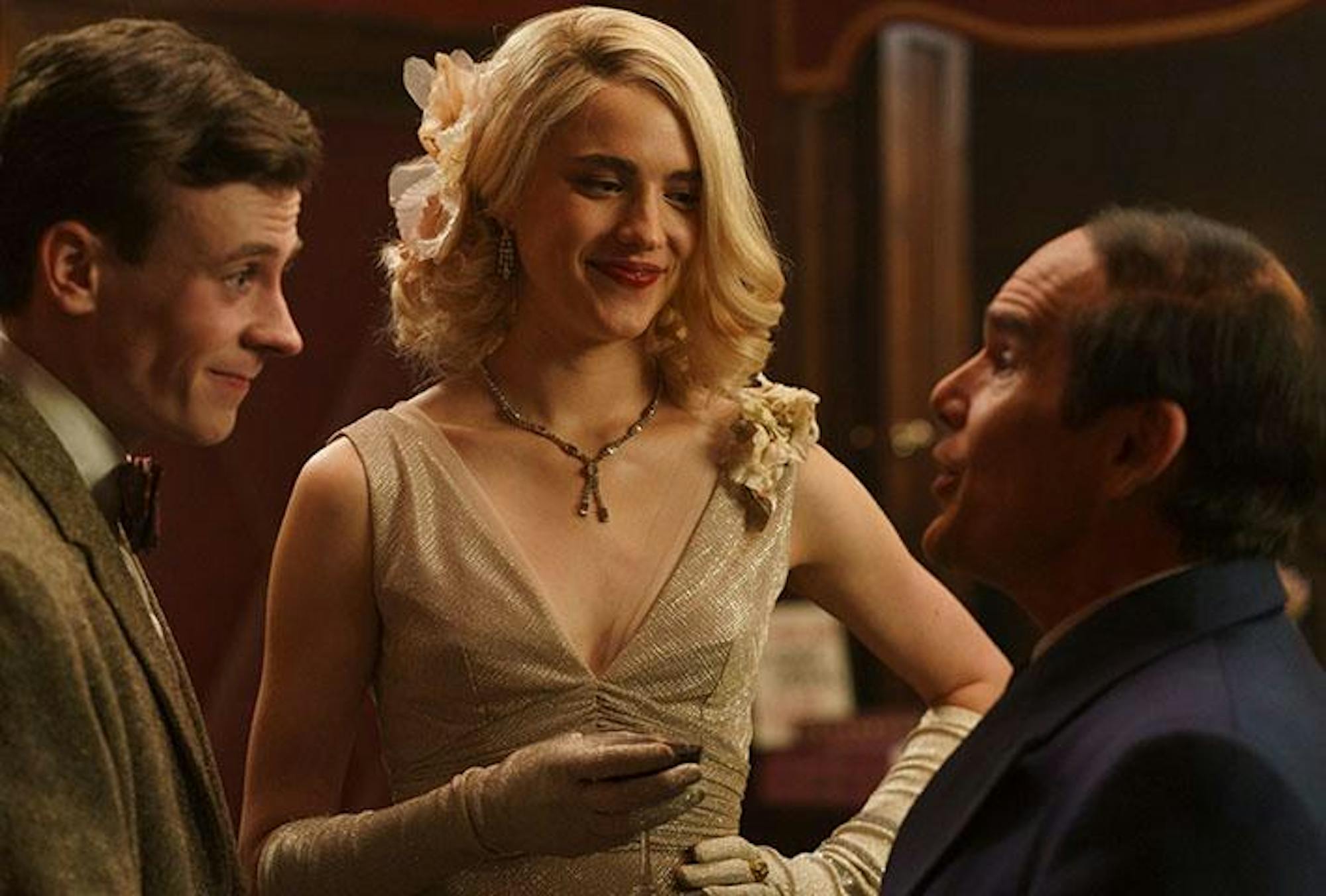
Blue Moon follows Ethan Hawke as Lorenz Hart over the course of one party on the opening night of Oklahoma!. Hart, the original collaborator of famed composer Richard Rodgers (Andrew Scott), is invited to celebrate Rodgers’s biggest success yet –– the first musical he’s written with the lyrics of Oscar Hammerstein II (Simon Delaney), Hart’s replacement. As the night unfolds, Hart grapples with his friend’s success, his own growing irrelevancy and, most importantly to him, his new relationship with 20-year-old Elizabeth Weiland (Margaret Qualley), his protégé and, he expects, future lover. Linklater’s camera follows Hawke as he roams the party, never leaving his protagonist even in his most shameful moments.
Blue Moon is, therefore, mostly a vehicle for Hawke’s performance, which has all the trademarks of a showy biopic role –– prosthetic makeup, an altered voice and even some camera tricks that make Hawke’s 5-foot-10-inch stature look more like Hart’s 5-foot. I constantly worried that Hawke’s performance would veer into something too gaudy, like Bradley Cooper’s performance in Maestro (one of my least favorite movies of the past five years), but Hawke manages to capture Hart’s flamboyant narcissism while maintaining the somber undertones the film requires.
I was, however, even more impressed with Andrew Scott’s performance as Richard Rodgers, the straight man (in all senses of the word) to Hart’s ostentatious personality. As Hart’s struggles with addiction become clear, Scott plays Rodgers as a concerned friend who, while empathetic, also recognizes the need to move on with his own career. His performance is extremely subtle, mostly shown through his facial expressions, creating a refreshing contrast to the more exaggerated characters of Blue Moon, whose thoughts and feelings are almost always explicitly expressed through dialogue.
Blue Moon is often funny, but it’s also deeply sad. Hart’s boisterous arrogance entertains, at first, both his companions and the audience, but after almost two hours of nonstop dialogue, viewers can’t help but understand how Hart has driven away those closest to him. His delusions prevent him from seeing Elizabeth’s attachment to him as it really is and put him in increasingly humiliating situations that only drive him back to the comfort of alcohol. It’s a painful cycle that Hart seems wholly unaware of, one that, as the audience is told in the very beginning of the film, will continue until his death months later. Blue Moon is, at its core, an extremely tragic character study where humor serves as a distraction –– just as it does for Hart himself.
All in all, I wasn’t as in love with Blue Moon as I wanted to be. It couldn’t help but fall into some of the biopic conventions that I’ve, frankly, just grown tired of. In a scene where Hart meets author E.B. White, the film teases the origin story of Stuart Little like it’s a hint for the next movie in a cinematic universe. This extended foreshadowing of future events feels overdone and takes away from a film that is so innately grounded in the present. It’s moments like these that draw me out of Blue Moon and, rather than allowing me to immerse myself in the world of the film, serve as a harsh reminder that these events have all already passed, and I am nothing more than an observer peering into the past. This disconnect might not be felt by everyone, and I certainly think the film is worth seeing, but I can’t say that Blue Moon fully connected with me.
Nicholas York is a junior in the School of Arts and Sciences. He can be reached at nay22@cornell.edu.
‘Projections’ is a column focused on reviewing recent film releases.