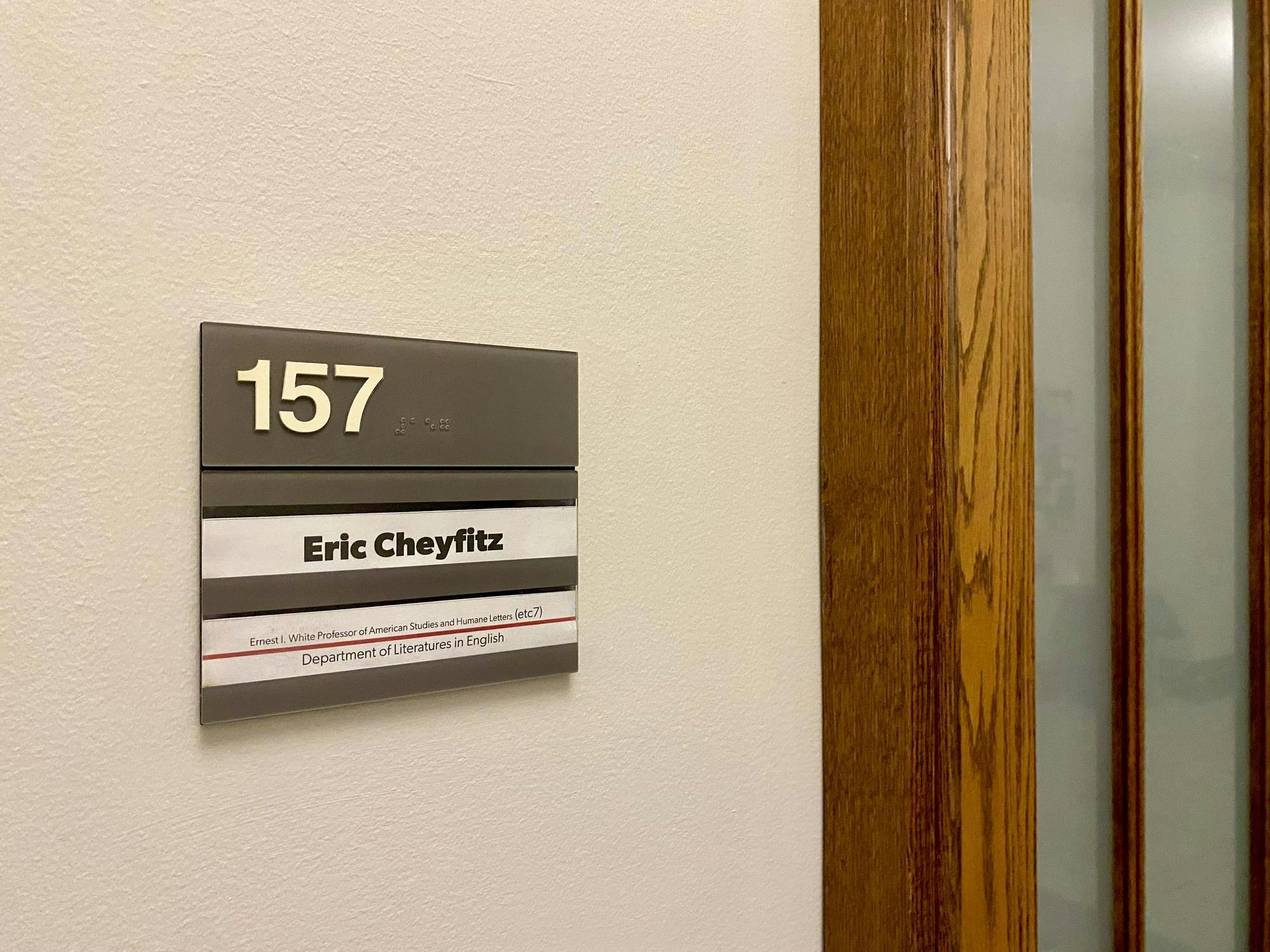
During an Oct. 22 Faculty Senate meeting, Provost Kavita Bala addressed what she deemed as “misleading information” surrounding the case that found Eric Cheyfitz, a former professor in literatures in English, in violation of anti-discrimination law.
“The University normally does not share confidential personnel matters in public,” Bala said. “However, the exception in this case has been made because of the amount of false and misleading information that's out there that's created understandable concern and confusion.”
Cheyfitz underwent a discrimination investigation after he allegedly asked an Israeli graduate student in his class to drop his spring course on Gaza, AIIS 3500: Gaza, Indigeneity, Resistance.
Cheyfitz previously told The Sun that the Israeli graduate student’s behavior in class was “disruptive.” According to Bala, the former professor was set to appear before a faculty review panel on Nov. 3, but accepted a deal to retire before the review, subsequently ending the investigation proceedings.
A Faculty Senate committee, which has jurisdiction under University Policy 6.4, Prohibited Bias, Discrimination, Harassment, and Sexual and Related Misconduct, had ruled in favor of Cheytfitz. However, in light of Cheyfitz’s retirement, the University deferred to the Cornell Office of Civil Rights’ initial finding of discrimination as the ultimate case outcome.
Why Cheyfitz Asked the Student to Leave
Bala noted that in courses on controversial subjects, different opinions will arise, but discomfort with viewpoints cannot be the basis for excluding a student from a course.
“After [the] third class, the faculty member talked to the student and explicitly told the student that he was not welcome in the class because ‘he was an Israeli citizen supporting an Israeli stance in Gaza,’” Bala said. “Those are the faculty member's words.”
When The Sun previously asked why Cheyfitz told the graduate student, Oren Renard, to leave the classroom, the professor largely pointed to Renard’s contributions during class discussions, claiming that Renard was either “simply making contradictory comments” or “not participating in the discussion.” Cheyfitz added that he was “upsetting [other] students and appeared to be not doing the readings.”
However, Bala said that in a conversation after class between Cheyfitz and Renard, Cheyfitz told his student that if there was a course that aligned with his views, then he should take it, but Renard did not “have any place” in Cheyfitz’s course on Gaza.
According to Bala, Cheyfitz said to Renard “‘If people want to take a course with your point of view, God bless them, and if there’s a course out there for them, they should take that course.’”
According to Bala, when Renard tried to explain that his viewpoint was “mischaracterized,” Cheyfitz cut him off.
When asked if Cheyfitz asked him to leave his class because he was an Israeli student or if he was ever cut off during his conversation with Cheyfitz, Renard did not respond to a request for comment.
Based on this information, Bala said Cheyfitz was charged with discrimination based on nationality and unprofessional conduct based on bias against a student's presumed view.
“This is not a case of academic freedom,” Bala said. “This is a case of discrimination based on national origin.”
Cheyfitz’s lawyer, Luna Droubi, denied Bala’s statements in an email to The Sun. She refuted that Cheyfitz told Renard to leave his class because Renard was an Israeli student, pointing to the Faculty Senate Committee on Academic Freedom and Professional Status of the Faculty’s determination on the case.
The Faculty Senate Committee on Academic Freedom and Professional Status of the Faculty unanimously found that Cheyfitz had not violated University policy. The ruling determined that Cheyfitz’s comments relating to national origin did not provide sufficient evidence to show that Cheyfitz had asked Renard to drop the course because of his national origin.
Contrary to Bala’s statement, Droubi alleged that Cheyfitz never cut Renard off during their conversation. She wrote instead that Renard “began but did not complete his statements,” and Cheyfitz’s pauses before speaking after Renard were not included in the transcript of the conversation.
Droubi emphasized that many of the statements Bala made were selected phrases from a transcript of a “secretly recorded” tape that Renard took during his conversation with Cheyfitz — something she said Cheyfitz was not aware of throughout the meeting. Droubi wrote that it was an “unauthenticated tape,” and noted that Cheyfitz had previously raised questions regarding the credibility and reliability of the recording from the start of his disciplinary proceedings.
“[Renard] was well-qualified to manipulate the conversation to his advantage,” Droubi wrote. “The student subsequently refused to hand over the audio file to investigators, instead requiring them to rely on a transcript for the investigation.”
When asked if he only submitted a transcript of the recording and about Droubi’s allegation that he was “well-qualifed” to manipulate that transcript, Renard did not respond to a request for comment.
Renard is a Ph.D. candidate focusing on computer theory. According to reporting by The Nation about his LinkedIn profile, he previously served in Israel’s elite military surveillance agency, Unit 8200. His LinkedIn profile no longer includes his time in Unit 8200, but it includes other cybersecurity work he did with the Israeli Defense Forces.
Renard’s In-Class Behavior
Bala also addressed the narrative surrounding the student’s “disruptive” behavior, saying that Renard had attended three classes in total and, according to Cheyfitz, was silent in the first, spoke briefly in the second and spoke for less than two minutes in the third.
Bala said that at the start of the third class, Cheyfitz asked to speak with Renard after class. In that conversation, Bala said “[Cheyfitz] explicitly told the student that I, quote, ‘think your conduct in the class has been fine so far, so I'm not complaining about you.’”
According to Bala, in Cornell’s Office of Civil Rights’ investigative interview with Cheyfitz, he said Renard was “‘respectful in his responses.’” When questioned about Renard’s engagement in class, Bala, quoting Cheyfitz, said, “‘As I remember, [Renard] responded a few times to what the students were saying for all I know. Again. I wasn’t paying strict attention to him.’”
Droubi wrote that Cheyfitz maintained, even before his decision to ask Renard to leave his class, that Renard was “disruptive to the learning environment” in class.
“The rest of Professor Cheyfitz's testimony — which Provost Bala did not release — makes clear that Cheyfitz did believe the student to be disruptive,” Droubi said. “Provost Bala continues to twist and take a few words out of context, going so far as to breach confidentiality of a closed matter simply to try and justify the administration's conduct.”
Droubi also wrote that Cheyfitz was not alone in evaluating Renard’s behavior, referencing a letter from nine of the students in Cheyfitz’s class that was published in The Sun. The students wrote that “it was immediately clear that [Renard] had come to disrupt” and “it was obvious that Renard did not join the class to engage in discussions about the reading material or have good-faith conversations about indigeneity and genocide.”
Droubi asserted repeatedly that Cheyfitz’s case had already been determined by the Faculty Senate committee, which unanimously found Cheyfitz not guilty of University policy violations.
“That Committee reviewed all of the evidence that the Provost is now selectively leaking to the public and determined that Professor Cheyfitz did not engage in national origin discrimination as defined by Policy 6.4,” Droubi wrote.
In response to Bala’s statements, Cheyfitz questioned the strength of both Bala’s claims and the University’s handling of his case.
“I can only conclude that — in addition to the determination that cleared me, and the students in that class who’ve publicly written in support of me — the administration's decision to settle with me is an admission of their weakness of their claims against me,” Cheyfitz wrote in an email to The Sun.
Droubi condemned the Cornell administration for continuing the “defamatory conduct” against Cheyfitz and its willingness to leak confidential information.
“We also want to emphasize how problematic it is that this administration is willing to selectively leak confidential material regarding a tenured faculty member,” Droubi wrote. “We hope they will move on in the same way that Professor Cheyfitz has.”

Matthew Chen is a member of the Class of 2029 in the College of Arts and Sciences. He is a staff writer for the News department and can be reached at mchen@cornellsun.com.