“What have we done? What can we do?” laments the chorus in the final moments of Hurricane Diane, facing a ravaged world that slipped through their fingers as they sat idly by, drinking coffee. Storms ravage their homes, flooding the streets and their beloved lawns as they sit sheltered behind their French doors.
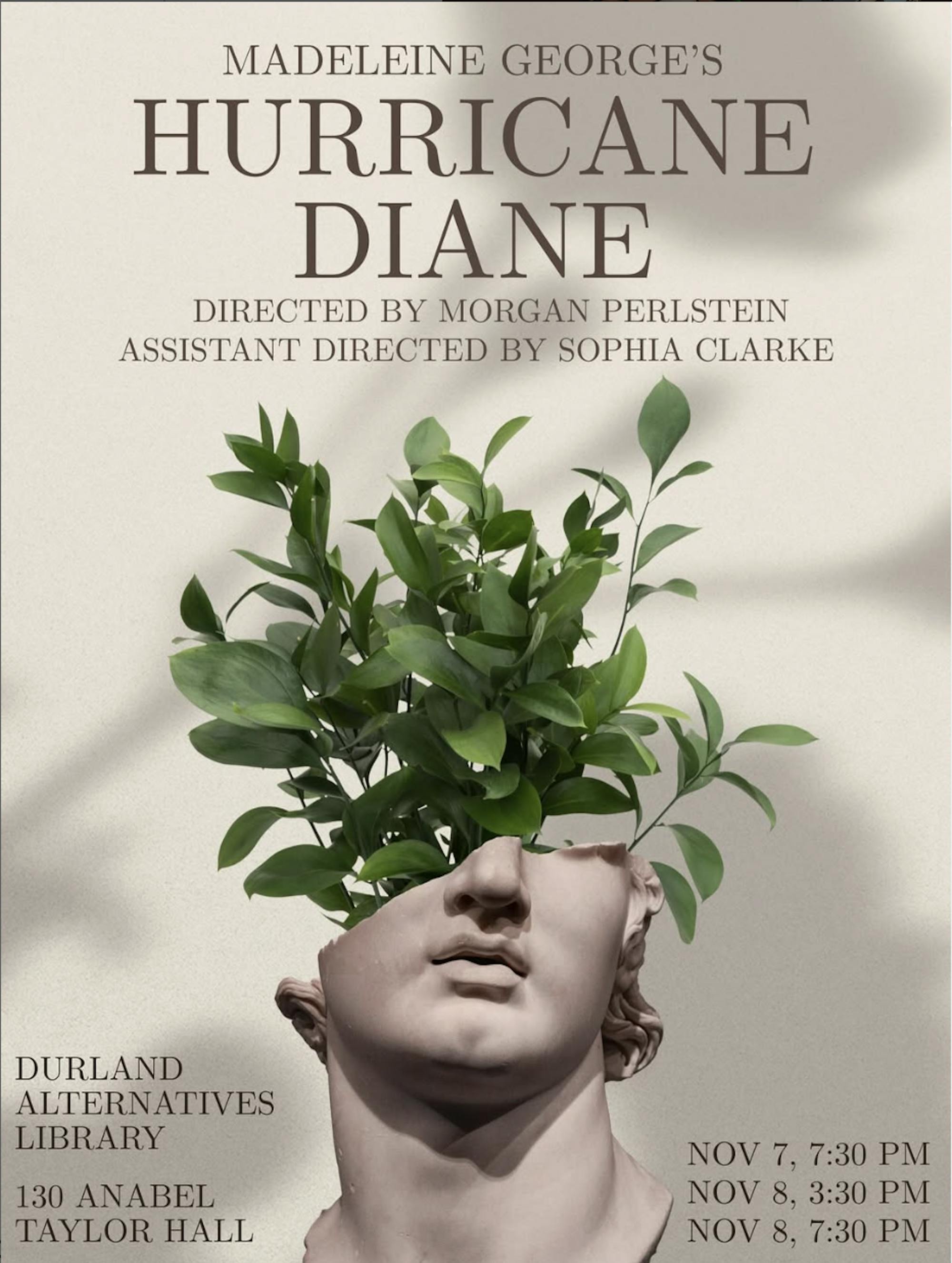
Cog Dog, a student-run theater troupe at Cornell, performed Hurricane Diane last weekend, a play written by American playwright Madeleine George. The play follows four eccentric New Jersey housewives as they encounter the god Dionysus, disguised as a butch lesbian permaculture gardener. Dionysus, or rather in the play, Diane, has returned to the mortal world to alert humankind to their ignorance regarding the deterioration of the earth, and means to build his cult by appealing to the suburban housewives’ aesthetic landscaping — and carnal — desires. Though she meets difficulties in the strong-willed women, Diane seduces them one by one until only Carol, the most steadfast in her beliefs and principles, is left. Though Diane begs for Carol to open her eyes to what is happening in the world around her, beyond curb appeal and accent benches, beyond frustrating husbands and bottles of wine, Carol refuses to acknowledge that the world is quite literally falling apart around her. Without enough support to remain in the mortal world, Diane curses humanity’s negligence and leaves them to reap what they have sown on their own.
There are plenty of unique characteristics in this show, one being the complex way it weaves together themes of climate activism as well as queerness in a sheltered society. It rewrites Greek mythology in a way that prioritizes and explores female sexuality while still lamenting the clutch of materialism on suburban living. This is a lot to take on for a 90-minute show, so each small element, down to the scenery and line delivery, is vital. This show was performed in the Durland Alternatives Library in Anabel Taylor Hall, a nonprofit library dedicated to providing the greater Ithaca community with resources about social change and alternative lifestyles. Given that the audience was surrounded by books of a similar urgency, Diane’s message felt more poignant. Not only that, but the low-lit cozy environment contributed to the comfortable, intimate feeling that the audience was inside of the kitchen where the play takes place right alongside the actors. Now just throw in some Chappell Roan as the audience walks in, and the environment was the perfect mix of comfortable, progressive and comedic.
Another unique element of the show is its reflection of Euripides’ The Bacchae. Similarly to the classic Greek text, Hurricane Diane has a “chorus,” the housewives, who come together in the traditional choral manner in the end. In Euripides’ text, this chorus is made up of “the bacchae,” women who worship Dionysus and serve as narrators describing the ecstatic, carnal rituals that the followers of Dionysus partake in. Similarly, as Hurricane Diane progresses, the housewives become more animalistic, reflecting traditional bacchanalian behaviors. Mary Caitlin Cronin ’28, who plays the fiery and strong-willed Pam, commented that Hurricane Diane is “an inverting of the norms of Greek mythology,” so that “the men are a footnote” instead of the women. Indeed, there are no male characters in the play save for in verbal reference, an uncommon but welcome phenomenon. This feminist focus allows for the women to dive into some unconscious desires that they hadn’t otherwise had room to even consider, or, as Cronin phrases it, “we felt trapped behind our French doors and Diane comes in and opens up our world.” It is ultimately this new way of thinking that allows them to break free from their environmental tunnel-vision and join Diane in an effort to protect their world.
What struck me most about this show was the ending: Dionysus ultimately loses. He comes to the mortal world in all of his divine glory to save us, and the stubborn indifference of humanity to the crises around us are enough to drive him back into the heavens. The cast and crew spoke on this during a talkback after their Saturday matinee performance, remarking on why this ending is so important to the overall message of the show. Student director and Cog Dog president Morgan Perlstein ’27 noted, “having capitalism win and the climate lose is a real reflection of where we’re at right now. … To have Diane win wouldn’t have been a proper reflection of where we are and it wouldn’t have been what people needed to hear.”
Hurricane Diane itself is a wake-up call. “It’s like you’ve been in a trance,” Diane says to the audience at the beginning of the play, “you just don’t get it.” Yes, the show is a comedy, and don’t get me wrong, it was hilarious, but that does not diminish the serious message it means to convey. We need to wake up and take a look around. Our world is larger than our backyards, and when the storms come there will be no one to blame but ourselves. Cog Dog’s intricate performance of this show managed to do justice to its message while providing the audience with a captivating and contemplative spectacle.
Gia Lish is a freshman in the College of Arts and Sciences. She can be reached at gml223@cornell.edu.

Gia Lish is a member of the Class of 2029 in the College of Arts and Sciences. She is a staff writer for the Arts & Culture department and can be reached at glish@cornellsun.com.