


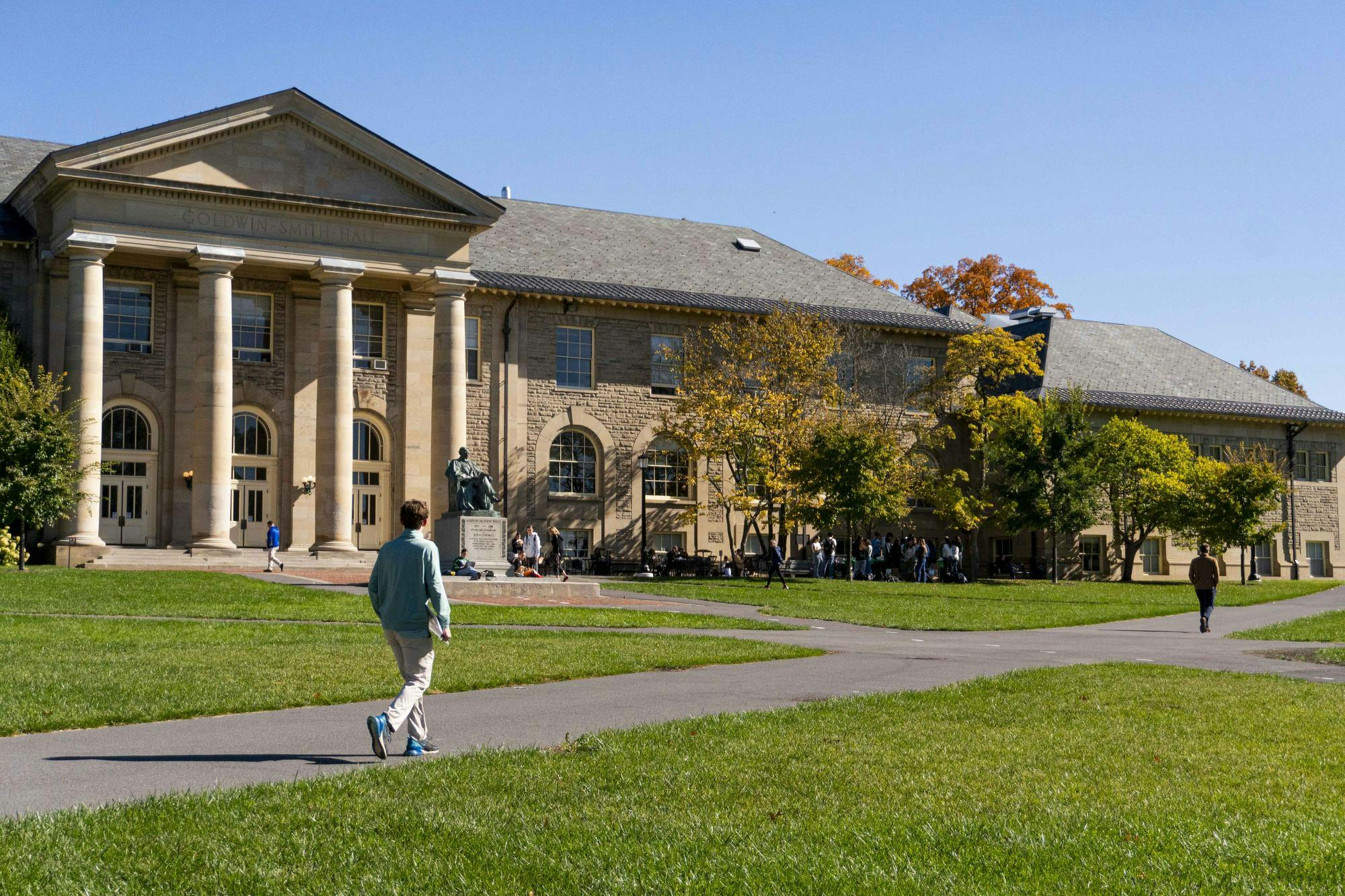
The Committee on the Future of the American University announced in a University Assembly meeting on Tuesday that it has begun meeting with Cornell students, faculty and staff to inform its recommendations about envisioning the long-term future of the University.
The FAU is a faculty-led, 18-member committee representing eight undergraduate colleges and five graduate colleges formed by Provost Kavita Bala in September. It was developed to create recommendations addressing challenges facing the University’s core missions in undergraduate education, graduate and professional education, scholarship and public impact and community engagement.
According to Co-chair Prof. Ariel Avgar, industrial and labor relations, the FAU plans to submit a draft of its proposals to Provost Kavita Bala by March, with a final report expected to come in May.
The FAU has finished the first stage of delineating the “pressures” the University is facing on the University’s core missions, according to Avgar. He told the University Assembly that the next phase will be a “robust discussion” with different stakeholders, and the FAU will investigate “ways we as the University need to adjust, shift, rethink some of the things we’re doing.”
From November to March, the FAU will host community events, including speaker events and town halls. Currently, there is an event scheduled on Nov. 24 for staff and another on Dec. 1 for faculty.
Co-chair Prof. Adam Smith, anthropology, said that FAU is split into subcommittees focusing on three topics: loss of public trust, shifts in university-government relations and addressing the rapid pace of technological change — for example, artificial intelligence.
The FAU will create advisory panels that will include “a broader array of experts” — including the dean and faculty, trustees and shared governance. According to Avgar, each subcommittee will stand up an advisory panel adjacent to the committee to “think through the information we’re receiving and the recommendations we are developing.”
The FAU will also produce “short-form outputs,” including guest submissions in The Sun and op-eds in national press.
“We want to make sure that as recommendations and ideas form, we’re having a broader discourse both with the community and outside stakeholders,” Avgar said.
In addition to community events and advisory panels, the FAU will also host individual meetings from November to January, followed by feedback sessions starting in March, in which the FAU will “report back on the community what we’ve heard.”
According to Smith, these subcommittees were chosen to highlight the challenges that need to be addressed to determine what the University will look like decades in the future, as opposed to the present. Smith noted that, “our purview is really not to think through the challenges of the current moment.”
U.A. Chair and Graduate Chair Irene Gatimi voiced concern about the “purview” that Smith explained.
“They said they don’t want to worry so much about the present and think more of the twenty, fifty-year outlook, but you need to acknowledge the present because the present informs the future,” Gatimi said.
Jason Chobirko, Ph.D. candidate, Graduate and Professional Student Assembly representative also disagreed with Smith’s sentiment, noting the current tensions between universities and the federal government.
“I don’t think we have the time to look ahead to twenty five years; we need to look at the now,” Chobirko said. “The federal government currently is attacking universities. It is withdrawing their funding. It is threatening the future of education.”
Prof. Rick Geddes, economics, who is part of the Shifts in University-government relations subcommittee, said that “diversification of funding” has been a “pressing issue” discussed in the FAU, pointing out that the University’s federal funding is “not as secure as we thought it was.”
Ameera Aftab ’26, Student Assembly representative, asked if there was "consideration” of student representation on the FAU. Avgar responded that the FAU would meet with the advisory panels, which he said will include students.
Smith added that the Graduate and Professional Student Assembly “is going to stand up its own expert panel as an ad hoc advisory focus group for us,” noting that the FAU has met with the GPSA and will meet with the Student Assembly.
“What we hope to develop is to have people who are really thoughtfully engaging in their own conversations that then we can share as well,” Smith said. “Our job is to synthesise these visions and bring them together.”
Yuhan Huang is a member of the Class of 2028 in the College of Arts and Sciences. Yuhan is a staff writer for the News department and can be reached at yhuang@cornellsun.com.


