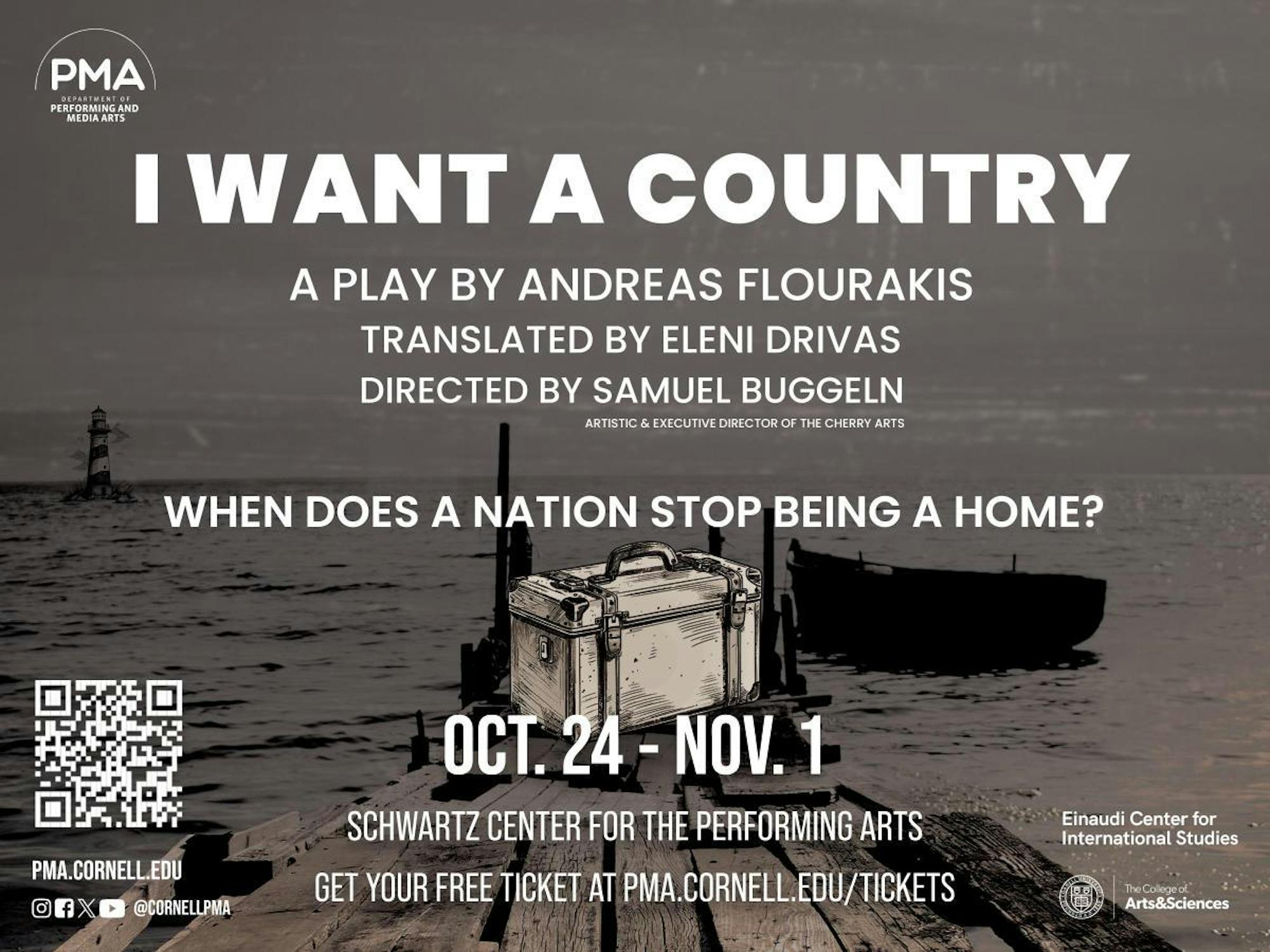
How do you build a country? What does the perfect country look like? What if there was no religion, no poverty and no death? Everyone is compassionate to one another and no one man lives above another. Sounds ideal, right? Well, the process isn’t quite that simple, especially if the reason you’re trying to create a new country is because you’ve been forced out of your own. The Performing and Media Arts department’s recent production of I Want a Country took on all these questions and challenged the very definition of a country in this modern, experimental piece.
I Want a Country was written in 2012 by Andreas Flourakis, a Greek playwright who wrote the play in response to the political and social instability in Greece in 2009. The play follows a displaced community as they seek and yearn for a place to belong. The group carries an ongoing conversation about what they want in their new country, varying from wealth and illness to sex, drugs and rock and roll. Their dialogue is broken up intermittently by moments of quiet reflection, solemn travel and even song and dance. It was admittedly jarring at first to be so suddenly torn away from the plot and thrust into a musical number, but it became clear that the abrupt shifts in tone were reflective of the instability in the migrants’ lives and how quickly things can go south.
Now, I would be remiss not to mention the most unique aspect of this show: the script. I Want a Country is not written in a traditional manner, but rather it resembles more closely that of a free verse poem, and instead of stage directions there is merely the indication of an ambiguous “action.” There are no defined characters nor established setting, so the creative process rests entirely in the hands of the cast and crew. I spoke with Bixby Piccolo Hill ’27, a member of the cast and seasoned theater veteran, who walked me through the process of creating the show, and explained that the first half of rehearsals were dedicated to breaking up the script into “moments” between actions, each of which contained a different set of characters in a different situation. Another actor, Alex Miloszewski ’27, expressed the difficulty of this particular process, saying that “it was hard not to get invested in a character’s arc” as the cast shifted from scene to scene.
Another aspect of this show that struck me was the degree of physicality. If actors weren’t speaking, they were always moving, sometimes in a playful, dancelike manner, or often in a more repetitive, contemporary manner repeating contorted movements like a machine. This constant movement served as a reminder that refugees in lack of a home are always on the move and aren’t afforded any opportunities to pause or rest. If an actor was performing a movement then it was always at 100% – big arms, expressive faces and full commitment. There was no restraint, just complete freedom in every dance, leap and run. “We could say a lot of things that we couldn’t say out loud just with our bodies,” Piccolo Hill commented on the abstract nature of movement in the show.
In one particular scene, one actor creates a tableau by gathering the cast and shaping their bodies like ragdolls in a close-knit sculpture that is drawn towards the end of the stage, beyond which their supposed ideal country lies. Whether they were kneeling, sitting, reaching or intertwined with each other, everyone became a part of this tableau in some way, standing still until they were moved.
This “moment” stuck with me long after the lights changed and the tableau broke apart, as it seemed reflective of the sense of community that the show cultivated as well as the forceful nature of displacement. Even though the characters were different in every scene, every actor was on stage through the entire show to demonstrate that the community remained interlinked, and there was a sense of friendly, comfortable intimacy that the actors exhibited between each other, particularly in the moments when they gathered tightly in artistic tableaus, reminiscent of renaissance-style art, such as this one.
Given its modernity, I Want a Country has been performed officially by fewer than 50 theater companies, making every unique interpretation of the show more valuable and distinctive. In fact, Andreas Flourakis was able to attend this performance on the opening weekend, and expressed his approval over the cast and crew’s interpretation of his show.
In a note to the audience, director Samuel Buggeln writes, “the play absorbs the issues and struggles of whatever nation it is performed in, acting as a kind of mirror of social and economic instability wherever it is produced.” Cornell’s production fulfilled this by addressing some common conspiracies as well as, in one scene, the constant onslaught of negativity that comes from the media, allowing the audience to question how concrete the foundations are that make up our own country.
Although this show laments the instability and uncertainty of displacement, it is also an ode to the importance of community. Regardless of the disasters that they face, one line rings true: “We are the country.” There are some questions that may never be answered and some needs that may never be met, but amongst all of this uncertainty, community is a constant.
Gia Lish is a freshman in the College of Arts and Sciences. She can be reached at gml223@cornell.edu.

Gia Lish is a member of the Class of 2029 in the College of Arts and Sciences. She is a staff writer for the Arts & Culture department and can be reached at glish@cornellsun.com.