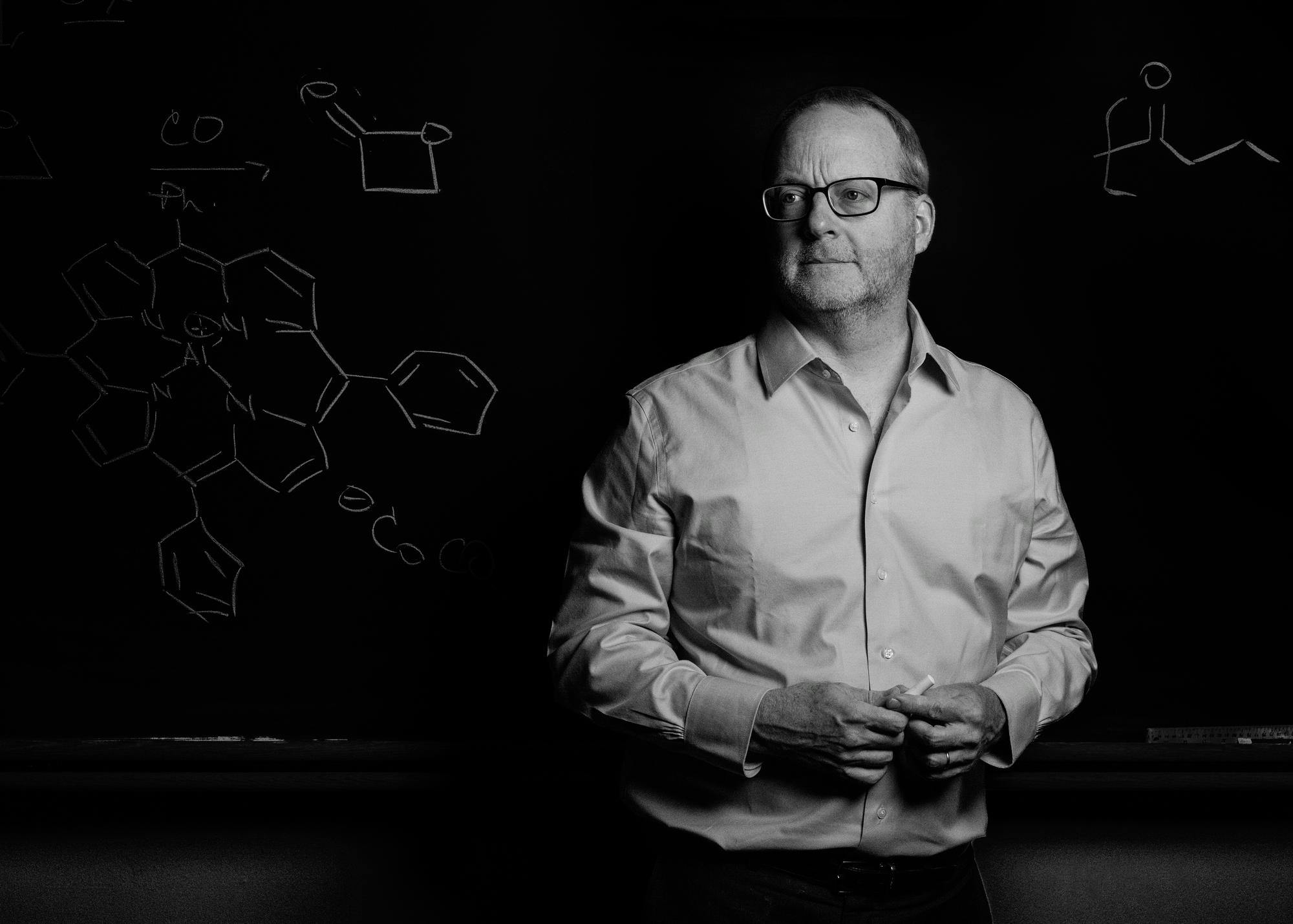
When Prof. Geoffrey Coates, chemistry and chemical biology, learned he would receive the Benjamin Franklin Award in Chemistry — which is one of the nation’s oldest and most storied honors in scientific achievement — his first reaction was, fittingly, shock.
“I’m not sure who was more shocked — Ben Franklin during his kite experiment, or me,” Coates joked.
The Franklin Award is not just another scientific accolade. It is a distinction reserved for researchers whose work redefines what science can do for society. Since its founding in 1824, the Franklin Institute has honored innovators such as Marie Curie, Nikola Tesla, Thomas Edison and, more recently, Nobel laureates including Coates’s own postdoctoral research mentor, Robert Grubbs. To join that lineage is to be placed in a scientific family tree whose branches helped to shape the modern world.
Coates is the first Cornell chemist in more than a decade to receive the prize after Jerrold Meinwald in 2013. But he is quick to resist framing the moment as a solitary achievement.
“These awards are given to me, but they really represent almost three decades of incredibly hard work from an amazing group of graduate students, postdocs and collaborators,” Coates said. “This is their recognition, too.”
For a scientist whose career has been defined by long-running, often decade-spanning projects, and by a lab culture that puts mentorship and shared creativity at its center, the honor feels less like the end of a journey and more like a celebration of the people who helped shape it.
Solving Problems the Benjamin Franklin Way
If there is a unifying thread between Benjamin Franklin and Coates, it is a shared instinct: start with a real-world problem and work backward to the fundamental science required to solve it.
Franklin didn’t invent the lightning rod out of theoretical curiosity; he built it to protect homes. Coates brings that same pragmatic creativity to polymer chemistry.
“Plastics are everywhere — some where they should be, and far too often where they shouldn’t,” Coates said. “If a bottle cap ends up in the ocean, do we really need it to last for centuries?”
His lab focuses on designing next-generation biodegradable plastics that retain the durability, clarity and strength of existing materials but can be broken down by natural processes if they enter the environment. The blueprint comes from nature itself: materials like cellulose and wood contain chemical linkages that enzymes easily cleave, allowing them to be reabsorbed into ecosystems.
Coates’s team has pioneered ways to replicate those linkages in synthetic polymers. One approach incorporates carbon dioxide as a feedstock, converting a greenhouse gas into versatile, high-performance plastics.
“If we can turn CO2 into something people want — something cheaper, greener and high-performance — then we’re not only keeping it out of the atmosphere, we’re building an economic incentive to do so,” Coates said.
These materials already have emerging applications in adhesives, foams, electronics and performance footwear. But invention alone is not enough.
“If it costs $50 a gram, no one will use it,” he said. “We have to design processes that are energy-efficient, low-waste and cheaper than what’s currently on the market.”
That delicate balance — creativity constrained by cost, chemistry guided by real-world needs — is what keeps Coates energized after nearly 30 years in the field.
The Art in the Sciences
Perhaps surprisingly, Coates entered his undergraduate career planning to pursue a degree in architecture. But after earning the highest score on Wabash University’s chemistry placement exam and receiving a fellowship, he decided to try out the major for a few semesters. Then he took organic chemistry.
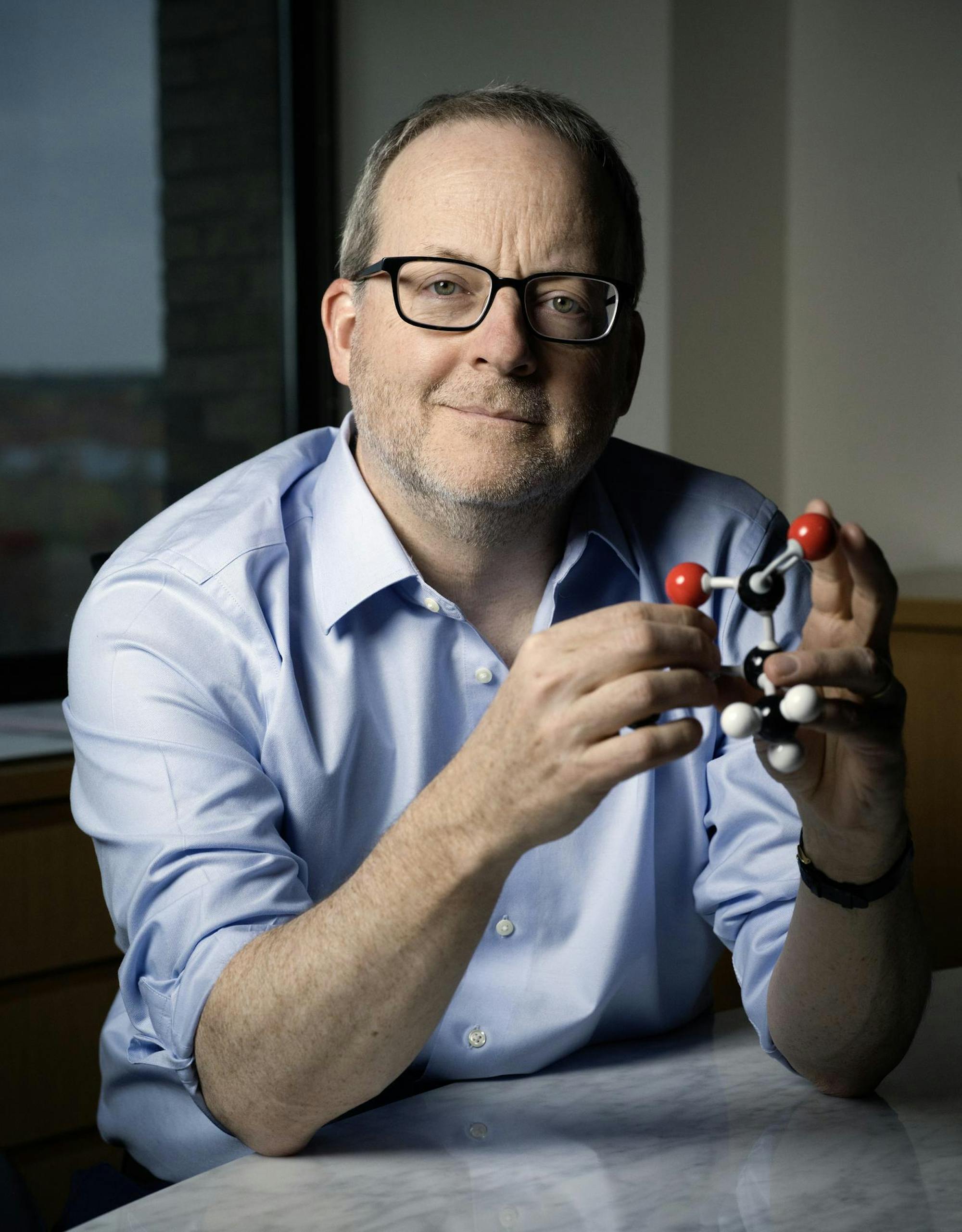
“I fell in love with thinking about structure and function at the molecular level,” he said. “Designing a molecule really isn’t so different from designing a house — you imagine what you want to build, and then you figure out how to bring that idea into reality.”
What architecture offered him in form, balance, and the deliberate shaping of space, chemistry offered him in the invisible geometries of molecules. The creative logic was the same. “How many fields let you dream up an idea of something that doesn’t exist in the world, and then go into a lab and try to make it real?” he said. “In that sense, chemistry is art. You have a vision, and you get to craft it into something real.”
That creative instinct — the drive to imagine something new and then chase it through the messiness of reality — has shaped Coates’s research ever since. In his lab, the frames and foundations simply happen to be polymers. Some of his ideas take decades to materialize; some never do. And he’s drawn to that uncertainty.
“It’s like this game,” he said. “You set your sights on a new molecular structure — something that might be tough, lightweight, biodegradable — and then you try to figure out how to bring it into existence. Sometimes you succeed. Sometimes you hit a wall for months. But it’s incredibly rewarding to wake up and feel excited about trying again.”
That long-view persistence has defined much of Coates’s scientific career. Some of the projects he has worked on have taken almost 30 years, he said. “You don’t know if you’re halfway there or nowhere close. You just keep going because the idea matters.”
The People Behind the Science
Despite the award, the metrics, and the global impact of his research, Coates is unequivocal about what brings him the most joy in his career at Cornell: the people.
“The most rewarding thing is getting to be part of these young scientists’ lives,” he said. “They come in as students and leave as independent thinkers—many becoming incredible scientists in their own right. To watch that growth, year after year, that’s the part of the job that makes it feel like you can’t believe you get paid to do this.”
He describes his role not only as a researcher, but also as a coach and mentor, especially when experiments fail, when setbacks feel personal or when projects hit the kinds of scientific dead ends that every long-term researcher knows all too well.
He credits the lab’s creativity, resilience and curiosity as the true engine behind its achievements.
“None of this happens without them,” he emphasized. “Their ideas, their experiments, their long hours. This award is a recognition of what we have built together.”
As for the Franklin Award? Coates sees it not as a finish line, but as an invitation to keep pushing, keep questioning and keep building materials that make the world better.
“Franklin believed science should make life better for people,” he said. “That’s the standard we try to live up to — finding problems that matter, and building the basic science that could someday help solve them.”
Marissa Gaut is a member of the class of 2027 in the College of Arts and Sciences. She is the Science & Technology editor on the 143rd Editorial Board. You can reach her at mgaut@cornellsun.com.