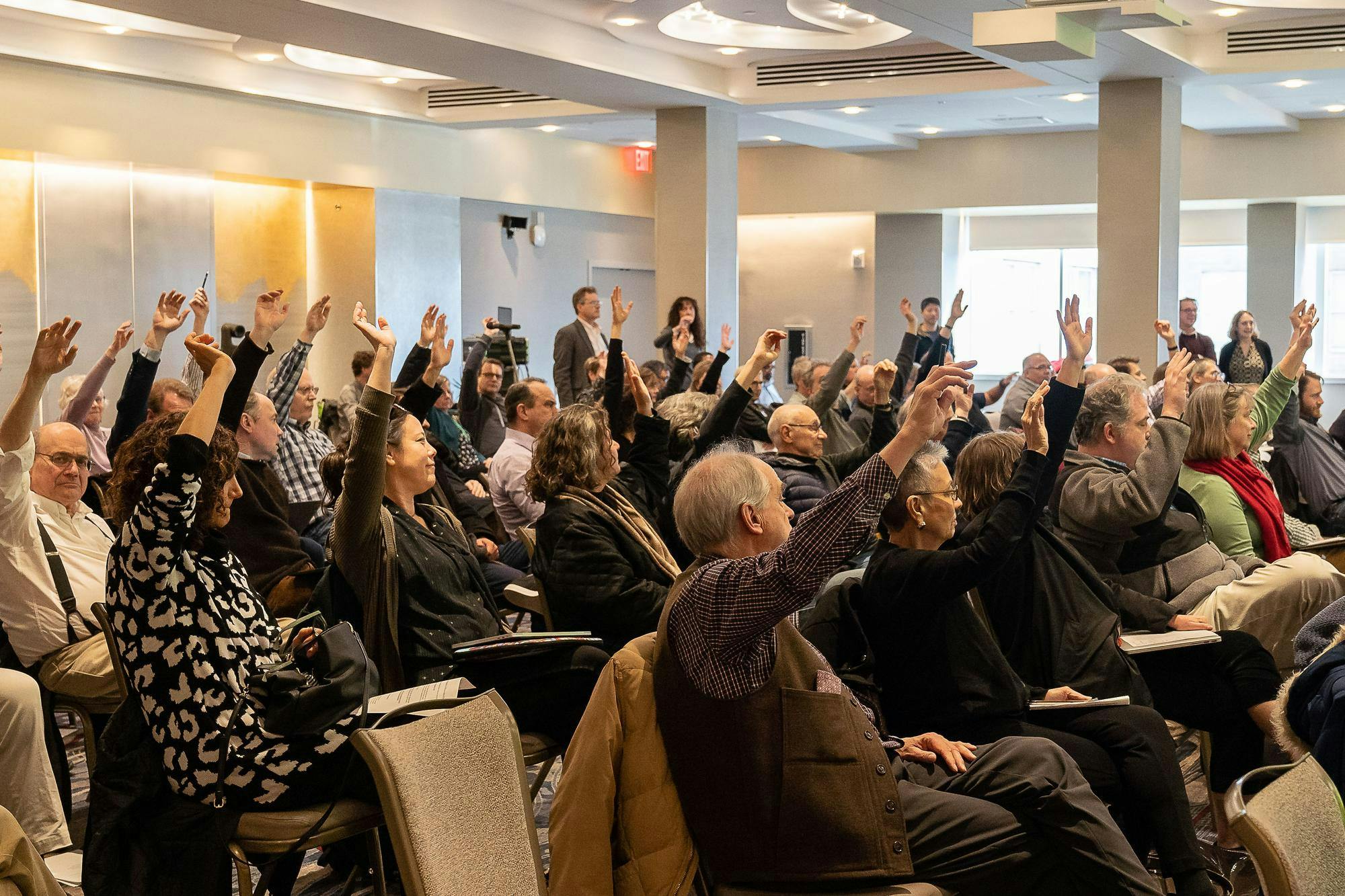
Dean of Faculty Prof. Eve De Rosa, human ecology, announced that the Faculty Senate voted to pass a resolution criticizing the increased use of temporary suspensions to discipline students involved in protest activity in an email to faculty senators. The resolution passed in an 80-16-15 vote on Friday.
The resolution, titled “Resolution Concerning Overuse of Temporary Suspensions, Excessive Delays that Violate Due Process in the Conduct of Disciplinary Hearings, and the Need for Reform of the Student Code of Conduct Procedures” was sponsored by 17 faculty senators and more than 30 other faculty members.
Temporary suspensions are a measure for students and organizations that may include the withdrawal of any or all University privileges and services, including class attendance, participation in examinations, and utilization of University premises and facilities. They should only be imposed when “less restrictive measures are deemed insufficient to protect the Complainant or the University community,” according to the Student Code of Conduct.
The resolution cited the 2024 Cornell Committee on Expressive Activity report, which expressed concern that temporary suspensions were being used punitively, as a tool for “coercive discipline used to deter, retaliate, or compel immediate compliance with Cornell policies” from disciplined students.
The committee, which was established by former President Martha Pollack to formulate a report evaluating and recommending changes to the University’s existing expressive activity policies, recommended that “Cornell make clear that the primary purpose of a temporary suspension is protective and not punitive.” It also recommended that the measure should “be imposed only when immediate action is required for the protection of others or to avoid substantial property damage, and that it ceases when the risk of harm has ceased.”
Calder Lewis J.D. ’25, who was a Respondents’ Codes Counselor from Fall 2023 to Spring 2025, estimated in an email sent to The Sun that around 85 percent of temporarily suspended students were political protesters. According to the resolution and estimates shared in the Nov. 12 Faculty Senate meeting powerpoint, the overwhelming majority of students suspended for protest activity had engaged in nonviolent conduct or speech on campus.
The resolution also criticized that members of the current Code and Procedures Review Committee — which is the committee of faculty, students and employees leading the current review of the Code — were appointed by the administration rather than Cornell’s shared governance bodies. The resolution called for the replacement of this committee with a “more representative committee” elected by shared governance bodies, CGSU-UE and the Office of the Respondents’ Code Counselors.
In October, the Student Assembly passed a similar resolution that criticized the committee leading the review and revision of the Code as composed of members appointed by Vice President Ryan Lombardi. The Student Assembly's resolution also mentions temporary suspensions, stating that “the implementation of the Student Code of Conduct by [the Office of Student Conduct and Community Standards] has caused excessive and unreasonable delays in cases where a student or student organization has been temporarily suspended.”
In an interview with The Sun, Vice President for Student and Campus Life Ryan Lombardi and Dean of Students Marla Love discussed how student and faculty members of the Code and Procedures Review Committee were selected. Love said that the committee has “almost all … of the governance structures covered.” In response to The Sun’s question about why students are a minority on the committee, Love said that there was not a “design to have the students be the minority,” and that “the Code not only sits in the student experience outside of the classroom, but has impact on inside the classroom and folks that work with students in those spaces.”
An earlier version of the resolution was submitted to the Dean of Faculty on Aug. 27. According Prof. Richard Bensel, government, De Rosa did not put the resolution on the agenda for the September meeting of the Faculty Senate, but approved the resolution for the Oct. 8 meeting’s agenda.
When De Rosa put the resolution on the agenda, according to Bensel, she also referred the resolution to the Committee on Academic Programs and Policies. This committee is housed within the Faculty Senate and “initially screens formal proposals for new academic programs, degrees, or policies,” according to its website.
Though the summary of CAPP review stated that the resolution “does not fall within scope of what CAPP has customarily reviewed in recent years,” the committee corresponded with Faculty Senate members who agreed that a CAPP review was appropriate. The summary CAPP review stated that one common recommendation among many CAPP members was that “the resolution might be reworded to invite dialogue and collaboration with the administration.”
The resolution was revised by the sponsors and presented to the Faculty Senate on Nov. 12.
“The Dean of Faculty refused to put it on the agenda for the September meeting, and the Faculty Senate only meets routinely, only meets every month, so it was a big delay,” Bensel said.