A Faculty Senate resolution condemning the University's disciplinary process against Eric Cheyfitz, a former professor in literatures in English, failed to pass a vote on Oct. 31.
Cheyfitz faced a discrimination investigation after he allegedly asked an Israeli graduate student Oren Renard to leave his spring course on Gaza, “Gaza, Indigeneity, Resistance,” last semester, claiming he was “disruptive.” Renard filed a discrimination complaint with Cornell’s Office of Civil Rights.
The Faculty Senate Committee on Academic Freedom and Professional Status of the Faculty ruled unanimously in favor of Cheyfitz, contradicting an earlier decision by Cornell’s Office of Civil Rights, which found him in violation of federal anti-discrimination law. However, the Faculty Senate’s decision was later overturned and reinvestigated by Provost Kavita Bala. The investigation ended when Cheyfitz retired on Oct. 7.
The resolution, which had around 200 co-sponsors, addressed what the Faculty Senate saw as a failure by the administration to follow the appropriate procedures in Cheyfitz’s case and called on the senate to censure Cornell’s central administration, a procedure used to express formal disapproval or condemnation. The resolution also asked the University to “renew its commitment to protecting academic freedom, even in the face of political pressure.”
40 members voted in favor of passing the resolution while 54 members voted against the resolution. 21 members abstained from voting.
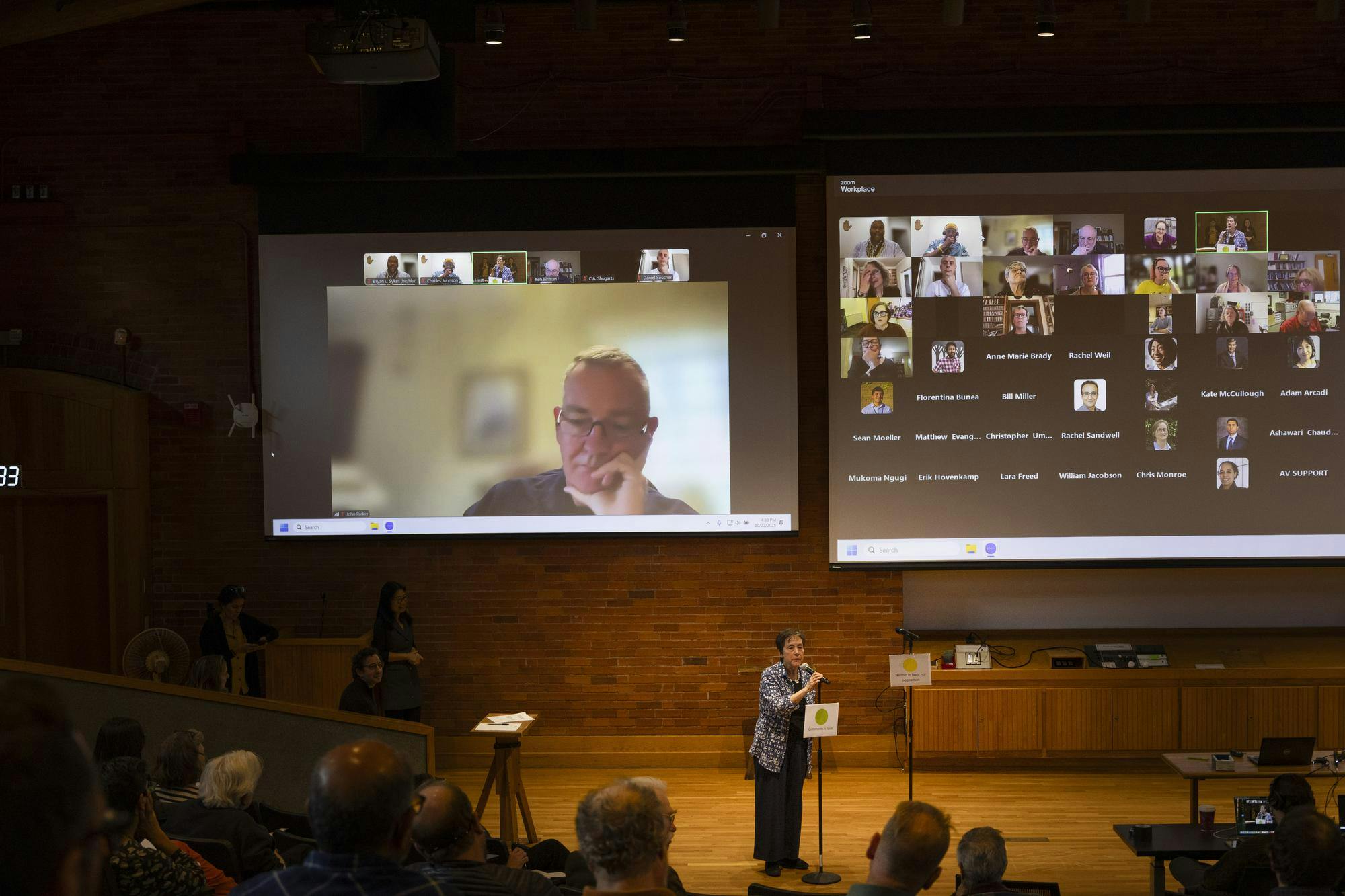
The vote followed a Faculty Senate meeting on Oct. 22, where top administrators, including Bala, as well as several professors, criticized the proposed resolution. The meeting ended contentiously after a professor alluded to Renard’s alleged past in Israel’s military surveillance agency before he was shouted down by faculty in the audience.
Prof. Sandra Babcock, law, and Prof. Risa Lieberwitz, industrial and labor relations, were co-sponsors of the resolution, and presented it at the Faculty Senate meeting on Oct. 22.
Babcock pointed to the number of voters who abstained as an indication of confusion surrounding Cheyfitz’s proceedings, which she saw as a key reason why the resolution failed to pass. She specifically cited Bala’s use of quotes from a confidential record that has not been disclosed to faculty senators, leaving what she saw as a “partial and biased account of what had happened in Professor Cheyfitz’s case, with inadequate means to rebut it.”
“I think that was, frankly, the reason why the resolution failed to pass,” Babcock said. “There was simply no way for us, the resolution’s sponsors, to contest the University’s version of events because we didn’t have access to the same records.”
But according to Babcock and Lieberwitz, although the resolution failed to pass, the number of voters in favor of the resolution indicated support from the faculty.
“I think it’s also clear that a significant percentage of the faculty who voted, voted for the resolution,” Lieberwitz said.
Some members of the Faculty Senate were relieved the resolution did not pass. Faculty Senator Prof. Yuval Grossman, physics, who spoke against the resolution at the Oct. 22 meeting, expressed disappointment in what he saw as the “doxxing” of Renard by national media, was in favor of the result of the vote.
“I am relieved that the resolution did not pass. I believe that, as members of the Senate, our responsibility is to protect our students and ensure that Cornell is a community that is welcoming, inclusive, and safe for everyone,” Grossman wrote in an email to The Sun.
Babcock, however, maintained that the core of the resolution, protecting faculty governance, is something all faculty should be concerned about, especially given the current political climate surrounding higher education.
“Given the attacks on faculty throughout the country who have engaged in scholarship that is disfavored by the Trump administration, I think that it is likely that one or more members of the Cornell faculty will be targeted,” Babcock said.
Lieberwitz said that the administration’s failure to follow policies adopted by the University is something “every faculty member should be more than concerned about,” and called on faculty to continue fighting for faculty governance.
“What needs to be done is for faculty to redouble our efforts to have strong faculty governance and to require the university to negotiate with us about policies and practices and their implementation, so that we can rely on policies as adopted,” Lieberwitz said.

Matthew Chen is a member of the Class of 2029 in the College of Arts and Sciences. He is a staff writer for the News department and can be reached at mchen@cornellsun.com.