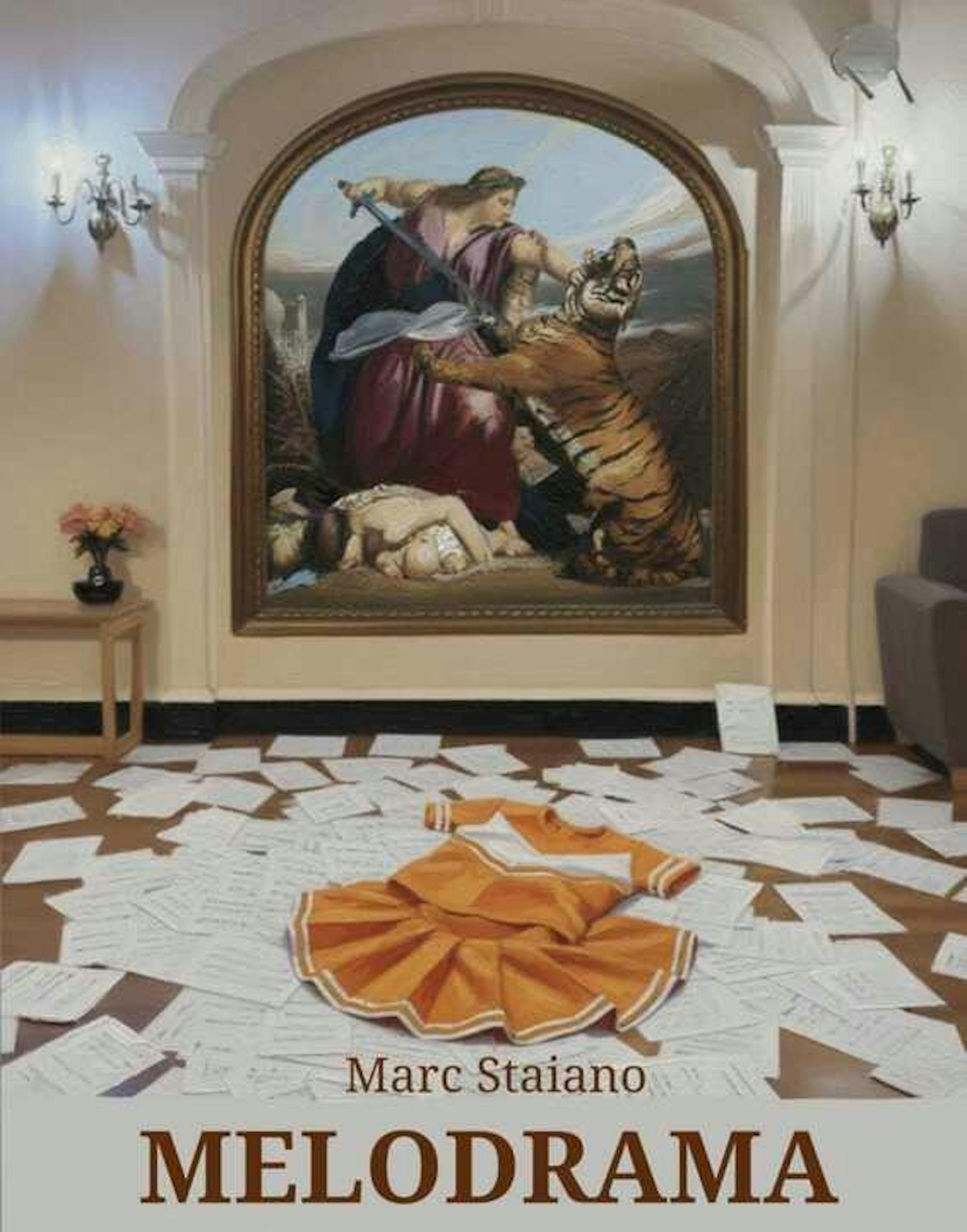
On Sunday, Nov. 16, 2025, just one day before my 20th birthday, I published my debut anthology book, MELODRAMA, through Kindle Direct Publishing and soon Ingramspark. It is processing through the veins of Amazon as I write this article, available only in physical copies.
A collection mostly of unflattering poetry and memoir — including one short story that’s already become a bit of a fan favorite — this passion project was written in the aftermath of a ferocious teenage heartbreak that swiftly sent me to on-campus therapy. A relationship autopsy, so to speak, MELODRAMA immortalizes knee-jerk reactions from an age in which emotion is literally everything, chronicling my sleepless confessions and epiphanies. The mission was to exorcise myself from the phantoms entirely, and I am thrilled to announce that I’ve achieved that.
When I reflect on the demons that vexed me in the first place, I get a jagged little rock clogged in my throat, followed strangely by an involuntary grin. Over the last year I’ve discovered that I’m a frightening combination of sensitive and vengeful. From the bitterness, to the naïveté, to the stalking and to the emasculating desperation of the queer experience, publishing has become my way of burning the whole field to the ground and allowing something green to grow again. I’ve dissected my own psychology more acutely than ever before, and have approached it with the knowledge that readers may see themselves in its candor and turn it into something beautiful. Writing is an inherently romantic art form that I believe should be more profoundly recognized for its therapeutic abilities. It is also arguably the most effective emotional outlet for students in an academic environment as apocalyptic as Cornell University.
Journaling translates the hieroglyphics of anxiety into something concrete and manageable, and turns overwhelming emotions into messages you can understand. Over time, a letter to yourself becomes a map of your inner world, exposing patterns, triggers and values that you might never notice in the turbulence of everyday life.
Beyond emotional clarity, journaling creates a private space where you can be entirely honest: no performance, no pressure, no audience; your mind is the final human empire. It flexes its creative muscle by freely allowing unexpected ideas and insights to surface. Perhaps most importantly, journaling gives you a time capsule of your growth — fears you’ve outgrown and mistakes you’ve learned from. Reading old entries can be humbling, hilarious, heartbreaking or inspiring. In a world that moves fast, writing is a way to pause, cry a little and then breathe in conversation with yourself.
I want to take a moment to talk about the publishing services I’m using. Amazon KDP and IngramSpark are both platforms that let you self-publish books, but they work differently and serve different purposes. KDP is free and extremely simple: you upload your book, Amazon sells it, and they print copies on demand. It’s the easiest way to get your book on Amazon quickly, and you earn royalties every time someone buys a copy. IngramSpark, on the other hand, is a more professional-grade distributor that puts your book into a huge global network, including bookstores, libraries and retailers that usually won’t order from Amazon. IngramSpark charges small setup fees and has stricter formatting requirements, but it gives the author much wider distribution. If MELODRAMA succeeds on Amazon, I’ll have the opportunity to expand internationally through IngramSpark, upgrade the cover and make it available at Barnes & Noble and indie bookstores.
My philosophy when making MELODRAMA was that if I wasn’t scared to release it, then it wasn’t vulnerable enough. I have become something of an emotional nudist in that regard, with every incriminating little cranny of myself and my muse to be printed and interpreted by friends, peers and strangers. “Was he the damsel, or was he the dragon?” you’ll wonder. My parents had no idea about what I was going through or that I’ve been writing this book in secret, and I think there’s something metal about this being the way I come out to them.
Moral of the story: don’t you dare succumb to regret; you have what it takes to rise above it. Make something incredible out of pain so that your future self looks back on it not with a sigh, but with a chuckle.
Marc Staiano is a junior in the College of Arts and Sciences. He can be reached at mcs382@cornell.edu.
Marc Staiano is a member of the Class of 2027 in the College of Arts and Sciences. He is an assistant Arts & Culture editor on the 144th Editorial Board and can be reached at mstaiano@cornellsun.com.