

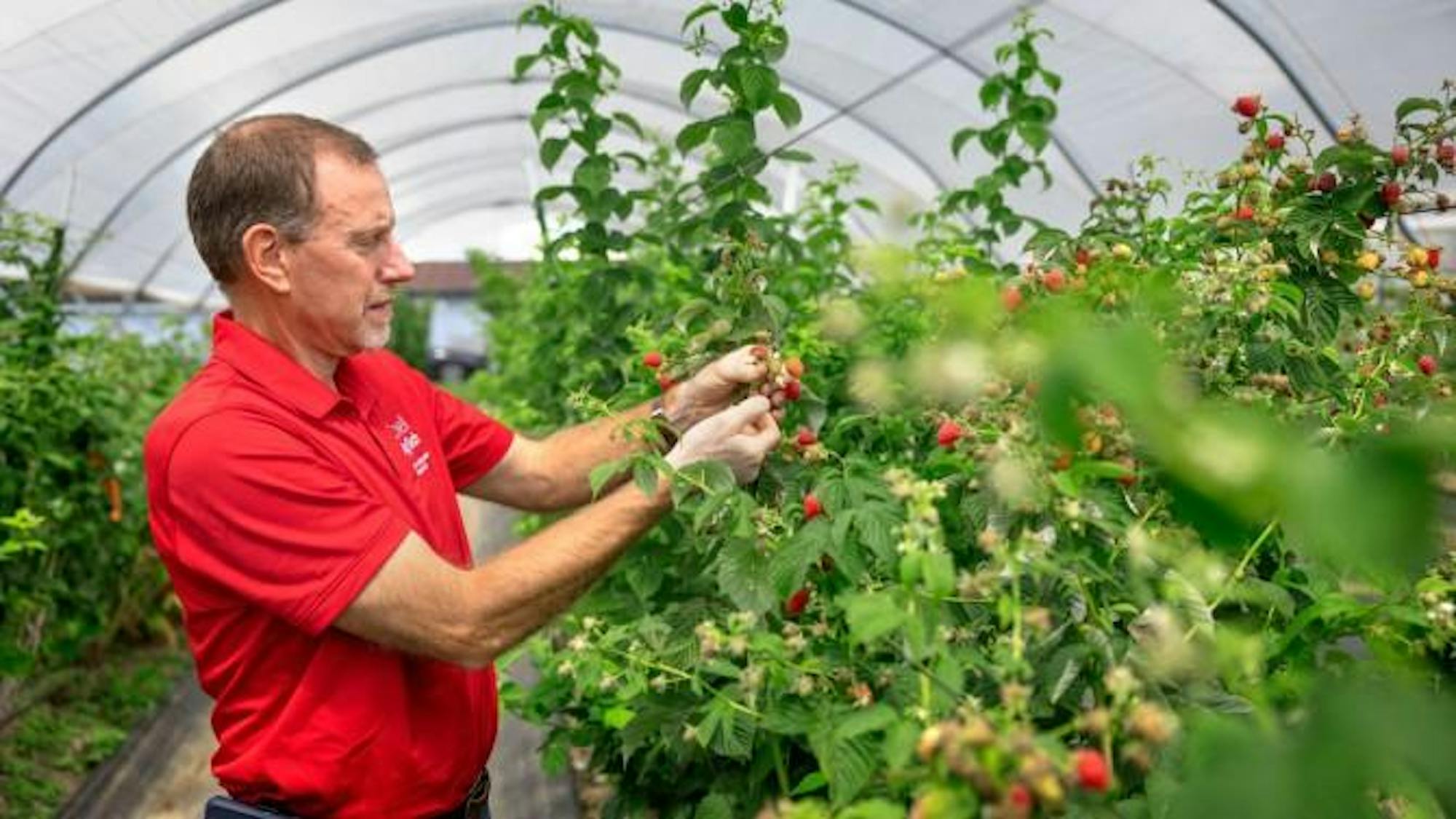
As erratic rain and heat stress disrupt planting and harvests, Prof. Margaret Smith, plant breeding and genetics, believes hybrids, genetic diversity and adaptive management must work together to protect consistent food supplies.
When most of us think about corn, we picture late-summer fields and sweet corn at the farmers’ market. For plant breeders, though, corn is a year-round puzzle about resilience, risk and timing and, increasingly, about climate.
“Consistency in a food supply means being able to produce a reasonable yield regardless of the challenges from the environment,” Smith said. “If what you’re producing is your family’s food, you need food every year, not just the years when the weather is nice.”
That idea, year-in, year-out stability, is becoming harder to achieve. In New York, Smith has seen the growing season lengthen, but rainfall has become less dependable.
“Our last frost comes earlier and our first frost comes later,” she explained. “We’re getting more rain in the spring, often in big events that delay planting, and then it shuts off when you need moisture in June and July.”
This year, her team couldn’t plant until early June because May was “endlessly” wet, as said by Smith. In other years, the fall turns so soggy that mold threatens the harvest. The total rainfall might average out, but it arrives in bursts that the soil can’t absorb, which is bad news for germination, root strength and disease control. The unpredictability itself, Smith noted, is now one of the greatest challenges facing farmers.
One of her main tools for managing that risk is hybrid seed. Unlike pure line or open-pollinated varieties, hybrids combine traits from two parent plants, allowing resilience against multiple stresses.
“This gives hybrids a degree of resilience,” Smith said. “You don’t always know what the weather will throw at you, so you try to bring together traits that provide reasonable productivity across a wide range of environments.”
But even hybrids have their limitations. Under drought conditions, corn plants often delay silk emergence, which is the female part of the plant, while still shedding pollen, which is the male part.
“If it’s very dry, the whole field may produce nothing because pollen is shed before silks appear,” she said. “That uniformity, the same strength that gives hybrids consistency, can also be a vulnerability.”
But she also pointed to the socioeconomic and infrastructure challenges around hybrid seed. “The shift from open-pollinated to hybrid requires reliable access to seed each year,” she said. “For that, farmers need both income and a functioning seed industry.”
To address this, modern breeding programs select for plants that keep developing ears even under stress and reduce the “anthesis-silking interval,” the gap between pollen shed and silk appearance. Smith explained that shortening this window minimizes the risk of total crop failure and allows plants to recover more effectively after heat or drought stress.
Still, breeding for resilience becomes increasingly difficult as weather patterns grow more erratic.
“If drought is predictable, you can breed for it,” Smith said. “When it’s erratic, which drought do you choose?”
To compensate, her program tests potential hybrids across multiple locations and years to identify which varieties perform consistently well, even when conditions differ sharply from one site to another. This kind of testing, she said, is both costly and essential.
Smith emphasized that genetic solutions alone are not enough to meet the growing environmental challenges facing agriculture.
“We need genetics and management together,” she said, pointing to regenerative agriculture techniques such as cover cropping, soil restoration and diversified rotations. “The genetics of the variety you breed has to make it fit with the environment it finds itself in, whether that includes soil management or crop rotation. You can’t just change one part of the system.”
The U.S. National Plant Germplasm System and international gene banks conserve genetic resources across thousands of crop varieties, protecting against the loss of rare or underused traits. She also stressed the importance of maintaining genetic diversity in an era of global climate stress.
“You never know which genes and combinations will be critical in the future,” Smith said.
When asked what role Cornell’s plant breeding research should play in the future of food security, Smith said she hopes the University continues combining basic genetic research with practical field testing. “It’s great to do the lab research,” she said, “but if you never take it to a farmer’s field, it may not be what’s needed.”
For students considering careers in agriculture, Smith’s advice was simple — go for it.
“Every person on this planet likes to eat at least once a day,” she said. “Trying to ensure the security of the food supply going forward, what more important work could there be?”
She acknowledged that the coming decades will test global food systems in new ways. “We’re going to need roughly 70 percent more food, especially protein, by around 2075 if population trends continue,” she said, referencing recent research in digital agriculture. “Right now, U.S. corn yields increase about 2 percent per year. That makes the goal achievable, but keeping it up will be harder as the environment grows more challenging.”
Smith also pointed to looming questions about nitrogen fertilizer, pesticides, and petroleum-based inputs.
“Our current gains rely on all of those things, and they have environmental costs,” she said. “We’ll need to figure out how to maintain productivity while reducing harm.”
Despite these challenges, she remains hopeful about what the next generation of scientists can accomplish.
“Agriculture and ensuring its sustainability and productivity going forward are central to our survival,” she said. “Food and water are the first fundamentals. No matter what changes, people will still need both, and that’s what makes this work so important.”


