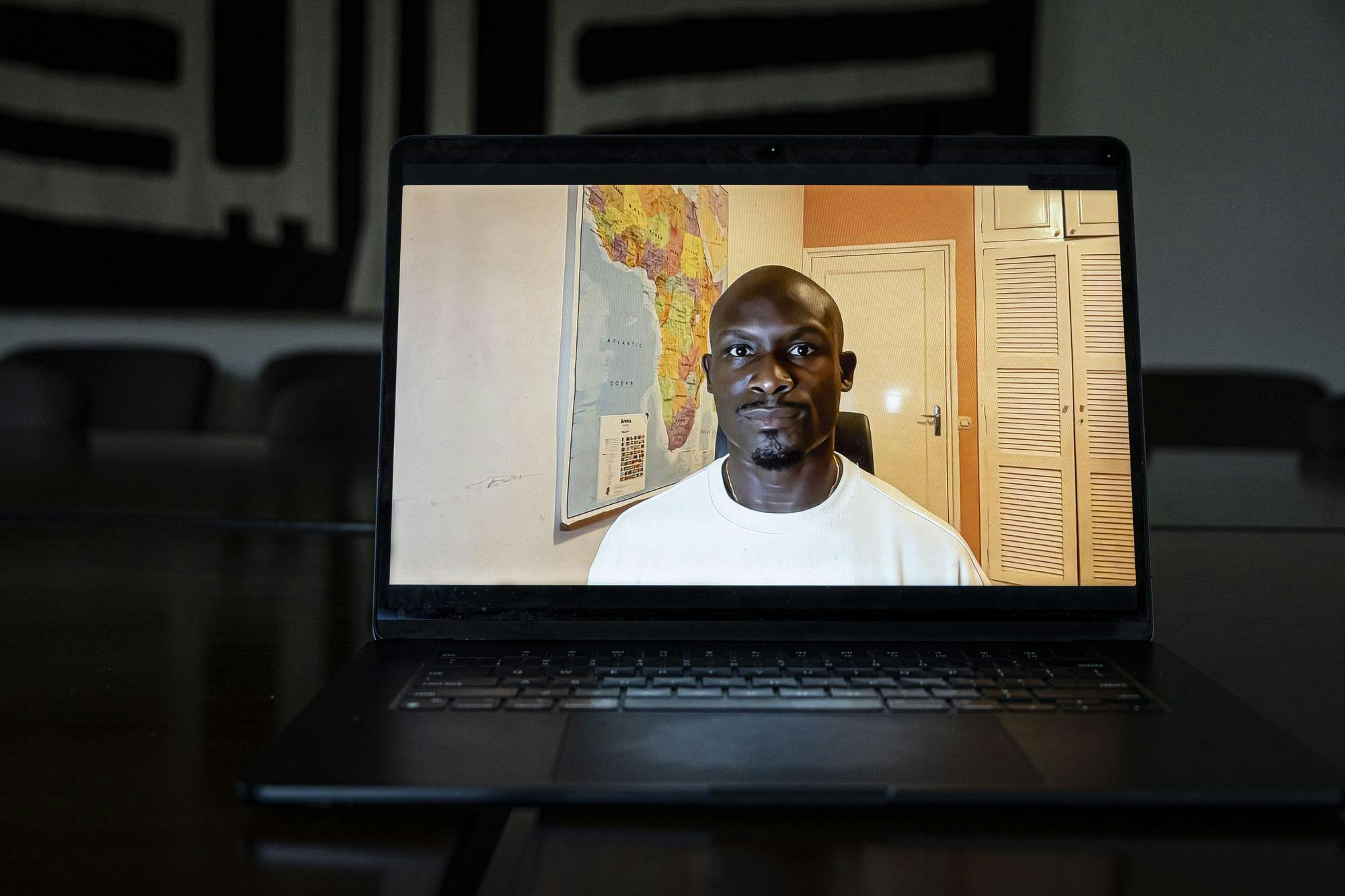
International graduate student Amandla Thomas-Johnson had already fled the country in April 2025 over deportation concerns when he received two emails spaced 90 minutes apart.
The first email, sent on May 8 from Cornell International Services, stated that his immigration status had been terminated by the federal government. The second email, sent from Google on the same day, notified him that his personal email account had been subject to a subpoena by the U.S. Department of Homeland Security on March 31.
Thomas-Johnson told The Sun that the question that immediately came to his mind was whether DHS had also accessed information from his Cornell Gmail account. Yet, when he later posed questions to both Cornell’s Media Relations office and to Cornell International Services, Thomas-Johnson said they did not respond.
“This is the big question — whether they were using our [Cornell] emails to track us as well,” Thomas-Johnson said.
Per Google’s terms of service, if an account is managed by an organization, like the University, only the organization's administrator, and not the individual, is notified when a request from a government agency is processed.
When asked by The Sun if the University had received notification from Google that Thomas-Johnson's Cornell-issued Gmail account was subpoenaed by DHS, a Cornell spokesperson declined to comment.
A Google spokesperson did not disclose to The Sun if Thomas-Johnson’s University email was subpoenaed, but defended the company’s decision to comply with the subpoena of his personal email.
"Our processes for handling law enforcement subpoenas are designed to protect users' privacy while meeting our legal obligations,” the Google spokesperson told The Sun. “We review all legal demands for legal validity, and we push back against those that are overbroad or improper including objecting to some entirely.”
According to Google, Thomas-Johnson’s subpoena requested only basic subscriber information, which did not include the contents of email communications metadata regarding those communications, or location information.
Legal correspondence with Google that Thomas-Johnson shared with The Sun showed that his personal email was accessed under federal communications law 18 USC 2703(c)(2). This code requires an electronic communication provider, such as Google, to give subscriber data to the government, including their address, telephone number, telephone connection records “of session times and durations” and credit card or bank account number, when the government “uses an administrative subpoena authorized by a Federal or State statute.”
A peer of Momodou Taal, a fellow international graduate student and pro-Palestinian activist, Thomas-Johnson said the two “went into hiding” together when Taal sued the federal government over alleged First and Fifth Amendment violations last March. Taal later self-deported after he was told to surrender to Immigration and Customs Enforcement. During this period, Thomas-Johnson worried that his Cornell email was being monitored.
“I think that was a factor in why they waited so long to suspend [my visa] last year because they knew what I was doing with Momodou, and I guess some of it [was] on my Cornell email address,” Thomas-Johnson said.
Yet for Thomas-Johnson, his main frustrations lie with the University's lack of response, adding that “Cornell's part in this hasn't been fully explained … I think they're hiding quite a lot.”
Thomas-Johnson left the country one month prior to the May 8 emails that formally revoked his immigration status and notified him of the breach of his email address. Thomas-Johnson said he was prompted to flee the country in April after a friend was detained at a Florida airport and questioned over Thomas-Johnson’s whereabouts. The fourth-year graduate student says he now resides abroad, where he is remotely continuing his studies at the University.
At Cornell, the Ph.D. student in the Department of Literatures in English previously taught First-Year Writing Seminars on Black identity and race and writing. Thomas-Johnson says he also took over teaching Taal’s FWS when Taal was suspended over his participation in the Statler Hall career fair disruption.
While the pair had been involved in pro-Palestine organizing on campus, Thomas-Johnson said that his own role was minimal, claiming that he “missed the entire semester, [Spring 2024], when everything happened.” He explained that he did not participate in the March 2024 Day Hall occupation or the April and May 2024 encampment, as he was out of the country that semester. Taal, however, later faced temporary suspension over his role in the encampment.
However, Thomas-Johnson did state that in Fall 2024, both he and Taal faced temporary suspensions from the University after attending a protest in Statler Hall, which disrupted a career fair featuring defense contractors Boeing and L3Harris. It was this protest activity that was later cited in federal district court as cause for Taal’s removal from the country.
While Taal’s case played out in the courts in March, Thomas-Johnson only learned of his loss of immigration status through the May 8 email from a representative for Cornell International Services, which was obtained by The Sun.
The University told Johnson that “we don’t have detailed information” about his loss of legal status but shared an update to his Student and Exchange Visitor Program record. It stated that his SEVIS record was terminated in accordance with Section 221(i) of the Immigration and Nationality Act, which allows for a consular officer or U.S. Secretary of State to revoke “a visa or other documentation [of] any alien … at any time, in his discretion.”
Thomas-Johnson believes that his protest activity was not the only reason DHS revoked his immigration status, maintaining that “there are other people as well they could have taken visas away from.”
Instead, Thomas-Johnson feels he was targeted because of his past as a journalist reporting on what he called the “war-on-terror” beat. Thomas-Johnson noted that he previously reported on Guantanamo Bay and what he reported was its "most tortured detainee,” Mohamedou Slahi.
“It’s not just about what happened last year [at the Statler protest],” Thomas-Johnson said. “It's about a longer production of knowledge that [the U.S government doesn’t] really like.”
DHS did not respond to a request for comment on whether it subpoenaed Thomas-Johnson’s Cornell email account.
Benjamin Leynse is a member of the Class of 2027 in the College of Arts and Sciences. He is a news editor for the 143rd Editorial Board and can be reached at bleynse@cornellsun.com.