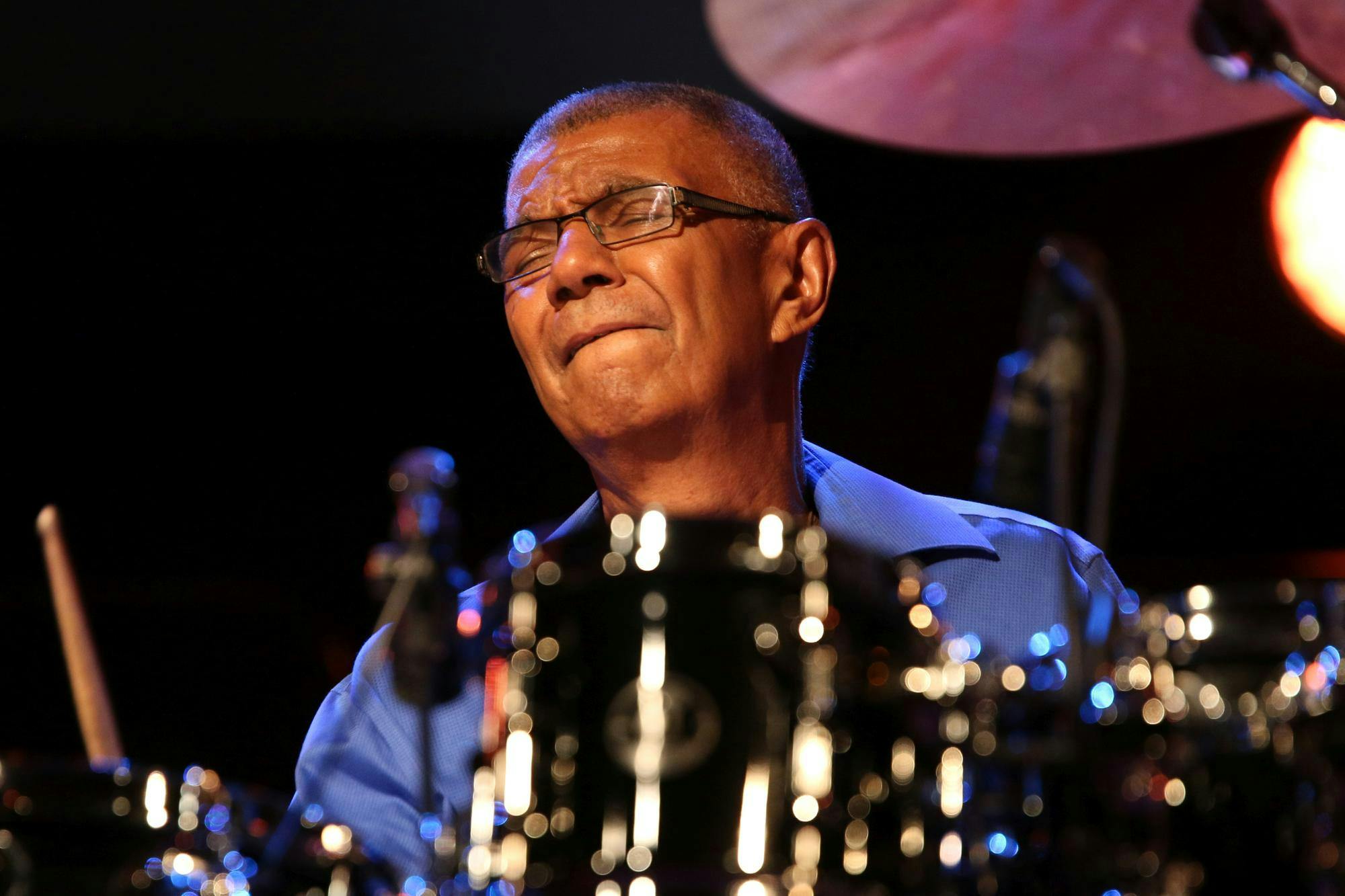
The world of jazz drumming has been shaped by countless rhythmic architects since the genre’s birth. Among them is Jack DeJohnette, a mainstay in ’70s jazz fusion, who died last week at the age of 83. Jack DeJohnette was born in Chicago in 1942. He began playing the piano at age four and took up the drums at 13. He moved to New York in 1966 and joined saxophonist Charles Lloyd’s quartet alongside bassist Cecil McBee and pianist Keith Jarrett, the latter a future collaborator. He left and joined pianist Bill Evans’s quartet in 1968 and Miles Davis’s the following year.
Jack DeJohnette replaced Tony Williams in Miles Davis’s band on the very precipice of the bandleader’s impending and irrevocable foray into electric music. 1969’s In a Silent Way was Davis’s first significant expedition, characterized by electric keyboards and bass and a freer, flowing structure. DeJohnette took over for 1970’s Bitches Brew, a gargantuan and explorative cacophony of an album that remains beloved, misunderstood and occasionally vilified. He played alongside drummer Lenny White, of Return to Forever fame, and some dozen-odd musicians during the marathon recording sessions famously held by Davis. The double LP harbors several side-length renditions of overwhelmingly dense jazz. Much of the music is improvised and based on “musical sketches” presented by Davis. Producer Teo Macero made extensive use of tape editing throughout, resulting in dizzying delay effects and long, chopped-up passages of music. The result is a disorientating musical unraveling and a landmark album from the early years of jazz fusion.
Working with Miles Davis, DeJohnette found a steady gig and early success as an eminent jazz drummer — one among few capable of adequately interpreting his bandleader’s cryptic directions. With the Bitches Brew band, DeJohnette embarked on several tours that took him to the Fillmore East, Fillmore West and the Isle of Wight. The band was back in the studio the following year, while simultaneously releasing hallowed live material from the road. He played on spliced sections of Davis’s Jack Johnson, the soundtrack for a movie commemorating the boxing champion. A series of performances with Brazilian multi-instrumentalist Hermeto Pascoal produced the sprawling Live-Evil, a darker, nebulous counterpart to Bitches Brew. This time, DeJohnette wrangled the shifting chaos alone on the drummer’s seat, joined only by Airto Moreira and Pascoal on percussion. Live-Evil pulls the restless energy of Bitches Brew to musical extremes: Davis’s arrangements are funky with an unbecoming urgency while Pascoal’s are less tangible, tending to float into the abyss without apparent direction. DeJohnette leads a face-melting trance on “Sivad” with characteristic ease. He showcases his technical mastery on the frantic, funk masterclass “What I Say;” his unbridled power drives the band for some 20-odd minutes at a brisk pace, ending in a thunderous extended solo. When necessary, DeJohnette plays with a fervor and volatility absent in his peers. He plays with a fury like that of Elvin Jones or Art Blakey in the ’50s, but with a free-form texture unlike any music of the time. From above, Davis’s laconic, newly-electrified trumpet pierced the wandering soundscape. 1972’s On The Corner distilled the band’s trajectory into hard, unadulterated funk. The jarring combination of heavy funk and heavy tape-editing alienated much of Davis’s audience. It would be his last proper studio album of the decade; he focused on live performances until he retired temporarily in 1975.
DeJohnette turned to other endeavors, including solo work and long time collaborations. His first recording as a bandleader, The DeJohnette Complex, was released in 1968, and featured his mentor and jazz titan Roy Haynes. He signed with ECM Records in 1973, beginning a long and fruitful relationship with the nascent label. Much of his work for the next decade was released by the label; among his earliest partnerships was a trio, dubbed Gateway, comprising himself, guitarist John Abercrombie and bassist Dave Holland. He would go on to record as a sideman for a plethora of bandleaders, including Abercrombie, guitarist Ralph Towner, saxophonist John Surman and trumpeter Kenny Wheeler. His solo work featured himself on the piano and melodica alongside the drums. He would also record with bassist Gary Peacock alongside Keith Jarrett and form Jarrett’s “Standards Trio,” one of the longest-lived jazz groups of all time.
A one-off celebration of the American Songbook in 1983 brought the Standards Trio together for some of the musicians’ best recordings in years. The music was too good to pass up on, and the three formed a partnership that has lasted decades. The trio offered a stripped-down, nostalgic take on jazz amidst an era of tireless exploration and advancement in the genre. The appeal was simple yet profound, and the Standards Trio recorded extensively both in the studio and on the road. As with many of Keith Jarrett’s musical endeavors, the live setting produces some of the piano wizard’s best work. For many fans, the live interplay between Jarrett, Peacock and DeJohnette is priceless, and their recordings revered as such. The trio improvised like no other in the business. Jarrett’s wandering approach sends forth snapshots of musical ideas at a blistering pace, suggestions that are taken up by the rhythm section with prowess and alacrity. DeJohnette shines on his extended solos, which he plays with a distinctly lyrical approach and astounding dynamic subtlety.
Alongside the Standards Trio, DeJohnette entered the ’90s playing with his solo group, Special Edition, and a quartet featuring Herbie Hancock, Pat Metheny and Dave Holland. He began playing the piano on stage again and embarked on a series of musical collaborations. He looked past the confines of jazz for inspiration, recording an album with rock band Living Colour in 1992. He spent the remainder of his career in pursuit of new sounds with collaborators, old and new alike. He reformed Gateway with Abercrombie and Holland and worked with the Standards Trio until 2014. Jack DeJohnette died on Oct. 26, 2025, leaving behind a legacy as one of jazz and fusion’s most creative, adventurous and reliable manipulators of rhythm.
Josh Yiu is a junior in the College of Agriculture and Life Sciences. He can be reached at jy793@cornell.edu.