It’s the 19th century again, and the Luddites are on the brink of revolt.
Only this time they are not yeoman farmboys nor of the anti-mechanist underclass cabal, and most certainly not of English refinement alone. They are all of us: the Jamie Dimon-wannabe financer, polypropylene plant wage employee; the international student heiress first-in-line to assume executive power over her father’s boutique logistics firm; tortured writers, Dimes Square metrosexuals; neoconservatives and Nancy Pelosis alike.
Unlike our cousins who procrastinated fleeing the Crown and missed their boat to liberty, we are not only class-defined laggards whose skilled artisanry was eclipsed by economic revolution. We are a species universally challenged by AI. Luddites of the past drove out specific, novel technologies — the medieval Catholics cringed over Westphallian notions of sovereignty and Japanese “sakoku” policy shut off the archipelago from conniving Westerners infected with the contagious spirit of laissez-faire.
But as we stand face-to-face with what some have claimed as a tool and by many a means to establish an autonomous, utopian political economy, our crisis transcends material conflict. It is purely existential. The AI industry and its snake-oil oligarchs promise, incessantly and without basis, liberation from our problem sets, from thought-out interactions between TA and student and from intellect itself.
Scaffolded only by Big Government and a venture capital-based captive ecosystem, depriving man of his soul, trade and virtues, Sam Altman & co. have birthed a race between man and half-man: for “everything you need,” the subhuman matrix will provide, and once the human has “nothing to do,” he will surely indulge in a “silly status game” to muster up some humanity. You will have to make do with whatever remains of it.
Cornellians are historically the anti-Luddites, along with the rest of our Ivy brethren. That’s not a compliment. From the inception of the Morris Worm began a tradition of our lofty, often careless arses jumping the gun on optimistic and novel technologies. I look around — yes, up from my own Chat logs and Spotify DJ, which like most LLMs, still suck — to students and faculty engrossed in their own. We’re very skilled adopters. But blind to the consequences which lie in the periphery, and to whomever the side effects of that first computer virus would make themselves known to, were not the worries of the dork conjuring dark magic out of code.
We may be more worried than those early technophiles now, as the AI bubble absorbs entire entry-level sectors and the postgraduate employment rate stagnates. But we are not worried nearly enough.
I find stunning similarities in our course of (in)action today. For one, willing AI-generated, subpar work to proliferate the academic vacuum, only to be responded to by equally brainshrunken graders, will stymie our standing as a university whose degrees’ value depreciates with every donation to the DOJ, each overadmitted class and PR jab by “founders” at our allegedly useless scholarship.
To see most any course, with the same tenured professors and readings as the olden days, pounce at the opportunity of AI whilst condemning its use among the enrolled, is ironic at best and academic suicide in the worst cases. False parallelisms and splices flood humanities discussion posts no more; Claude much prefers static, boring prose. Some of my discussions mandate closed laptops, as though the mind does not already rely on content to derive from it an opinion or idea now vacant from the self.
What’s of urgent concern, in my view, is that the recursive habits ingrained in these models will breach the college feedback loop.
When we open Chat, the machine’s breadth is unbound. Add into its ether a syllabus, some quasi-legible notes and a prompt so grammatically flawed it’d make E.B. White shudder, and the scope narrows acutely. Unelastic and devoid of nuance, our models flounder on mention of ideas unspecific to the materials we feed it; this is not the catalyst to learning, but its detriment. False, prophetic promises flood the tech world with musings of a messianic Artificial General Intelligence whose sole purpose (if it will ever exist) is to disband the human monopoly on conscience and logos. Yet if the myopia present amongst said models is a bad omen for aspirant tech oligarchs, it rings especially dangerous to our academic rapport: a university once bent on generating ideas will only be good for relaying them.
Forgetting academia, whose cards now lay in the hands of the President and fellow gamblers at the Department of Education’s closing sale, who will we be as a race, species or as individuals once total cognitive ease sets in? When us anti-Luddites permit our tools of convenience to determine the very ways we think, without critical verve, and interact with each other, diminishing our trust and shared compassion, how much of our humanity prevails? There are more signs of the times than can be counted on twelve fingers (the average number Sora assigns to humans). I’ve seen Replika “girlfriends” on multi-monitor display in the Olin stacks. Have we forgotten about our renowned cruising tradition? My hard sciences compatriots haven’t penned essays of their own since perhaps 2023. Plagiarizing might even be more virtuous, now.
We’re well on our way to some tipping point, whether it's a dot-com-esque bubble on pink cocaine or regression to a dystopia born of complacency. Our AI overlords, the industrious mill owners of the present-day, know we’ll be out of work soon. Or that the federal government must bail them out Putin-style. They deny it as a means of extracting our remaining life force; of scraping the last globs of pulp from our hollow human rinds.
I don’t have sure answers to these questions. I am no technocrat, nor VC-er and have yet to hear back about an internship from the Deep State. I certainly don’t seek to alarm — but c’mon now. I do know this cancerous design has gone terminal, and none of us will be left uncontaminated.
Maybe it’s due time we give Luddism its flowers. For our love of innovation and novelty, we’ve been given all but stains on our conscience, ingenuity and sociality. To the mythical Nedd Ludd, our situation invokes a time-tested, barely tweaked exhortation:
You have nothing to lose but your wires.

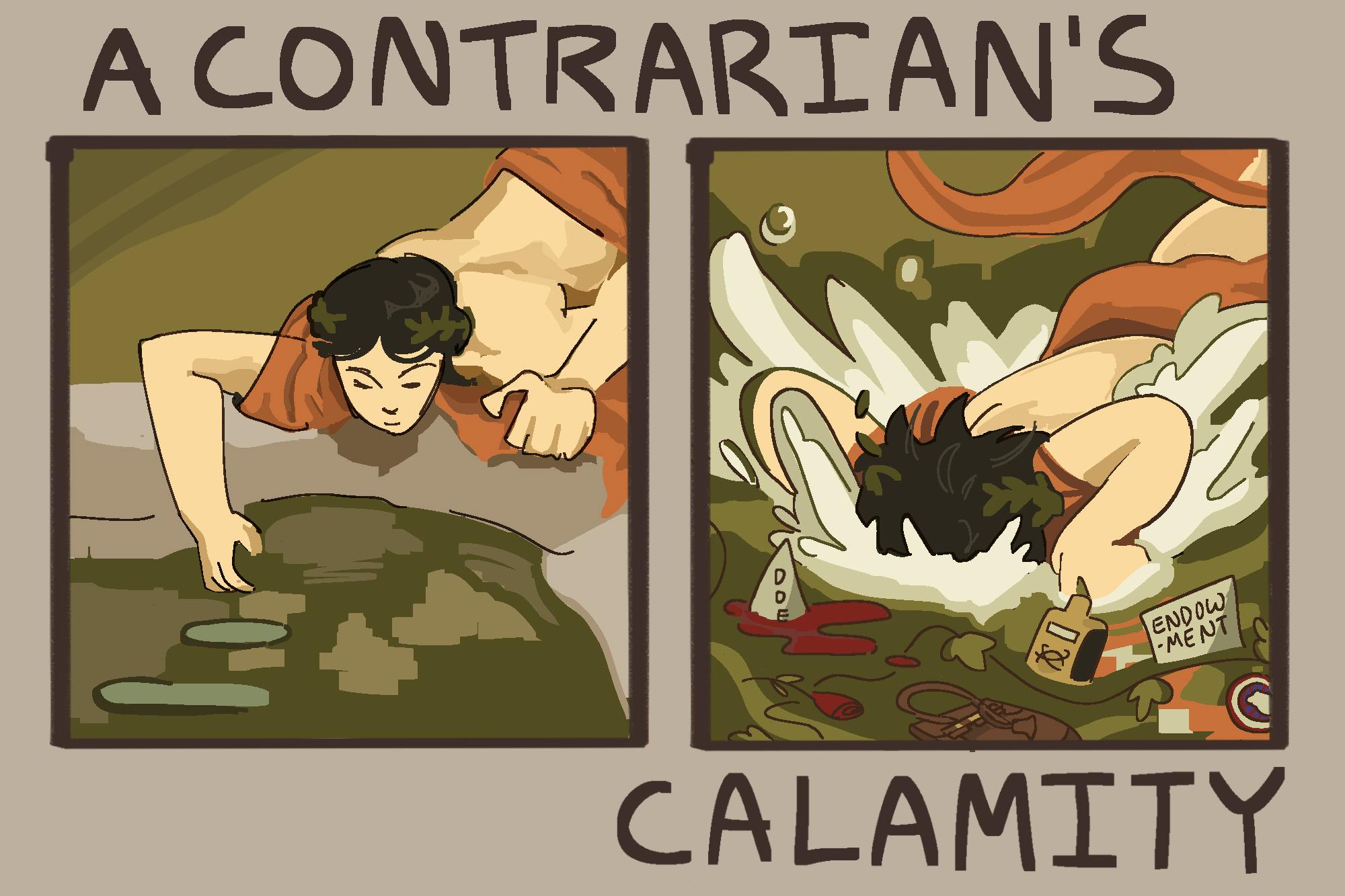
Francis Xavier Jaso '28 is an Opinion Columnist and a Government and Economics student in the College of Arts & Sciences. His fortnightly column “A Contrarian’s Calamity” defies normative, dysfunctional campus discourse in the name of reason, hedonism, and most notably, satire. He can be reached at fjaso@cornellsun.com.