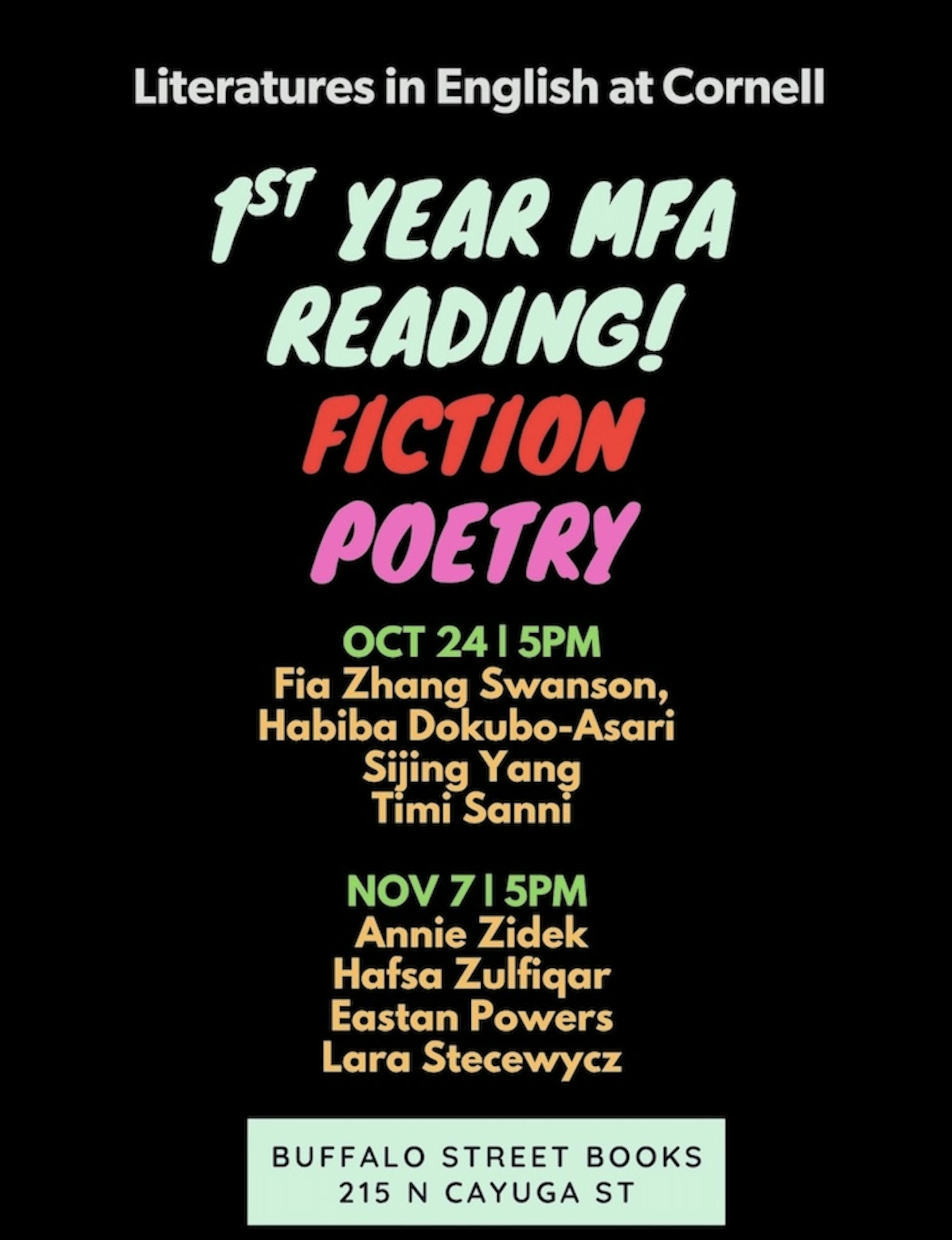
Last Friday evening, in the deepening twilight, I caught a 15-minute bus into Ithaca, looking not for dinner or a drink but for something a bit more elusive to start off the weekend. Disembarking from the bus, I turned away from the heart of the Commons and went around a corner to the independent Buffalo Street Books store. Stepping inside, I turned another small corner and entered the homely room where Buffalo Street Books hosts a variety of events throughout the year. However, this Friday’s event was made particularly special by the night’s featured readers: First-year MFA candidates currently pursuing their degrees at Cornell University.
The candidates in question, Annie Zidek, Hafsa Zulfiqar, Eastan Powers and Lara Stecewycz, each featured their unique works and style to an audience of around 40 people. The readings were performed not standing at a podium but sitting at a small table and using a mic with cables that ran nudged against a wall. After each reading, the writer received their applause and returned to a seat within the audience. This atmosphere created very intimate readings that allowed the writers to showcase their work along with themselves as people.
The first reader of the evening was poet Annie Zidek, an artist with work published and forthcoming in DIAGRAM, The Reservoir and elsewhere. Zidek read a series of despairing poems from her current project — writing her family’s archives. The poems documented a mother’s illness through the vivid sounds of medical machines, and Zidek skillfully used the soulless onomatopoeia of technology to express the longing pleas of the healthy for their loved one’s recovery. In one of many sorrowful moments, Zidek described the sound of a hospital bed as a “mrr mrr,” which, particularly when read around, simultaneously invoked the murmured prayers of the living, the whispers of the weakened sick and the mutterings of the visiting dead. When she finished, Zildek left lingering the fading sounds of death.
Following Zidek’s moving performance was fellow poet Hafsa Zulfiqar, who has already been featured in a multitude of publications and is currently a poetry editor for Muzzle Magazine. Zulfiqar prefaced her reading by explaining her reputation as a writer of structured verse. This structure, along with dialogue and frequent repetition, lent Zulfiqar’s reading a deeper and more haunted feel than Zidek’s despite also capturing themes of deterioration to illness. The smoothly flowing lines of this haunting exploration enveloped the audience and became especially visceral when Zulfiqar described in tandem the loss of such smooth language to age, sickness and cultural fading. In the space of her poetry, Zulfiqar allowed the voiceless not just to be heard but gave them speech with intricacy and eloquence.
The third reader, Eastan Powers, provided a much needed break from profound but weighty poetry with their quirky creative fiction. Being introduced as an undergraduate Biology major and a writer of brain-scattering fiction established Powers as a very different writer right from the get-go. Powers’ reading was a short piece of fiction that can be compared to the works of Swedish author Fredrick Backman on a psychedelic trip. In their piece, Powers exhibited the incredible awareness for comedic yet thought-provoking everyday events that made Backman a success in novels like A Man Called Ove. Powers actually pushed this idea further by using distinctly modern phrases like “not in this economy,” “get a load of this” and “facts” to further humanize their characters and ground the audience in the extreme, almost-fantastical strangeness of their plot. Though truly bizarre, Powers’ work was a delightfully engaging experience.
The final reader of the evening, Lara Stecewycz, wrapped up the event with a return to poetry. Stecewycz is a Ukrainian-American poet who, among many other accomplishments, has translated poems and essays for Crimean Fig / Qırım İnciri, the first anthology of contemporary fiction and poetry by Crimean Tatar writers to be published in English translation. Stecewycz’s reading was a series of poems exploring the responsibility and failures of money, age, motherhood and fatherhood through the innocence of a child. In these poems, lists of seemingly unrelated household images create nests of metaphor like a child might notice the parallels interweaving pieces of the world. But, even as these comparisons invoke innocence, their aptness foreshadows the loss of such innocence to reality. Stecewycz provided a very contemplative conclusion to the readings.
Unfortunately, it was impossible to appreciate every facet of these four rising writers' work within the 15 minutes they each were given to read. But beyond the pieces, what struck me was the MFA candidates themselves: masters-in-training, if you will. These are experienced, published, decorated writers who, by certification, have yet to achieve mastery in their field. Yet, at this event, these writers took the chance to share their partial projects with a live audience precisely to showcase this progressing mastery.
When thinking of art, the image that normally comes to mind is the polished, or at least published, piece for sale or on exhibit. But readings, which present even fully finished work in fragments, publicly embody an often elusive view of art — that of the incomplete work and the unrealized artist. In doing these readings, Zidek, Zulfiqar, Powers and Stecewycz establish their place within Cornell English Department’s larger Zalaznick Reading Series and along the continuum of developing artistry. With the Zalaznick Reading Series’ next event on Nov. 13 and only a few more to follow, I highly recommend attending to experience in-person art mastered in its elusive incompleteness.
Wyatt Tamamoto is a freshman in the College of Arts and Sciences. He can be reached at wkt22@cornell.edu.