


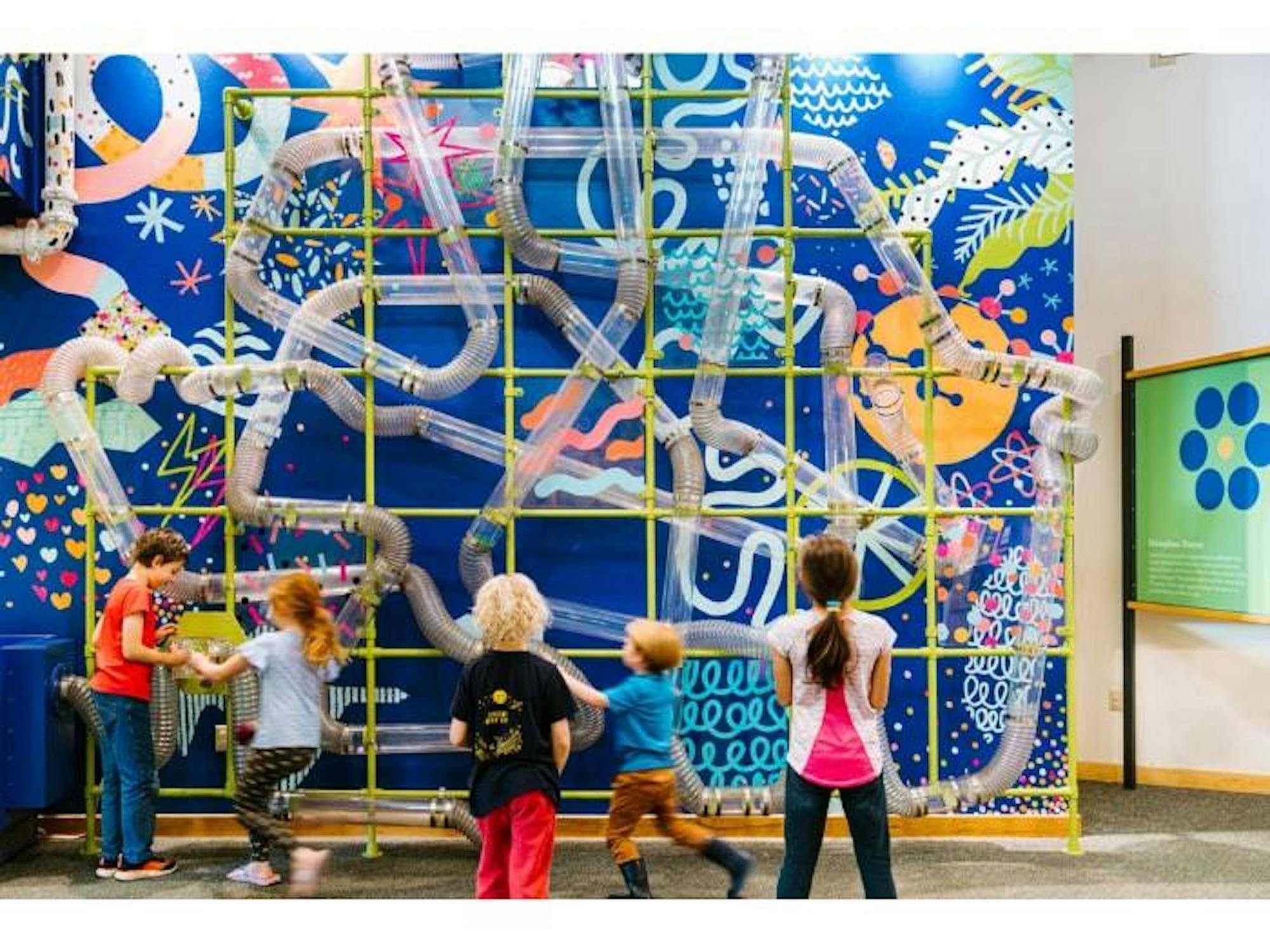
Students of PSYCH 4500 are turning psychology and cognitive science into fun, interactive exhibits for young children at the Sciencenter, a hands-on science museum in downtown Ithaca.
The course, created by Prof. Michael Goldstein and Prof. Khena Swallow in 2016, introduces students to science communication in the context of psychological sciences — not through public talks or articles, but through museum exhibits designed for children.
Although psychology and cognitive science may not be featured in science museums often, there is a strong public interest in understanding how we think, act and develop. Funded by the Einhorn Center for Community Engagement, PSYCH 4500 seeks to address this gap.
The course begins with students reading academic literature about science communication and the role of museums in society. Students then form small teams to design exhibits for display at the Sciencenter.
One team creates a “shape factory” to teach the concept of geons: basic shapes that serve as building blocks of objects in the world. At the exhibit, children use these shapes to build ducks, and the factory produces three-dimensional rubber ducks based on their creations.
Prof. Goldstein explained that interactivity is key when designing exhibits for children.
“This is called informal learning, as opposed to formal learning that you might do in a classroom,” he said. “We’re just trying to spark curiosity.”
Each exhibit undergoes three rounds of prototyping, with students revising their designs after each round. Exhibits have specific learning goals for different age groups, and during prototyping, students observe how children interact with the exhibits and whether the learning goals are met.
In an exhibit designed to visualize emotions, children first choose colors and sounds that match how they feel. Then, they make emoji-like faces to represent their feelings. In their second prototype, the team added an “emotion box” where children can toss in the faces they make. The playful feature was popular among young visitors.
“One thing I really took away from this course is how important it is to talk about psychology in a way that’s fun,” said Melissa Zavala ’26, one of the team members.
Students have also learned from different guest speakers such as museum evaluators, exhibit developers and science communication experts. They will even participate in improv activities with a Performing and Media Arts professor to better engage with children.
“There’s a lot of diverse skills you’ll learn in this course,” Prof. Swallow said. The course is open to both graduate and undergraduate students and has no prerequisites. Students come from a variety of majors, including psychology, human development, economics and design + environmental analysis.
“There aren’t many classes at Cornell where you can be so creative and collaborate with all different kinds of people to make something hands-on,” said Claire Wu ’27.
Prof. Goldstein and Prof. Swallow presented about the course at the Association for Science and Technology Centers in 2023.
“The room was packed,” Prof. Goldstein said. “Everyone gets excited when they hear about what we’re doing because they want to know how to do this, but they’ve never seen it.”
Prof. Goldstein explained that psychology as a scientific discipline is relatively young, and public perception of it often lags behind other sciences. Additionally, psychological processes are internal and less tangible, making them challenging to present in a museum setting.
Going forward, Prof. Goldstein and Prof. Swallow hope to professionally develop students’ designs. They have kept detailed user guides from every exhibit the course has ever done. Even years later, the exhibits can be rebuilt with instructions on how to build and facilitate them for learning goals.
Amid major federal cuts to the National Science Foundation’s STEM-learning programs, the professors are exploring support from small private foundations. With sufficient funding, the course could evolve into the nation’s first traveling exhibition on psychological and brain science designed for children.
“I have toured museums all over the country and in Europe,” Prof. Goldstein said. “There’s nothing like this in the world.”


