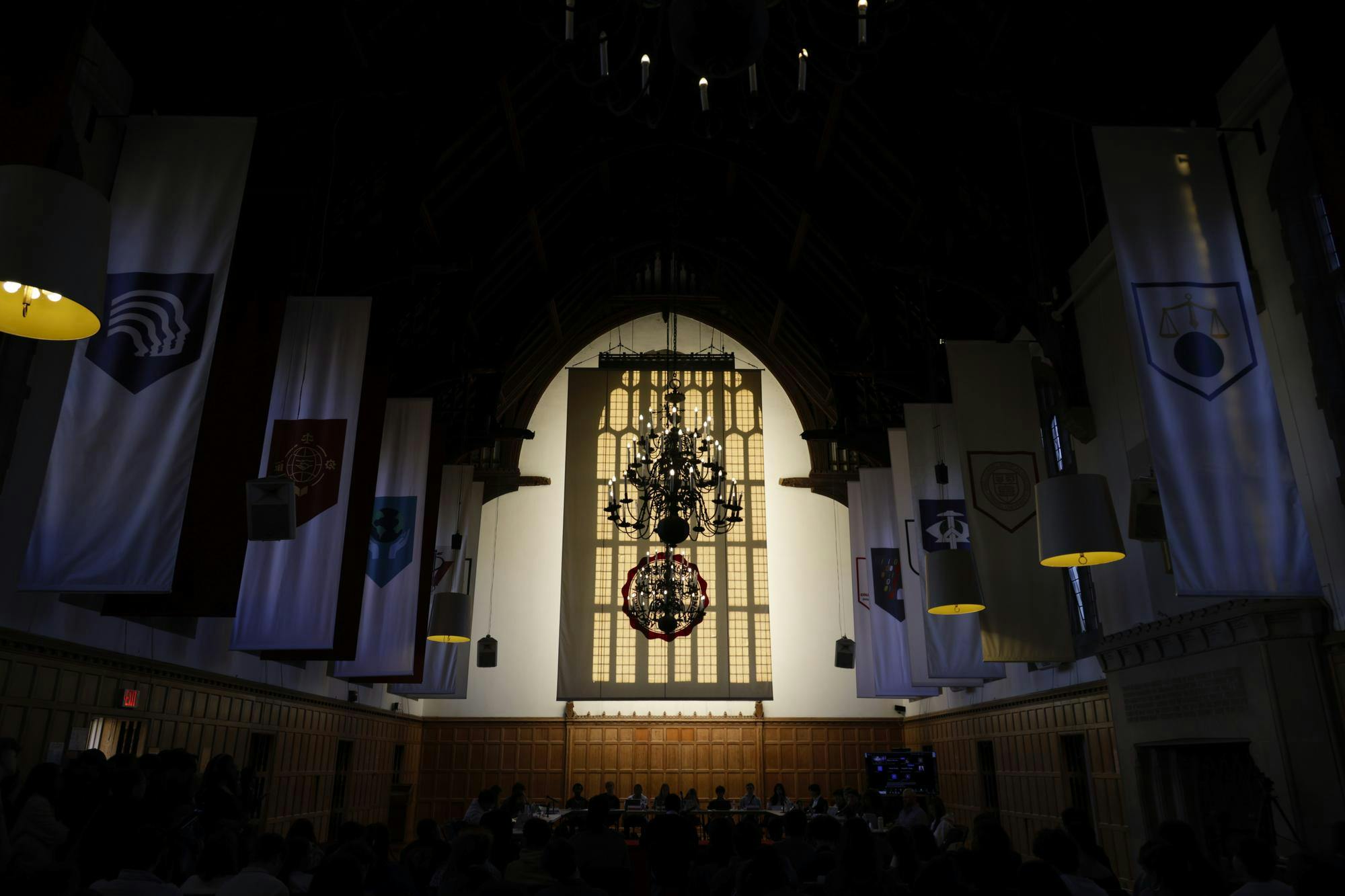
The Student Assembly voted to hold a referendum to poll students about Cornell’s disciplinary process, including upper-level administration’s involvement with judicial processes and the University’s 2021 decision to replace a campus-wide code of conduct with the Student Code of Conduct. The referendum was introduced by several community members at Thursday’s meeting, and nearly 100 community members voted strongly in favor in an initial community poll conducted during the meeting.
The Assembly also rejected the finance committee’s recommended funding cut to the Gender Justice Advocacy Coalition and approved its recommendation for Cornell Minds Matter’s funding.
Funding Recommendations
The Assembly voted to reject the finance committee’s recommendation to reduce GJAC’s funding by 39 percent. A new recommendation for funding will now be drafted and discussed with GJAC, with Nov. 16 as a tentative date, according to Assembly Vice President of Finance Hayden Watkins ’28.
The decision to reject the recommended 39 percent cut came after students packed the Oct. 30 Assembly meeting and criticized proposed funding cuts for over an hour of public comment.
Also at the meeting, the finance committee's recommendation to increase CMM’s funding by 100 percent — from 50 cents to $1.00 per student — was approved. CMM appealed this recommendation, requesting a 240 percent increase in funding, equivalent to $1.70 per student, but their appeal was ultimately rejected after a brief executive session.
The finance committee’s recommendations for all other organizations on the agenda were pushed to next Thursday’s meeting after several voting members had to leave at 7 p.m., leaving the Assembly with too few members to continue the meeting.
Referendum on Cornell’s Disciplinary Process
The Assembly introduced a referendum regarding concerns with Cornell’s disciplinary process. The call for a referendum comes after a formal review of the Student Code of Conduct was initiated in August by Vice President of Student and Campus Life Ryan Lombardi, sparking dissent on campus surrounding the judicial processes of the University and the revision process itself.
Referendums consist of two questions polled to the student body via email. The Assembly can introduce referendums to “determine community opinion regarding matters of student concern” twice a year if at least three percent of the registered undergraduate student body calls for it, according to the Assembly’s charter. If a majority of participants vote in favor of the submitter(s), then the Student Assembly will communicate the results to the Office of the President, who has 30 days to respond accordingly.
The charter tells students to anticipate collecting at least 450 signatures. The referendum's submittees obtained around 540 student signatures.
The referendum has two questions, the first of which reads, “Prior to 2021, conduct was overseen by the Judicial Administrator, an office independent of Cornell University’s central administration. It is now overseen by the Office of Student Conduct and Community Standards (OSCCS). Should Cornell’s judicial system be independent of the University’s administration?”
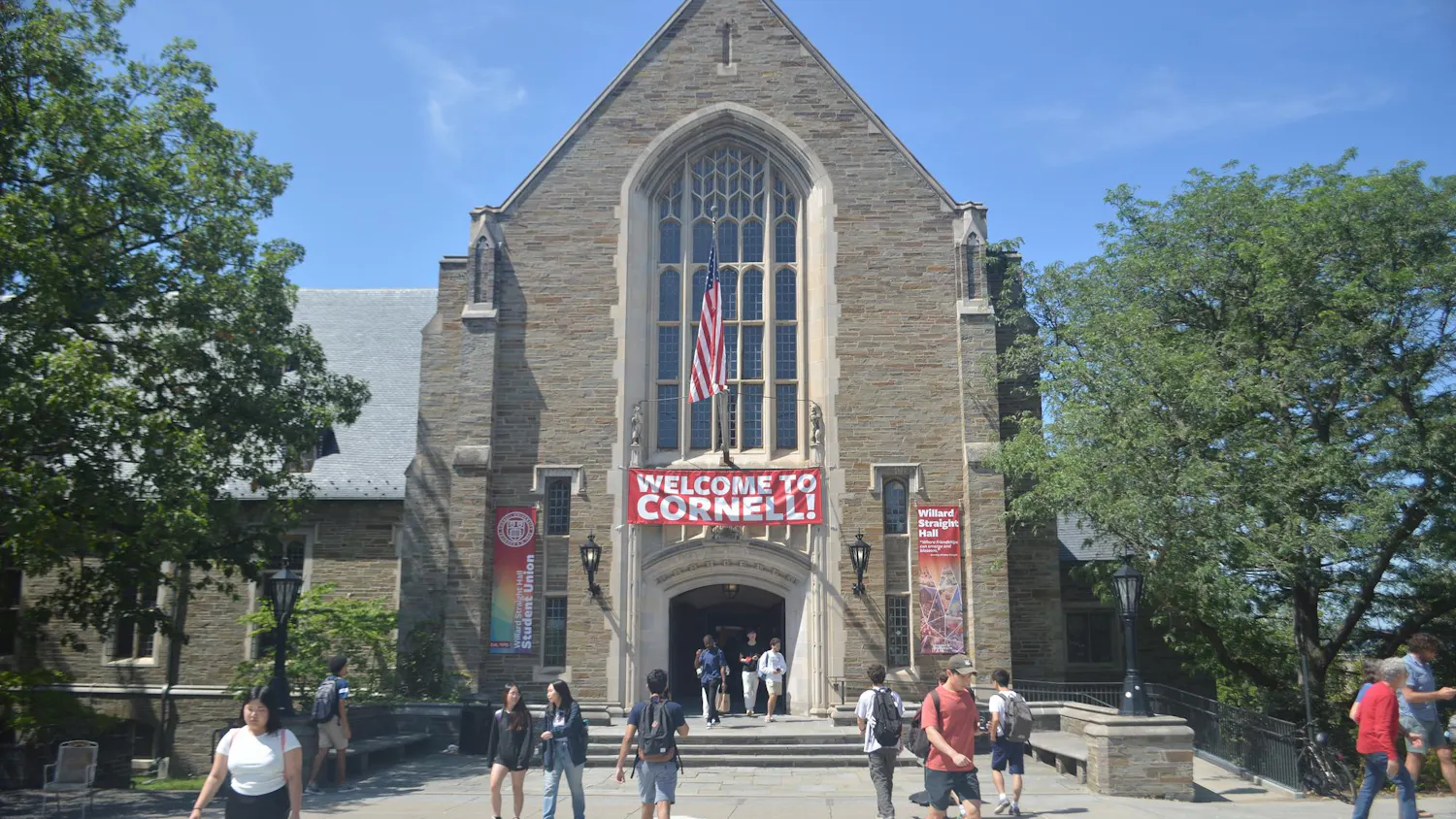
The second question reads, “As a result of the 1969 Willard Straight Hall Takeover, the conduct of students, faculty, and staff was collectively governed under the Campus Code of Conduct. In 2021, the Student Code of Conduct replaced the Campus Code. Should Cornell University return to a community-wide Campus Code of Conduct?”
Since the announcement of the Code of Conduct revision process, campus groups, students and shared governance bodies have been discussing concerns and questions regarding Cornell’s disciplinary process. The review process of the Student Code of Conduct itself faced criticism on numerous points, including that members of the Codes and Procedures Revision Committee were appointed, not elected, and the lack of shared governance involvement in the process.
The University Assembly, which was previously in charge of reviewing the Code, questioned the lack of U.A. representation on this committee and alleged a “lack of transparency” at their Aug. 26 meeting.
On Oct. 9, the Assembly passed Resolution 10: “Addressing the Administration’s Undemocratic Review of the Student Code of Conduct and Affirming Cornell’s System of Shared Governance” in a 21-1-2 vote. Resolution 10 “condemns the exclusion of the elected Assemblies in [the University’s] revision of the Student Code of Conduct,” and calls for the Code to be revised by members of the elected Assemblies.
Lombardi responded to concerns during the Oct. 9 meeting and assured the crowd that he “always support[s] student interests on campus.”
Now, the referendum will serve to better illuminate the opinion of the Cornell community at large regarding these changes.
The last time the Assembly introduced a referendum was in Spring 2024. The referendum polled student opinion on divestment from weapons manufacturers involved in the Israel-Gaza conflict, and whether Cornell should call for a ceasefire. The majority of student voters chose “yes” to the questions by a 2:1 ratio, while only 46.77 percent of the Cornell undergraduate student body voted.
Ultimately, former President Martha Pollack rejected the spring 2024 referendum, stating that it was not the place for a university to “make a statement about this complex political issue,” especially with a diversity of opinion among the student community.
In a vote by community members present during the meeting, the opinion was overwhelmingly in favor of the referendum, which consists of two questions. Non-Assembly members in attendance voted 91-4 in favor of the first question and 93-2 in favor of the second during the meeting.
Assembly members then voted 28-0-1 in favor of the referendum. The community vote was tallied as two votes in favor of the referendum on the Assembly vote.
Following this, Assembly President Zora deRham ’27 announced that the referendum will soon be formally presented to the public.
She explained that students are permitted to submit pro or con statements for the first seven days after the referendum is presented, after which a three-day promotional period will follow before the 36-hour voting period commences. Results will be announced within one business day of voting closing.
Admir Cekic ’26, first-generation college students representative, stressed the importance of a high voter turnout and pointed to problems with the current Code.
“If you actually read the Student Code of Conduct procedures, you’re not allowed to call your own witnesses. You’re not allowed to ask your witnesses questions,” Cekic said. “It’s a kangaroo court. Student Code of Conduct procedures are the antithesis of everything that Cornell stands for, shared governance stands for, democracy, America. I mean, it’s really a horrible current system.”
Correction, Nov. 7, 5:30 p.m.: This article has been corrected to note that the referendum focuses more widely on Cornell’s disciplinary processes, not solely the Student Code of Conduct, and that it was introduced by student submitters, not the Student Assembly.
Kate Turk is a member of the Class of 2027 in the College of Arts and Sciences. She is the assistant managing editor of the 144th board and was an assistant news editor for the 143rd Editorial Board. She can be reached at kturk@cornellsun.com.