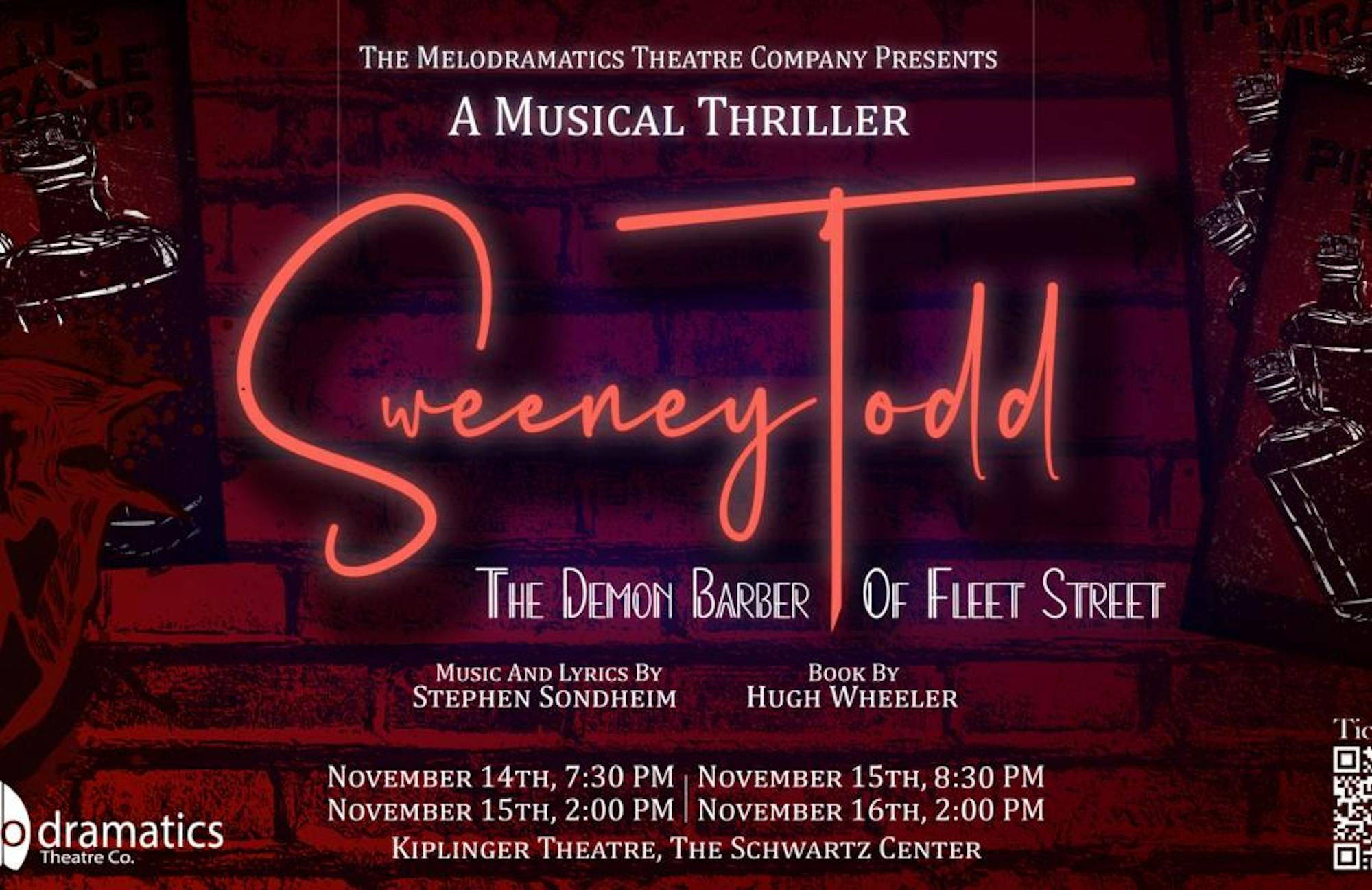
Cornell’s Melodramatics Theater Company put on Sweeney Todd: The Demon Barber of Fleet Street for their semesterly production this past weekend. The musical originally premiered on Broadway in 1979, with a book written by Hugh Wheeler and music composed by Stephen Sondheim. It has most recently been in the wider musical theater consciousness due to a 2024 Broadway revival starring Josh Groban and Annaleigh Ashford.
The musical follows the barber Sweeney Todd’s return to his old shop on Fleet Street, which you may have gathered from the title. Long ago, the malevolent Judge Turpin framed Sweeney for a crime in order to violate Sweeney’s wife. Sweeney’s real moniker was Benjamin Barker, only assuming the name Sweeney to inconspicuously return to London after escaping from prison. All that remains of his old life is his former landlady, the eccentric Ms. Lovett, who recognizes him as her old tenant. His wife has died, and his now-grown child, Joanna, is Judge Turpin’s ward.
Sweeney sets up his barbershop above Ms. Lovett’s pie store once again. His mission is to exact revenge upon Turpin and to reunite with his daughter. After he impulsively kills a fellow barber who threatens to reveal his true identity, Sweeney and Ms. Lovett naturally collaborate to kill customers at the barbershop and cook them in her meatpies.
The book for Sweeney Todd is a bit tonally puzzling. Still, the show has endured through the decades partly due to Sondheim’s composition, with earworms like “Not While I’m Around” and “Pretty Women,” and also through the ample emotional material within the script.
The director, Ithaca College student Avery Wrobel, writes in the playbill that “every character in this story is a product of their environment, each coping with injustice and suffering in their own way.” At many junctures, characters of Sweeney read as creepy, selfish, rash and ultimately, entirely unsympathetic. Even with that being true, Wrobel’s interpretation is not excluded.
Such a perspective is underscored through the song, “Johanna (Mea Culpa),” sung by Judge Turpin (played by Brayden Handwerger). Judge Turpin is the irredeemable villain of Sweeney Todd, yet in this number, he lusts for Johanna, whom he has raised as if she were his own daughter. While the audience may never identify with Judge Turpin, they will sympathize as he violently chastises himself, yelling “God! Deliver me!” over and over again. Even as this unforgivable villain makes the deplorable decision to pursue his ward, we come to better understand him as a “product of [his] environment,” to quote Ms. Wrobel.
I found it to be the most poignant scene of the production, with focused staging and a performance from Handwerger that was more acting-focused than singing-focused, which is not to insult the singing, but to say that sometimes musical theater can lose the theater for the music, which was not the case here. I will finally add that the actor had a remarkably intimidating authoritative-adult voice, which is very rarely seen in young performers.
The comedic highlight of the production was the role of Adolfo Pirelli (played by Ethan Washington), Sweeney’s first kill. The first time I ever saw Sweeney Todd, this role was not memorable to me, but that was not the case in this production. Washington’s accent work was incredibly strong, and he made each outlandish Italian choice as if it were the first time.
I appreciated that the set design was very restrained, essentially just consisting of the dual layers necessary to separate the barbershop and the pie shop, with very little other noticeable detail from the audience. This allowed the attention to focus on what is truly remarkable about the show, particularly the music and the emotional twists. Moments of spectacle were not overdone, so when they were employed, they were particularly effective, such as the glimmer of Sweeney’s single-blade razor in the spotlight or the increasingly gory blood spurts.
From their playbill notes to their post-show remarks, the creative team of this show sought to underscore the importance of community in the making of this production. The performances the Melodramatics staged this past weekend are just a small glimpse of the value that they derived from their creative process. Perhaps what community was reflected in that glimpse was a chorus that was fully committed to their choices and their roles through the entire two-hour-and-45-minute run, which is no easy feat in the ever-unpredictable world of community theater.
Chloe Asack is a senior in the College of Arts and Sciences. She can be reached at casack@cornellsun.com.

Chloe Asack is a member of the Class of 2026 in the College of Arts and Sciences. She is a staff writer for the Arts & Culture department and can be reached at casack@cornellsun.com.