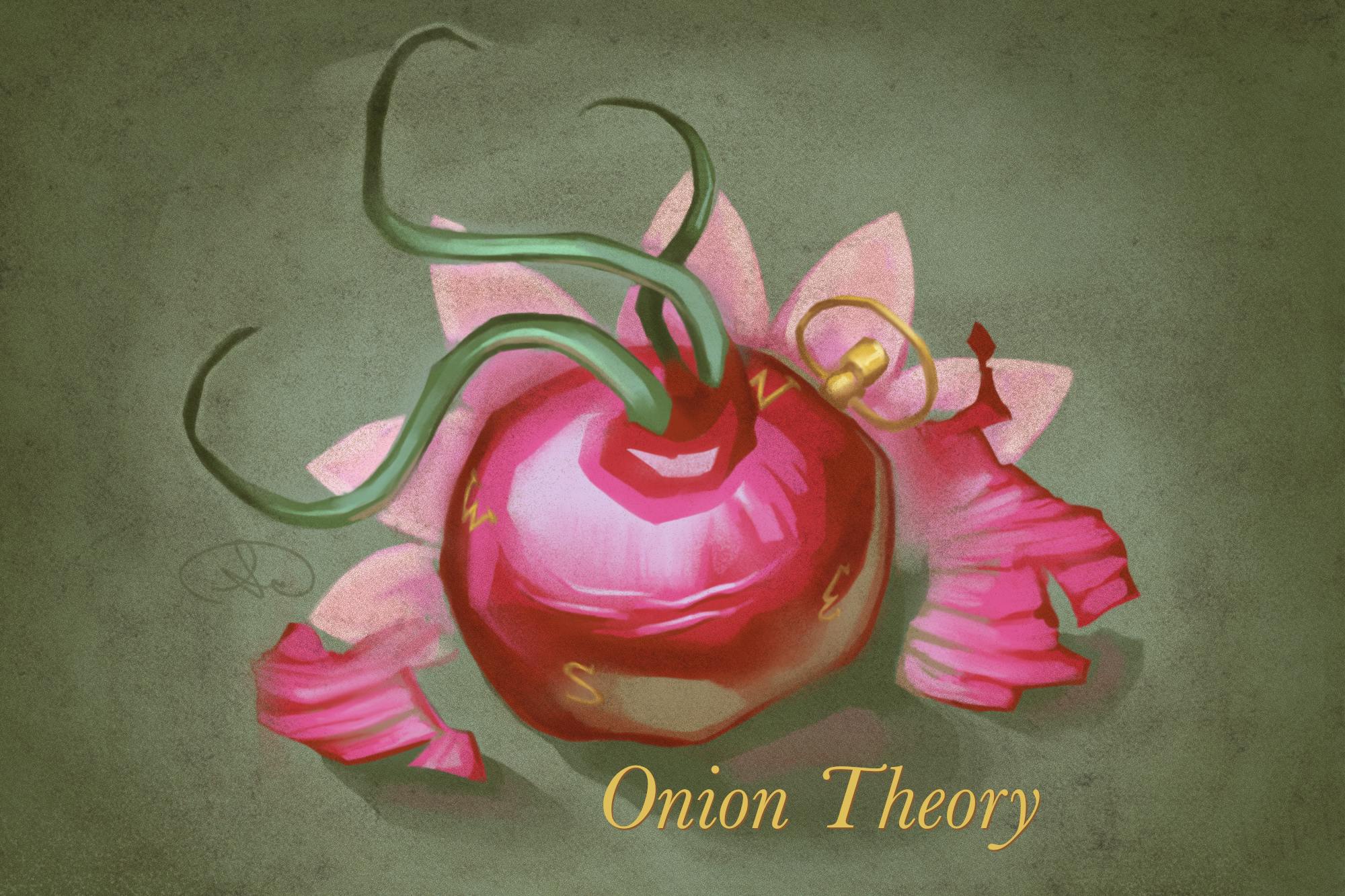
Time is not linear in the astral plane: We all come into the onion at once.
When I received my first diagnosis for prodromal schizophrenia, onion theory was already under development. With no sense of linear concepts, chronology, little awareness of space, shape or rhythm, I needed a more simplistic model of my surroundings.
After a lifetime struggling with baseline logic, deconstructing my synesthesia case, I created minimal expectations for my personal performance and outlooks. I would see the Earth as an onion body: the entire cliche purpose of existence connecting with souls on your onion layer.
That was my thought at 18, the incontestable verdict about my symptoms, turbulent youth and reckoning. I decided with conviction in one unitary goal: reject any materialistic aspirations for sole devotion to forging connections. Back then, the onion was very subjective — an interpretable ground for mentally degenerative years ahead, always victim to change.
As other psychologists confirmed my condition into undergrad, I began the fervent obsession with Mahayana Buddhist scripture, attaching ideals to the expanding theory of onions. Rinpoches, monks, the spectrum of western then eastern voices all promised that one can train the mind out of suffering. Meditation offered authority over perceptual distortions, while bodhichitta ideologies centered in openness allowed the continual influx of relations.
Onion derives its origins from the Latin word “unity,” and the layers aren’t hierarchical but randomized, transcendible, with no qualitative correlation to the core or the peel. Placement is irrelevant: I understood this but wasn’t able to align with it until I arrived at the Monastery.
The intersection of synesthesia and buddhist doctrine, involuntary hallucination and exercises in control, resurrected my psyche. Confronting unreality with the faith has afforded me perspective outside career competition and capitalist standards. My understandings are limited to my privilege, subliminal engagement with academia, and 21 years bearing witness to mortal suffering.
But in such systems that proliferate hierarchical patterns, refusing to accommodate psychopathology, I’m convinced the global state is overcomplicated. To reduce our outlooks to the simplicity of onions is to lift a modern burden off the collective human shoulder.
A simple outlook offers relief. Relief becomes expression and proliferates art, which is dying in the youthful eye. Recognizing the inherent faults in surroundings inspires creation, so the protester moves against the incoming wave of cyborgs. The creative process becomes more and more discouraged as the demand for conformist corporate servants continues.
The four pillars of onion theory are navigating neurodivergence, continuing spiritual conquest, returning to a sustainable nature and fostering space for expression. I’m expected to lose stability as an unmedicated schizophrenic, but I’ve been grounded in these pursuits through all fortuitous years of undergrad. Amidst the horror, the ecstasy, the unrelenting catharsis of the college experience, the theory constantly propagates new branches.
I’m practicing how to manipulate my synesthetic abilities: color, pitch and degree of light into verbal martyrs on the page. I commit small acts of undoing systematic suffering daily, and in that I’ve found immeasurable peace. There is the poor artistry of an allegedly degenerative mind — I’m looking to use it for the betterment of my kin on the onion. The layers shift undiscovered: Here I enlist some compass for discovery.
The Sun is interested in publishing a broad and diverse set of content from the Cornell and greater Ithaca community. We want to hear what you have to say about this topic or any of our pieces. Here are some guidelines on how to submit. And here’s our email: opinion-editor@cornellsun.com.
Kira Walter '26 is an opinion columnist and former lifestyle editor. Her column Onion Theory addresses unsustainable aspects of modern systems from a Western Buddhist perspective, with an emphasis on neurodivergent narratives and spiritual reckonings. She can be reached at kwalter@cornellsun.com.