

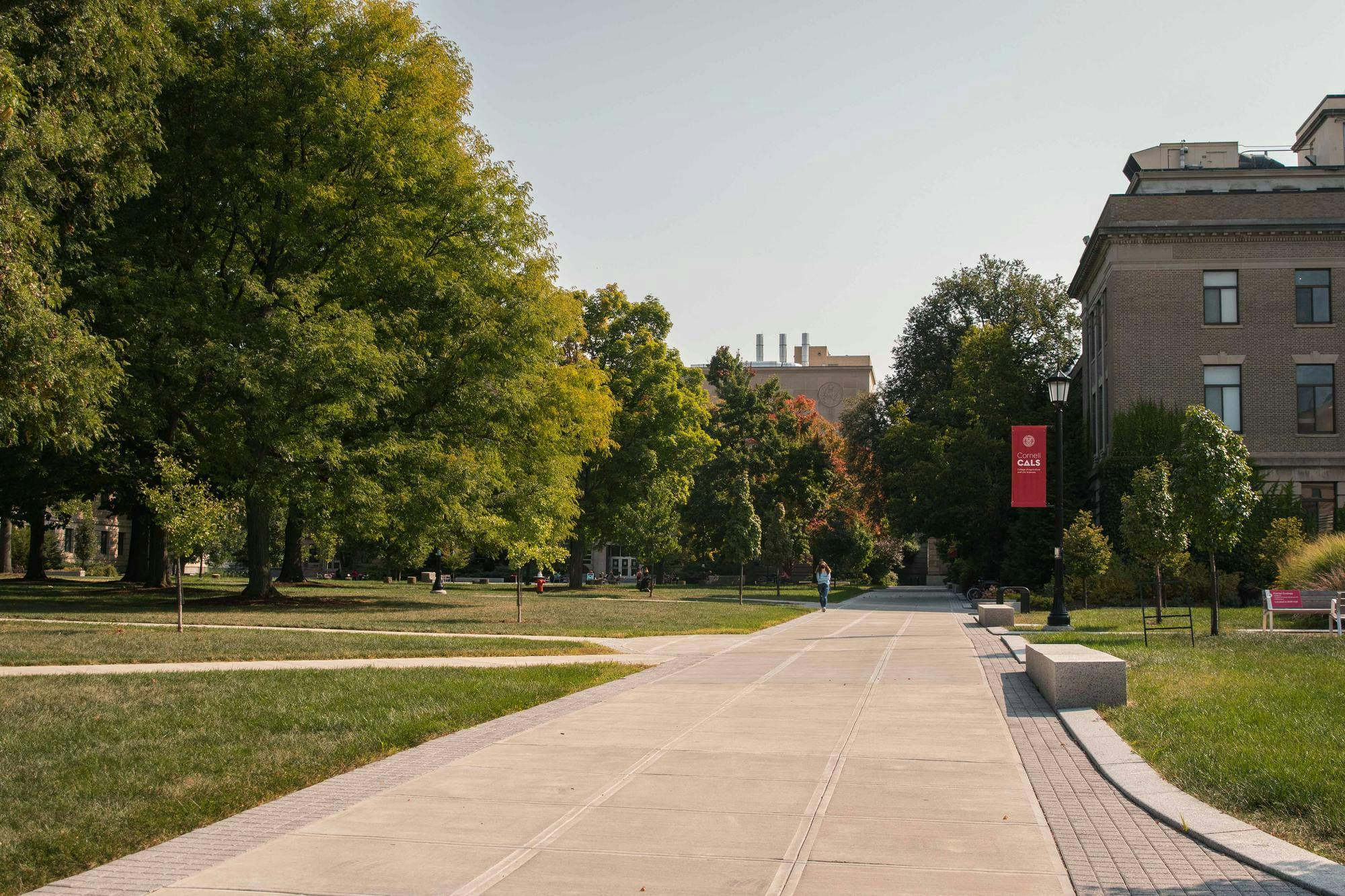
Cornell’s $60 million settlement with the Trump administration includes a unique financial provision 一 a $30 million investment in agricultural research, to occur in installments over the next three years.
However, it is not yet clear how exactly funds will be distributed.
The settlement, which was reached on Nov. 7 after months of negotiations following the Trump administration’s decision to freeze $250 million in federal research grants and contracts from April 2025, also requires the University to pay $30 million to the federal government over the next three years. In return, the administration agreed to drop the Civil Rights complaints and investigations they had raised against the University and will restore the halted funding.
The settlement states that the agricultural investment should be directed towards “research programs that will directly benefit U.S. farmers through lower costs of production and enhanced efficiency, including but not limited to programs that incorporate AI and robotics, such as Digital Agriculture and Future Farming Technologies.”
This provision for a specified research investment is unique from the four earlier settlements between elite U.S. universities and the Trump administration. Columbia will pay $200 million to the Trump administration and $21 million to Columbia employees who experienced antisemitism, while Brown will invest $50 million in Rhode Island workforce development. The University of Pennsylvania and the University of Virginia are not required to make payments under the terms of their settlements.
The agricultural investment was “Cornell’s choice” and “Cornell alone will decide how and where to direct this $30 million agricultural research expenditure,” according to a Federal Agreement Frequently Asked Questions page created by Cornell.
When asked about the purpose of the agricultural research investment and the University's plans for allocating the funds, a Cornell spokesperson referred back to the settlement FAQ page, stating that it “includes all the information we have to share at this time.”
Currently, the University is developing “a program within the Office of the Vice Provost for Research (OVPR) to administer the disbursement of this funding. More information will be disseminated by the OVPR later in the year,” the Federal Agreement FAQ page states.
While it is still unknown as to which programs will be funded by the investment, there are several programs and institutes at Cornell that are involved with research that connects agriculture and technology.
Cornell Institute for Digital Agriculture
The Cornell Institute for Digital Agriculture was founded in 2017 and grew out of four Cornell colleges: the College of Agriculture and Life Sciences, the Bowers College of Computing and Information Science, the College of Engineering and the College of Veterinary Medicine.
Prof. Renata Ivanek, veterinary medicine, is a co-director of CIDA, collaborator in the Cornell Agricultural Systems Testbed and Demonstration Site for the Farm of the Future and the primary investigator for the Artificial Intelligence for Agriculture program.
“[CIDA] provides the ecosystem for many people … from around the university that are coming together around the idea to produce food in a smart way, in a way that doesn't damage ecosystems, to provide abundant [and] safe food [and] in using technology to do so,” Ivanek said.
In addition to establishing a community for digital agriculture research, CIDA also provides seed grants for faculty and students involved in digital agriculture research and hosts workshops related to the field.
Cornell Agricultural Systems Testbed and Demonstration Site for the Farm of the Future
The Cornell Agricultural Systems Testbed and Demonstration Site for the Farm of the Future provides test beds and demonstration sites to allow for agricultural research. Since 2021, the program has been funded through a grant provided by the United States Department of Agriculture’s National Institute of Food and Agriculture, according to USDA NIFA.
“New technologies like [AI], for them to work in real commercial environments, have to be tested, and there is a lot of trial and error in those kinds of situations,” Ivanek said. “[CAST’s] test beds provide an opportunity for those things to be tested in a safe environment. … It's like a living lab.”
A recent extension of CAST that is currently under development is the Artificial Intelligence for Agriculture Testbed, which is being developed between August 2025 and July 2026. AI4Ag is sponsored by the National Science Foundation.
Prof. Julio Giordano, animal science, is the director of the Dairy Cattle Biology and Management Laboratory, director of the CAST and Demonstration Site for the Farm of the Future and co-director of CIDA
“Through monitoring and management, [AI] is going to enable farmers to make better decisions, to be more profitable, to implement environmentally friendly practices and better practices to improve the lives of the animals and the people that work on farms,” Giordano said.
Giordano hopes that there is more investment in “critical infrastructure and on personnel as well as research.”
“I think that one of the key enablers of impactful research in this field is having the right infrastructure and right people,” Giordano said. “I'm hopeful that Cornell invests in those two areas.”
Prof. Parminder Basran, veterinary medicine, is a member of the Executive Committee at CIDA. Basran’s team is a recipient of a seed grant provided by CIDA for research in the dairy sector regarding the use of digital tools and data to improve efficiency in agriculture.
“There's an incredible opportunity here to leverage this amazing expertise that's here at Cornell University when it comes to digital agriculture,” Basran said. “I think that our university is a real leader in this space globally and it's demonstrated through having organizations like CIDA at the forefront of it, leading this digital revolution in agriculture.”
Coral Platt is a member of the Class of 2029 in the College of Arts and Sciences. She is a news editor for the 144th Editorial Board and can be reached at cplatt@cornellsun.com.


