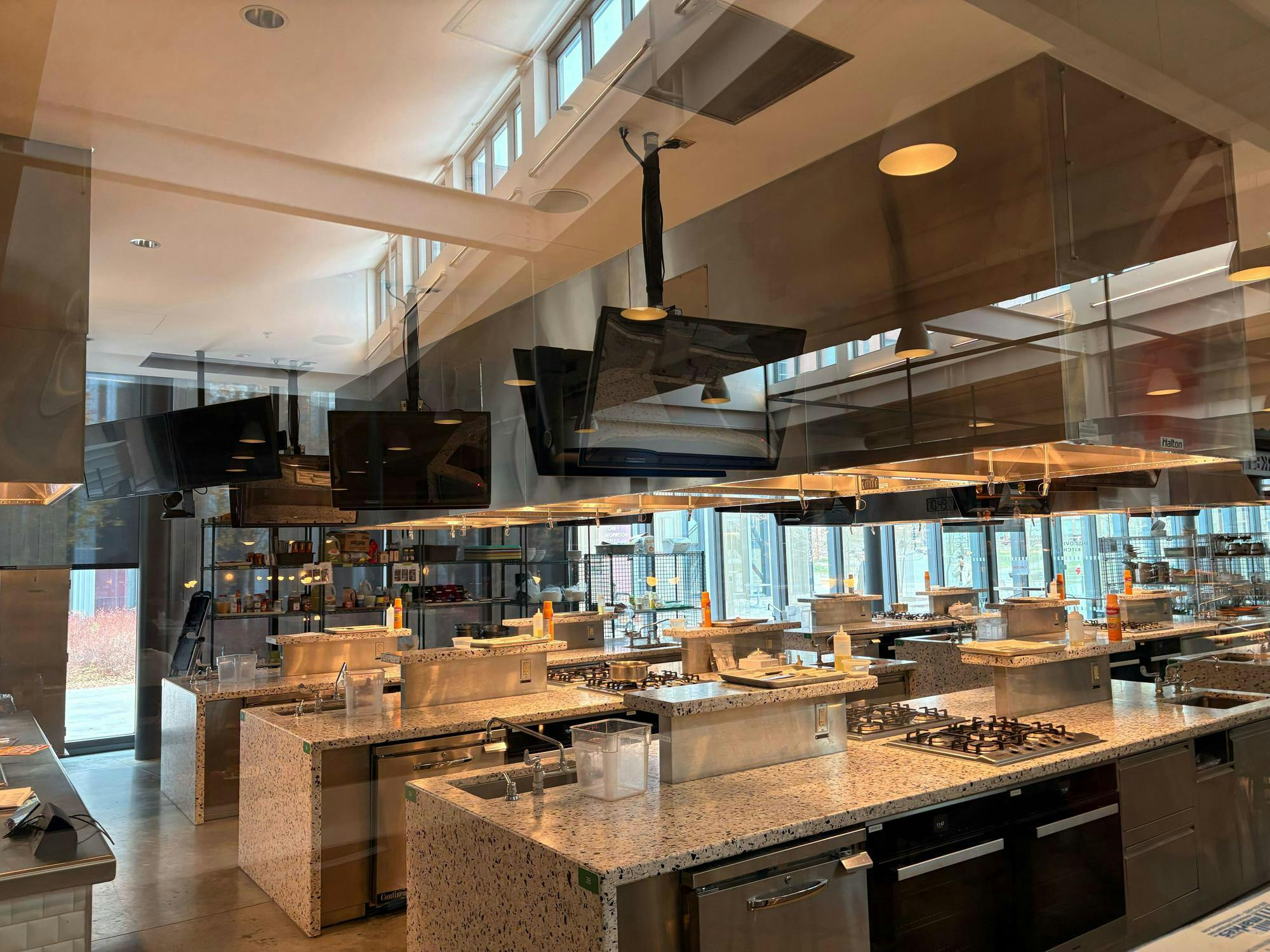
White-coated students and faculty chefs alike work together inside Morrison Dining on North Campus, inside a glass-enclosed kitchen for onlookers to see.
They are a part of the Cornell’s Discovery Kitchen which combines scientific learning with community collaboration in an interactive teaching kitchen used for culinary testing, classes and events.
“It was a great space to put there so people can see the great work that's done across Nutritional Sciences and dining to watch people take classes, to watch people prepare meals and really kind of invigorate the spirit of understanding how food is prepared, and how to cook healthily,” said Dustin Freeley, assistant director Residential Dining and Cornell Dining.
Since its opening in Fall 2021, the Discovery Kitchen has hosted a limited number of events per semester, enabling people to sign-up to learn how to make seasonal items. Some activities that the kitchen has hosted include pumpkin-spice pastries for fall, as well as everyday foods served at the dining halls. These events implore students to understand nutrition alongside learning about how to use different ingredients to make easy, healthy recipes.
“They've [made] individual homemade apple pies … vegan quiche, stir fries scallion pancakes,” Freeley wrote in an email statement to The Sun. “And [the thought] behind those is to be sustainable and healthy eating, you know, just different ways to eat.”
The Discovery Kitchen also cultivates collaboration between other student organizations on campus, like an event with the Iconic Cornell series, where students worked in groups to make pizza pies, similar to those served at Morrison Dining Hall, customizing them with toppings of their choice. Student participant Brandon Chiu ’29 described his experience at the event.
“I think that it was a really good opportunity for a lot of the student body to get to know each other and to get to know the professors as well,” Chiu said. “I did not know that making pizza was that hard. I'm eternally grateful for all that Cornell dining staff has done for me here.”
While events have limited capacity, the Discovery Kitchen also offers semester-long culinary classes in partnership with the College of Human Ecology and College of Agriculture and Life Sciences. Courses such as NS 2470: Food for Contemporary Living explain food science foundations through hands-on-preparation.
Once a week, NS 2470 students attend a three hour class that combines a traditional lecture with a food lab. The students are given quizzes before and after lectures to test their understanding on basic culinary principles, such as how each ingredient operates in a recipe or how to use the kitchen utensils and appliances.
Talia Ghetie ’28, a student who took NS 2470 last spring, emphasized the unconventional format of the class.
“It's not a traditional classroom,” Ghetie said. “[The chef] goes into like the lecture in the beginning, and then they just set you free to cook your recipe.”
The class additionally fosters a collaborative learning experience through post-class debriefs. Teaching assistants collect samples of the students’ culinary creations, discussing the sensory and physical aspects of a dish to show off or critique student work. The course follows a curriculum that teaches students through the established recipes, which Ghetie told The Sun can decrease the creativity that students can put into making the dishes.
Though students are generally expected to follow pre-established recipes, the course also features two large projects that allow them to develop and create their own recipes. The meal planning project requires students to form their own daily eating schedule, taking into account nutritionary factors and incorporating food preferences.
Another project, the cultural variations project, allows students to, as the name sounds, cook three dishes from various cultures. After students pick a theme to follow, they give their own lecture and presentation about food science principles behind the theme.
“My friend and I talked about mango floats from the Philippines, this avocado smoothie from Vietnam and cactus ice from Mexico.” Ghetie said. “So you get to be creative there.”
Beyond these experiences, the Discovery Kitchen also serves another purpose in supporting culinary training. This training includes culinary assessments and programming for students and staff. An example of this is the Get Cooking classes, where students learn basic culinary and nutritional skills.
While the Discovery Kitchen already hosts many different types of activities, the space is constantly evolving.
“We plan to expand programming for trainings, retreats and community events, while possibly offering additional free Get Cooking classes for students," Freeley wrote in an email statement to The Sun. “The goal is to balance its dual role as a classroom and kitchen to support continued growth and serve the needs of our campus community.”

Elizabeth Chow is a member of the Class of 2029 in the Brooks School of Public Policy. She is a contributor for the News department and can be reached at ec977@cornell.edu.