The Paleontological Research Institution may face closure by the end of the year if it cannot pay off a $3 million mortgage, according to PRI Director Prof. Emeritus Warren Allmon, earth and atmospheric sciences. A financial crisis involving the institution’s largest donor has left PRI unable to cover loan payments, leading to an urgent fundraising scramble.
Allmon said that PRI has raised $2.1 million dollars but must secure the remaining money or renegotiate the loan at high cost. The current interest rate stands at 13 percent. Failure to resolve the mortgage could result in the loss of its buildings and the eventual breakup of its fossil collection, one of the largest in the United States.
Founded in 1932, the PRI preserves all the non-botanical fossils and modern mollusk shells that were formerly at Cornell, along with collections acquired from other institutions over the decades. With over seven million specimens, it is home to the largest fossil collections from Antarctica, Venezuela, the Dominican Republic and New York State.
PRI was founded by Cornell Prof. Gilbert Harris, geology, and has maintained a formal partnership with the University since 2004. PRI staff teach and advise students, support student research and contribute to fields such as paleontology, evolutionary biology and science education. The institution’s collection is used by Cornell students and faculty, who regularly volunteer, work and conduct research at PRI.
“We act like a natural history museum for the university,” Allmon said. “We serve the University and so we view ourselves as part of the Cornell community.
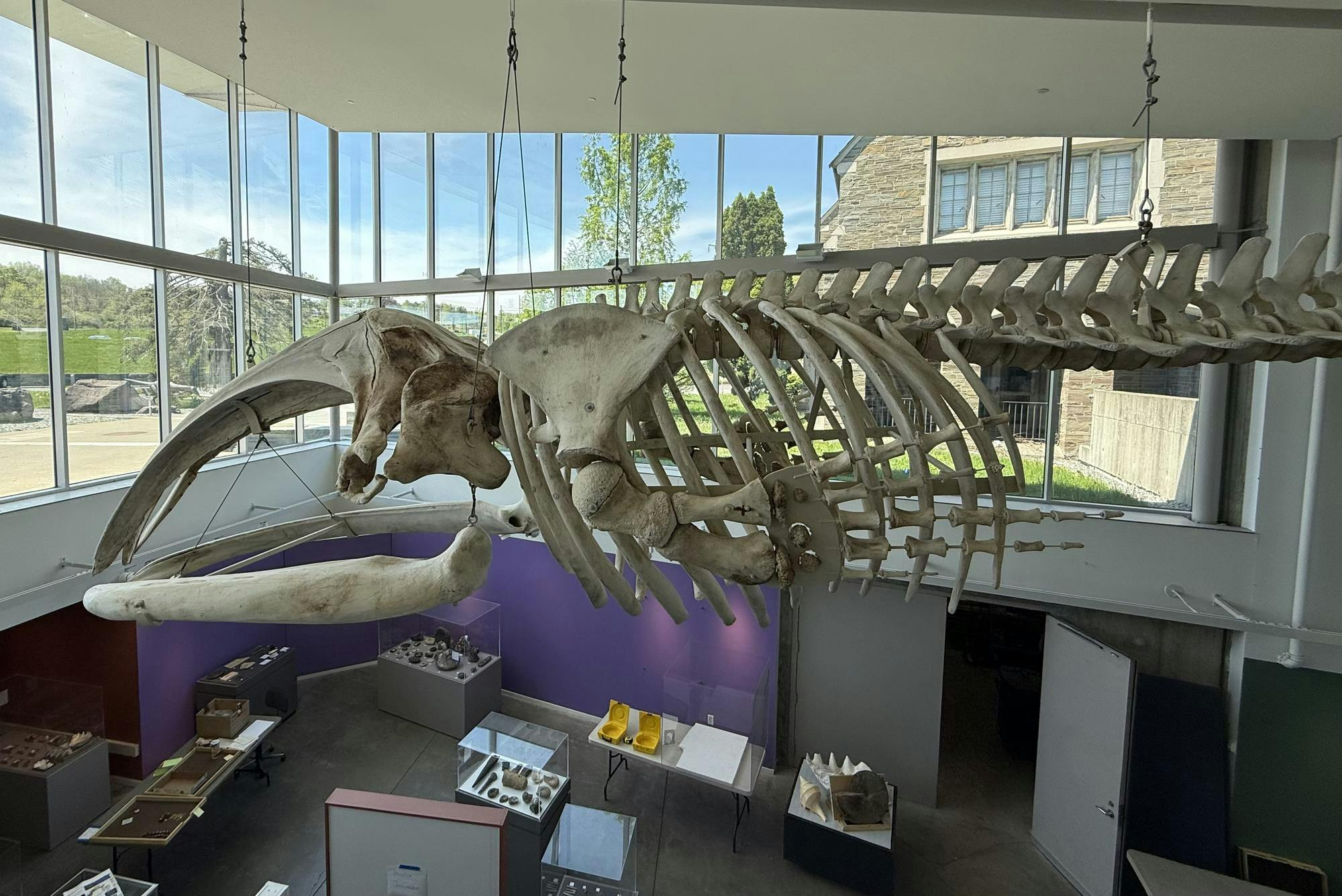
The Museum of the Earth, PRI’s public-facing facility overlooking Cayuga Lake, showcases a small fraction of the institution’s vast fossil holdings, including a 44-foot long right whale skeleton and the world’s largest fossil sea scorpion. Beyond the museum, PRI provides professional development for teachers through workshops and online programs, with a strong focus on climate change. These initiatives reach over a million people a year, according to Prof. Robert Ross, mechanical and aerospace engineering, PRI’s Associate Director for Outreach.
PRI’s financial emergency began in 2023 when its largest donor experienced a liquidity crisis — a sudden shortage of readily available cash. PRI had borrowed $3 million in 2003 to fund the construction of the Museum of the Earth, and for more than twenty years, the donor had been covering the interest on that loan while the principal remained unpaid. The donor had also pledged an additional $30 million to support endowment, operations and other initiatives across the institution.
PRI initially believed the donor’s financial issues were temporary, but by early 2024 it became clear that they were permanent. With the donor unable to continue, PRI was suddenly responsible not only for the full $3 million balance, but also for the gap left by the unfulfilled pledge.
In 2024, PRI laid off half of its staff and significantly downsized the Cayuga Nature Center. They also transferred ownership of Smith Woods, New York State’s largest old-growth forest, to the Town of Ulysses. Most public operations, however, remain open. PRI continues to serve a wide range of audiences, and Cornell courses and research access continue largely unchanged.
Cornell courses such as BIOEE 1540: Introductory Oceanography bring thousands of students into the Museum of the Earth each semester, exposing many non-science students to Earth sciences, climate change and sustainability. Ph.D. student William Hooker, who was a teaching assistant for the course, stressed the role of PRI in spreading awareness about such concepts.
PRI has been essential to Hooker’s development as a paleontologist. During his undergraduate years, he took courses and volunteered at PRI, which helped shape both his skills and research interests. He now does research on deformed fossils and much of his work depends on PRI’s collection.
“PRI has been essential to my career as a paleontologist,” William said. “It’s one of the country’s largest fossil collections in the nation, so without them I wouldn’t have been able to learn a lot of my profession.”
Ross warned that most programs and resources would disappear if the institution were to close. Researchers would lose access to one of the country’s largest fossil collections, students would no longer be able to volunteer or intern, and courses that rely on the museum for field trips would lose a valuable opportunity for hands-on learning, according to Ross.
“All of that would cease,” Ross said. “Cornell just wouldn't have a natural history museum.”
Since the crisis became public, PRI has seen an unexpected wave of grassroots support. Donations arrive daily, ranging from $5 to $90,000. Allmon credited advocacy at Cornell last winter — including a petition initiated by Hooker and Emily Cavanaugh ’25 that gained over 5,000 signatures — with helping spark this momentum.
“That's really a silver lining to all of this,” Allmon said. “We've made a huge universe of friends that we hopefully can hang on to after this is over.”
Despite the support, Allmon emphasized that $30 million dollars is an enormous sum, and the scale of the financial gap means ongoing fundraising is essential.
Should PRI be forced to close, the institution would continue operating internally to disperse its vast collections. PRI has been in discussion with peer institutions over the past year about potential transfers should shutdowns become unavoidable.
“Natural history museums don’t say that they own the collection, they take care of it as a public trust,” Allmon explained. “So if we’re not here to take care of it, then we have to find somebody else to take care of it so that the collection will survive.”
At the same time, federal support for museums is shrinking dramatically. About a quarter of PRI’s budget comes from federal agencies such as the National Science Foundation and the Institute of Museum and Library Services. PRI narrowly avoided losing its IMLS funding this spring, when the agency was briefly raided and shut down before a court decision restored its grants.
“If we didn’t have this financial crisis caused by our donor, I’d be scared to death about the status of federal funding,” Allmon said. “[The crisis] is coming at one of the worst times you can imagine.”
A recent report from the American Alliance of Museums paints a grim picture nationwide. Many museums never fully recovered from the pandemic, and over a third have government grants or contracts cancelled — funding that in most cases is not replaced.
PRI has seen financial crises before. It was founded during the 1930s Great Depression and has weathered nearly a century of recessions and institutional upheavals. Allmon remains cautiously optimistic about the future of PRI but emphasized that the next several years would require extraordinary effort.
“People think what we do matters through thick and thin, and we’re seeing that with the support that we're getting right now,” Allmon said. “So fingers crossed there will be enough people that think what we do matters to get us through this, not only this crisis, but the next three years.”