

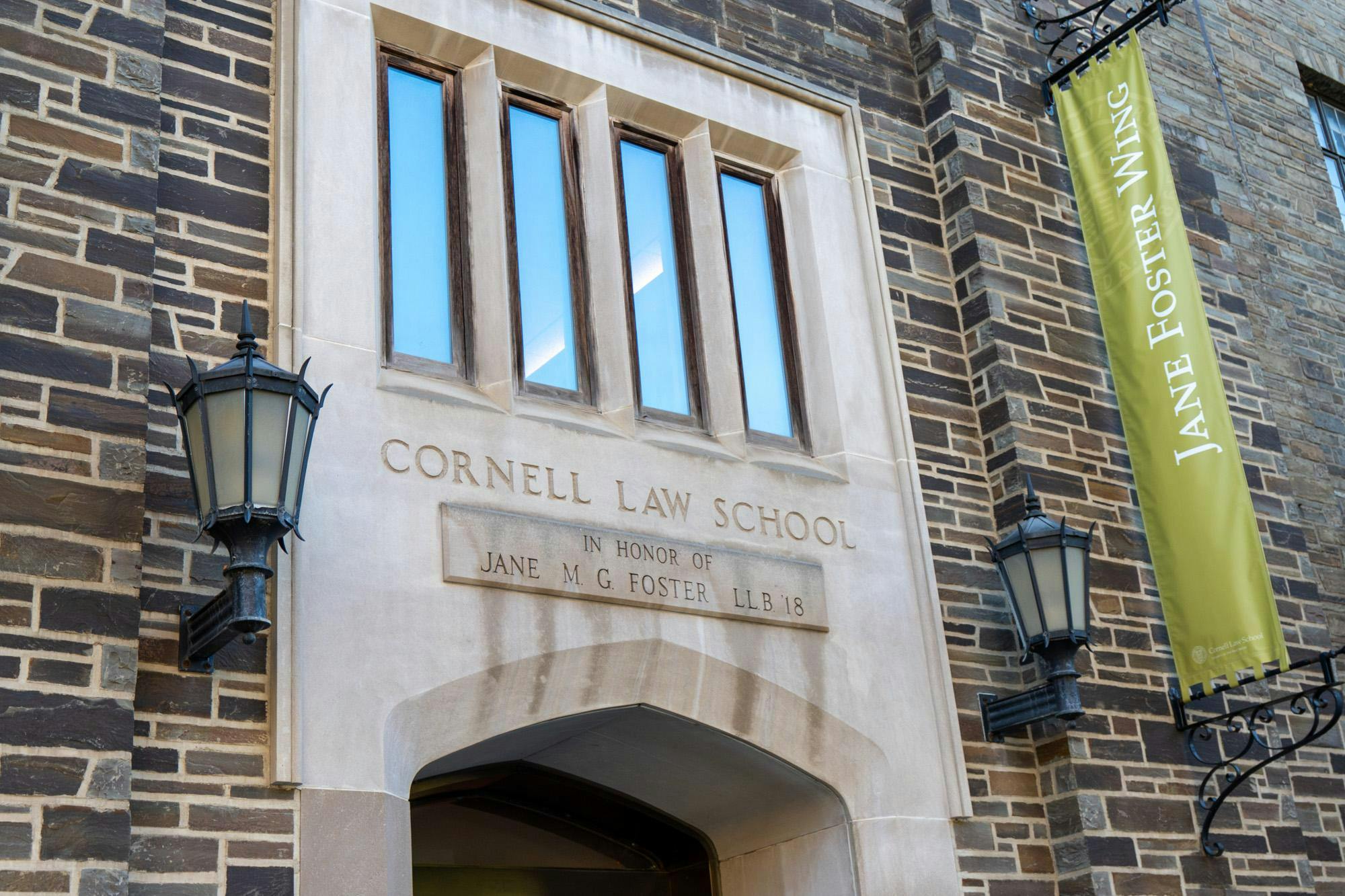
Following a freeze of over $250 million from the federal government, the University announced its settlement — a legally binding agreement that ended the freeze and resulted in the dismissal of any pending civil rights investigations — with the Trump administration on Nov. 7.
The settlement restored all funding for grants that were paused and those that were yet to be funded and ended all ongoing Civil Rights Title VI investigations into Cornell from the federal government.
The University’s commitment of $60 million to the federal government and agricultural research received criticism from the community, including impacted researchers, student groups and the American Association of University Professors. Following the University’s settlement, The Sun spoke to three University professors to learn more about the language of the settlement and what it means for the future of Cornell.
$30 Million To The Federal Government
The University will pay $30 million to the U.S. Treasury over the course of the next three years.
According to the University’s Q&A page about the settlement, the sum will be paid out of a litigation reserve account established in a prior budget plan.
Clause 8 and Clause 14 of the settlement state that the restoration of grants and the University’s payout of $30 million to the Treasury are in “consideration” of entering into the agreement.
The legal term “consideration” refers to the mutual exchange of promises or obligations between the parties to a contract. Consideration is necessary for a contract to be legally binding and ensures that the terms of a contract are fair and reasonable.
“We are giving [the government] money and they are promising to cease engaging in unlawful actions,” wrote Prof. David Bateman, government, in an email to The Sun. “It is extortion dressed up in the language of contracts.”
Prof. Michael Dorf, law, called the funding freeze "illegal" at an April Hands Off Cornell rally, which called out the federal government for bypassing statutory due process protections — the proper procedures defined by federal statutes.
President Kotlikoff wrote in a May 7 message to the Cornell community that the funding freeze was an “arbitrary reduction of research operating costs,” calling it “immediate and devastating.”
In an article for the Chronicle of Higher Education, Dorf wrote that within Title VI of the Civil Rights Act of 1964, recipients of federal funding are required to be granted a hearing before any funding is withdrawn. It also mandates agencies to notify Congress and wait at least 30 days before taking action.
$30 Million To U.S. Agriculture
The University also committed to invest $30 directly into U.S agriculture in its Nov. 7 settlement over the next three years.
Cornell will invest in “in research programs that will directly benefit U.S. farmers through lower costs of production and enhanced efficiency, including but not limited to programs that incorporate AI and robotics, such as Digital Agriculture and Future Farming Technologies,” the settlement reads.
Bateman wrote that Clause 13, which commits the University’s investment in U.S. agriculture, “reads like a press release.”
“One plausible reason is that it was written by people at Cornell, to frame these new priorities as part of our longstanding public mission,” Bateman wrote.
Clause 13 is the settlement’s longest clause and details the University’s historical “partnership with America’s farmers [that] greatly contributed to the United States’ rise as an economic superpower,” according to the settlement.
“As the land-grant university for New York state and a global pioneer in agricultural research and innovation, Cornell is proud to lead efforts in supporting American farmers,” Kotlikoff wrote in a Nov. 7 statement to the Cornell community.
This provision for a specified research investment is unique from earlier settlements between elite U.S. universities and the Trump administration. For example, Brown, The University of Pennsylvania and University of Virginia’s settlements do not include direct financial concessions to the government.
Deciding how the federal government should spend its money and financially prioritize certain areas of study is the “constitutional right” of Congress, according to Bateman.
“[The settlement] is not that,” Bateman wrote in reference to Congress’ right to decide government expenditure. “The Trump administration, without legal authorization, is instead requiring Cornell, through unlawful coercion, to spend its own money on priorities set by the Trump administration.”
Koltikoff said in a Dec. 2 University Assembly meeting that the University is establishing a merit based process that will seek proposals from the research community to make the farming process more viable, particularly for small farmers.
The University’s Q&A page for the settlement states that the research expenditure was Cornell’s choice, and that Cornell alone will decide how and where to direct this expenditure. The University is also developing a program within the Office of the Vice Provost for Research to administer the disbursement of the funding.
Providing Undergraduate Admissions Data
Clause 9 stipulates that the University must provide the government with anonymized undergraduate admissions data on race, grade point average and performance on standardized tests. The agreement states that this is consistent with Title 34 of the Code of Federal Regulations, which pertains to education.
Prof. Risa Lieberwitz, industrial and labor relations, described this provision as a “fishing expedition for the federal government to try to find something.”
“There is no evidence that Cornell is violating any law — that it's not complying with its duties under the Department of Education requirements in admissions,” Lieberwitz said. “So why is Cornell having to provide these quarterly reports at this level of detail?”
Kotlikoff explained in his Nov. 7 statement that “Cornell’s agreement to these terms is not an admission of wrongdoing.”
Lieberwitz pointed out that section 100.6 of Title 34 requires that federal funding recipients have students’ racial data for submission to the DE for compliance reports, but does not mention the submission of data about standardized test scores and grade point averages.
According to a guest column for The Sun by Cornell’s chapter of the AAUP, the clause “goes beyond the Supreme Court’s SFFA v. Harvard decision about affirmative action in student admissions.”
The Supreme Court struck down affirmative action for race in college admissions decisions in 2023. At Cornell, while Black, Hispanic and Hawaiian/Pacific Islander first-year enrollment for the Class of 2029 increased from the Class of 2028, levels still remain lower than before the SCOTUS ruling.
“These are data that we were required to collect and report to the federal government on request prior to the agreement,”, according to its Q&A page. The University submits annual reports to the Integrated Postsecondary Education Data System, a series of surveys the ED conducts annually. Participation in IPEDS is mandatory for universities that participate in federal student financial aid programs under Title IV.
President Trump’s Aug. 7 memorandum Ensuring Transparency in Higher Education Admissions builds on the Harvard Supreme Court ruling. The memorandum directs institutes of higher education to report data on admitted students’ race, standardized test scores, grade point averages and other applicant characteristics.
In response to the memorandum, the ED proposed a week later a new Integrated Postsecondary Education Data System component — the Admissions and Consumer Transparency Supplement.
If ACTS is approved, academic institutions will be required to submit applicant data including average GPA, standardized test scores and first-generation college student status.
Department of Justice Memo As Training Resource For Faculty And Staff
The settlement’s Clause 6 stipulates that the University use the U.S. Department of Justice’s Guidance for Recipients of Federal Funding Regarding Unlawful Discrimination July memo as a training resource for faculty and staff, which identifies Diversity, Equity and Inclusion practices in universities that receive federal funds as “unlawful”.
“The guidance offered by [U.S. Attorney General Pamela Bondi] is not legally binding,” Bateman wrote. “It does not supersede current civil rights law.”
According to Kotlikoff’s statements at the post-settlement town hall on Nov. 7, the University “agreed to obey the law, specifically civil rights laws. We did not agree to obey interpretations of the law that have not been adjudicated by the courts or interpreted by judges.”
“If it’s not a statement of federal law, why would you use it as a resource?” Prof. Sandra Babcock, law, said.
The DOJ memo claims it is unlawful to “compel” students to “share intimate spaces,” such as bathrooms and locker rooms, with the opposite sex. The University currently allows transgender students, staff and faculty to use the restroom that corresponds to their gender identity.
According to Bateman, the memo’s recommendation that recipients of federal funds refrain from DEI initiatives is “likely incompatible with civil rights law.” He referred to the 2020 Supreme Court ruling that discrimination against transgender employees is illegal under the 1964 Civil Rights Act.
“The provision isn’t clear,” Babcock said. “It raises more questions than it answers, and the guidelines are extremely problematic.”
Possibility of Future Government Investigations
Babcock also expressed concern about Clause 10, which requires Kotlikoff to certify on a quarterly basis Cornell’s compliance with the settlement. The clause states that the government “may make such inquiries as it deems necessary to verify the accuracy” of Kotlikoff’s certification.
Babcock raised questions regarding whether “inquiries” could mean that the federal government “just pose[s] questions,” or “demands records or other data.”
On the Q&A page, the University cites Clause 21, which notes that “any action brought by either party to enforce this Agreement must be brought in the United States District Court for the Northern District of New York,” as a statement to “protect the academic freedom of Cornell faculty, staff and students.”
“[Clause 21 is] just standard legal language in any agreement ... about where you’re going to settle disputes over the terms of the agreement,” Babcock said.
She pointed out that Clause 20 allows the government to conduct new investigations into the University and ask for additional settlement payouts.
“The agreement does not constrain the United States from coming back to Cornell at some future date to say, well, we have new allegations of misconduct,” Babcock said.
Babcock also described the settlement as a “capitulation” that would leave universities that may be investigated by the Trump administration “in a worse position.”
According to the University’s Q&A page, “the agreement explicitly supports academic freedom, does not require Cornell to accept federal guidelines that go beyond existing law, does not dictate admissions or hiring policies, [and] does not compel Cornell to provide internal data beyond what is available through existing law.”
“To not admit or even acknowledge that there are moral values that are being imperiled by this decision by this agreement is disingenuous at best,” Babcock said.

Yuhan Huang is a member of the Class of 2028 in the College of Arts and Sciences. Yuhan is a staff writer for the News department and can be reached at yhuang@cornellsun.com.


