

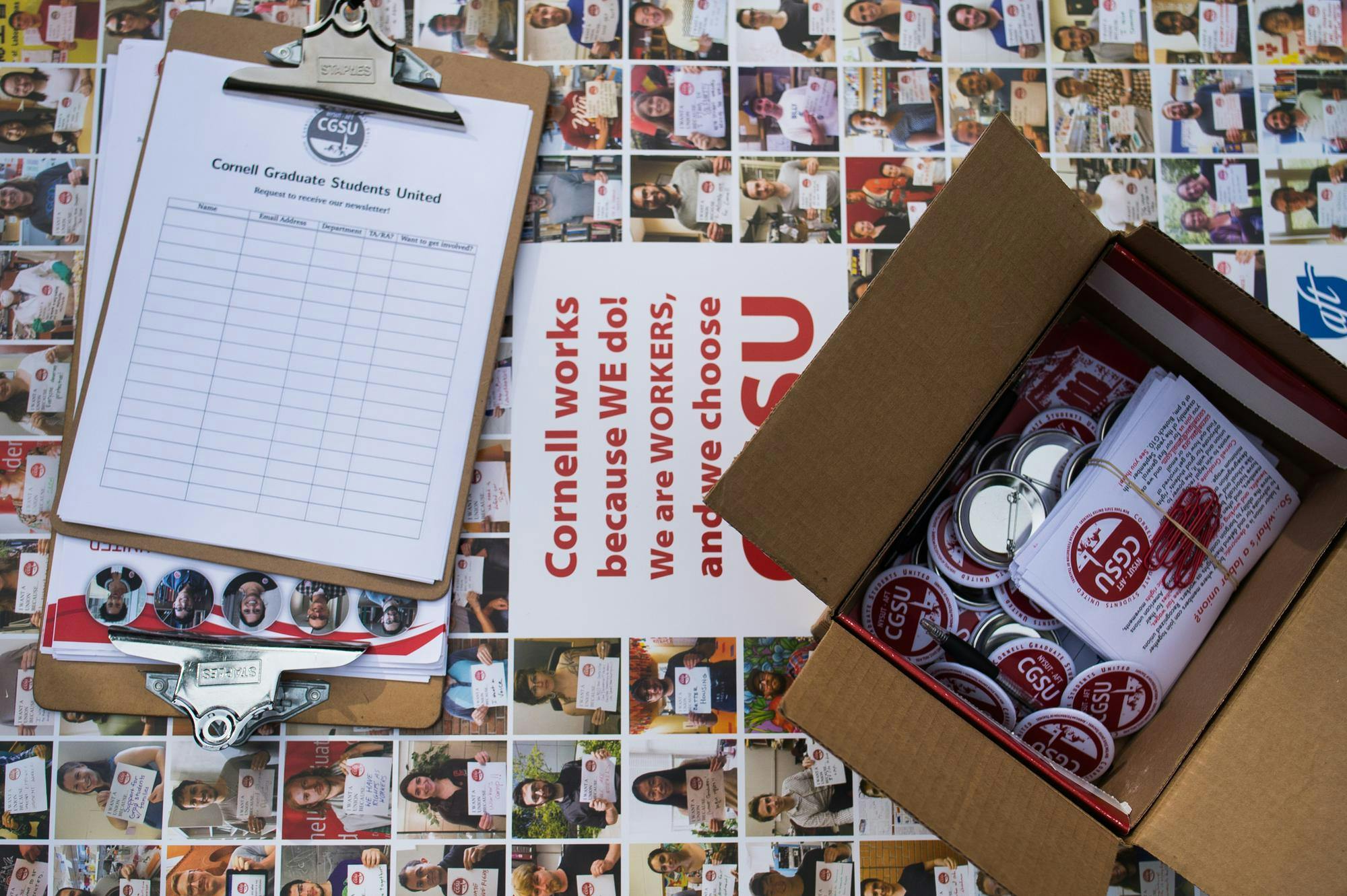
Cornell Graduate Students United announced on Nov. 26 that its members passed a referendum to adopt a statement titled “International Solidarity with the Palestinian Liberation Struggle” as the organization’s official stance. The statement, in addition to declaring solidarity with Palestine, lays out actions that the union will take to achieve this goal.
During a Nov. 13 general membership meeting for United Electrical Workers Local 300 Cornell Graduate Students United, attendees voted to put the Palestine solidarity statement drafted by the union’s political action committee to a membership-wide referendum. Members could vote from Nov. 21 to Nov. 25.
The solidarity statement explains that “the labor movements faces a once-in-a-generation opportunity to build international worker solidarity” through “end[ing] all forms of complicity with Israel’s crimes, halt[ing] all funding and military research with ties to Israel, and center[ing] Palestine’s struggle for liberation within our struggle for better material working conditions.”
“Cornell is implicated in the Israeli genocide of Palestinians through research, recruitment, and financial ties with the weapons industry, and endowment investments” and “University workers have paid a price when standing up for Palestine,” the statement reads.
In a speech given at the “Take Back our University” rally on Aug. 28, CGSU-UE President and Ph.D. candidate Ewa Nizalowska described the union’s experiences with University retaliation.
“We have seen Cornell deliberately target graduate workers who have stood up for Palestinian rights,” Nizalowska said at the rally. “We have to protect each other from unjust firing, suspicions and attacks.”
CGSU also commits itself to use “Boycott Divestment and Sanctions (BDS) guidelines.”
BDS is a “Palestinian-led movement for freedom, justice and equality,” according to the movement’s website.
Their guidelines include boycotting “Israel's apartheid regime, complicit Israeli sporting, cultural, and academic institutions, and all Israeli and international companies engaged in violations of Palestinian human rights,” “withdraw[ing] investments from the State of Israel and all Israeli and international companies that sustain Israeli apartheid” and “pressur[ing] governments to end Israeli apartheid.”
The solidarity statement supports “[Palestinians’] unequivocal human right to resist oppression by any means necessary,” which has been met with opposition by some Jewish organizations on campus.
Grinspoon Hillel at Cornell and the Jewish Graduate Student Association issued a joint statement on Nov. 24 condemning the referendum’s support of resistance by “any means necessary.” They argue that the language “introduc[es] hate and division to our campus and creat[es] a hostile environment for all students, including Jewish students.”
The organizations wrote that CGSU’s referendum “actively endorses violence, including terrorism, murder, and torture—echoing the rhetoric of Hamas, whose charter explicitly calls for killing Jews.”
CGSU’s referendum was passed just four months after Cornell Ph.D. student Russell Burgett filed a federal complaint on July 8 against the union for a provision in its contract that required all graduate students to pay dues to the union or to donate the equivalent amount to one or more predesignated charities, regardless of membership within the union.
In his complaint, Burgett stated that “he did not want to fund or support the political and ideological activities of the unions and their affiliates.”
On July 30, the National Right to Work Legal Defense Foundation sent a letter to the U.S. House Committee on Education and Workforce arguing that CGSU-UE, along with UE affiliates at the Massachusetts Institute of Technology and Stanford, “pressured Jewish graduate students … into supporting the union despite a ‘pattern of antisemitic abuse.’”
At the time, UE General President Carl Rosen defended the UE’s action in a statement to The Sun.
“We flatly reject the claim that condemning the state of Israel’s killing of civilians and starving of children, or supporting the non-violent Boycott, Divestment and Sanctions movement to pressure it to stop doing so, is in any way anti-Semitic,” Rosen wrote. “As Israel continues to engage in what more and more people agree is genocide, it is clearer than ever that our members’ principled support of non-violent means to end the slaughter is on the right side of history.”
Included in CGSU’s solidarity statement are six action items for the union to undertake.
Three of the proposed actions relate to funding. CGSU-UE calls for increased funding transparency by graduate student assistantships, aims to support its members in refusing funding “tied to the US and Israeli militaries and weapons manufacturers” and plans to pressure Cornell to disclose its “endowment, landholdings, and partnerships” and commit to divestment from “morally reprehensible activities.”
The other three actions aim to protect the right to free expression, ensure a safe and inclusive environment for graduate students, and “undertake political education about the Palestinian struggle for liberation and its connection to our working conditions at Cornell.”

Coral Platt is a member of the Class of 2029 in the College of Arts and Sciences. She is a news editor for the 144th Editorial Board and can be reached at cplatt@cornellsun.com.


