

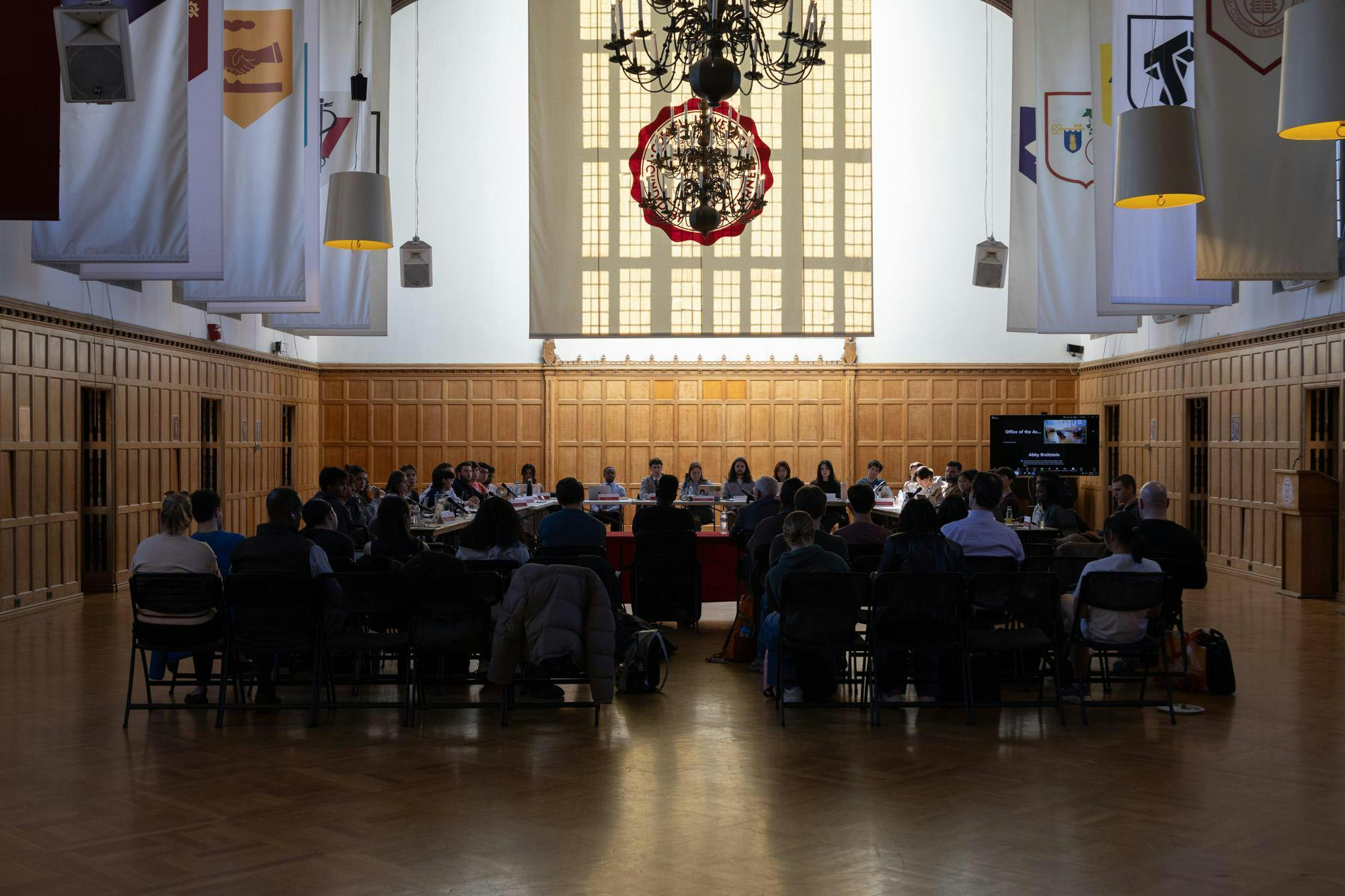
Since its inception, the Student Assembly has served as a key advocate for student interests on campus, providing student feedback to campus administration. However, as part of its role in voicing the interests and concerns of the student body, the Student Assembly also has a secondary role in addition to advocacy: byline funding and student aid.
Through contributions sourced from the Student Activity Fee — a mandatory fee for all undergraduate students set by the Student Assembly and included in the cost of attendance — the Assembly has built a number of financial aid services for undergraduate students in collaboration with the Office of Financial Aid and Student Employment.
However, Assembly members note that many of these programs have remained largely unknown to a significant portion of the student body.
Several members of the Assembly, including President Zora deRham ’27 and Executive Vice President Christian Flournoy ’27, have pushed for wider awareness of the funding opportunities offered by the Assembly.
When asked about the key financial aid programs they thought every Cornell student should know about, both listed a number of initiatives aimed at supporting a diverse range of student needs, from emergency funding to grants for academic projects and student-run events.
Emergency Grants: The Students Helping Students Fund
Under the management of the Student Assembly Financial Aid Review Committee, the Assembly's emergency grants serve as one of the primary forms of student aid for undergraduate students from the Assembly.
Emergency grants, subsidized through the Assembly’s Students Helping Students Fund, are awarded to provide assistance to undergraduate students with unexpected costs that fall outside of a student's standard expenses, caused by an emergency or urgent situation.
There are a number of guidelines established by the Financial Aid Review Committee determining which expenses are eligible for the grant. deRham explained the scope of what can be covered:
“[Students] can reach out because they had emergency car repairs, needed a new laptop, whatever the unexpected fee may be. Students on all ranges of financial aid are eligible to be recipients of the grant for whatever it is that comes up,” deRham said.
While all students are eligible to become recipients, the Office of Financial Aid notes that priority is given to students with “significant financial need.”
A list of allowable expenses may be found on the Financial Aid Committee Review Guidelines, available through the Assembly webpage.
Despite its value for the student body, the grant has received comparatively little notice in recent years, according to deRham. deRham has noted that demand for the grant has fallen, saying that prior to COVID-19, the emergency fund was used "quite frequently."
"I'd say that in the years that I've been [on] the Assembly, maybe 15 students per year request [the fund]," deRham said.
deRham went on to say that prior to the COVID-19 shutdown, the emergency grant fund was most notably used to support the opening of Anabel's Grocery, as well as to provide emergency aid to students affected by a major fire in Collegetown.
Anabel’s Grocery is currently being financially supported by the Graduate and Professional Student Assembly, as the Division of Student & Campus Life ended its affiliation with the Center for Transformative Action, Anabel’s parent organization, in early 2025.
deRham attributes the reduced interest in emergency grants to increased aid from Cornell, saying "since COVID, Cornell has really stepped it up with emergency fund-related similar projects on the University side."
Still, the grant remains a viable option for students struggling with emergency fees, and deRham remains optimistic that it will continue to help students in need.
"I'm still hoping that people can see that the Student Assembly's Students Helping Students grant money can be used for whatever they need," deRham said. "This is my favorite part about what the Student Assembly does."
To apply for the grant, students must submit a Request for CU Emergency Fund Application, available through Cornell Financial Aid. Further information is available through the Assembly website or by contacting the Office of Financial Aid and Student Employment.
Summer Experience Grants
The Student Assembly Summer Experience Grant is directed towards students who are interested in pursuing career-related experiences over the summer, but are concerned about their ability to meet the associated costs.
The grant program, accessible through a general summer grant application on Experience Cornell, prioritizes students with a demonstrated high financial need, which includes students who are "from low-income backgrounds, experiencing a financial hardship, unique family situations, or experiencing a significant change in financial circumstances," according to the Cornell Career Services website.
The Summer 2026 application opens on Feb. 1, 2026. If received, the award may be used for personal expenses such as housing, transportation to work and food. The maximum award amount for 2025 was $5,000.
“[The Summer Experience Grant] can be a form of a stand-in stipend, and I think that it's a really great and underutilized program,” deRham said.
Experience Cornell states that the grant primarily targets students who are completing summer “unpaid or minimally paid career-related experiences,” and “demonstrate a high financial need.”
Decisions for grant funding are made jointly by Cornell Career Services and the Student Assembly's Financial Aid Review Committee. Students who receive the grant once are not eligible to be selected again in the future.
Special Projects Fund
Unlike the other funding programs provided by the Assembly, the Special Projects Fund is aimed at supporting student organizations, and is designed to provide additional assistance for any project, program or service that it "deems to improve the quality of undergraduate student life or to further the goals of the Student Assembly."
For students, this means that ambitious projects planned by student organizations that fall outside their allocated budget may apply for additional funding, so long as the project is considered to benefit the wider student body. In the past, the most common use for the Special Projects Fund has been to subsidize club trips to visit other cities for conventions or similar events.
Despite its value, however, the Special Projects Fund still remains relatively unknown to many students and organizations on campus.
In response, Flournoy has spent the past year promoting greater awareness of the fund through targeted outreach efforts aimed at encouraging various student groups to apply.
"When I came to the Assembly, it really wasn't used that much," Flournoy said. "I continued to talk with groups and try to get people to use it, and I'm happy because more people have been using it."
Most recently, the fund was used to support a trip for Black Students United to attend the 2025 Congressional Black Caucus Retreat in Washington, D.C. Before that, it financed a similar trip for the Diverse Leaders of Tomorrow to engage in a networking conference in New York City.
"Having any experience in a different city is what — to people in college — is a very unique experience, and I think it's something that is beneficial to everyone," Flournoy said. "I really have been trying to push and get more people to know, apply for and use the Special Projects Fund, and I think it has been working."
To apply for Special Projects Funding, student organizations must fill out a Special Projects Funding Request Survey. Applications are reviewed jointly by the Assembly Executive Committee and Appropriations Committee.
Infrastructure Fund
Another unique way the Assembly provides funding to students is through the Student Assembly Infrastructure Fund Commission, which allows students to request financial support for on-campus infrastructure projects. In the past, the fund has been used to support a broad variety of small and large-scale projects, a list of which may be found on their website.
According to the guidelines of the SAIFC, the purpose of the Infrastructure Fund is to "financially support projects and/or initiatives that improve infrastructure or facilities on campus that contribute to the undergraduate experience of Cornell students."
To Grace Dorward ’26, current chair of the Infrastructure Fund Commission, this means that infrastructure can refer to anything from physical infrastructure, like "adding bike racks, bus stops, bus stop signage, trash cans," to "infrastructure like app development, that isn't physical infrastructure but can be useful for the student body long-term."
"There's been bike repair centers, which have been really useful to people on campus,” Dorward said. “Most recently, we funded a project for more computers in Olin Library, so that students can work on computers there."
The SAIFC operates through two funding cycles per academic year, during which students have a number of months to prepare and submit applications with project ideas. Twice a year, SAIFC awards funding based on their feasibility and eligibility. Details for eligibility may be found in the SAIFC guidelines.
"One of the [projects] that I'm really excited about from last cycle is that we're funding a project to create a Student Assembly kiosk through an architecture and urban planning club," Dorward said. "They're designing a kiosk that will help us disseminate information from the Student Assembly, because that's definitely been a major gap in previous years."
The application for the Spring 2026 funding cycle is open until the beginning of the spring semester in January 2026. Applications must at minimum include a brief description of the project, though additional details regarding the project timeline, cost estimates or communication with Cornell's facilities are encouraged, according to Dorward.
"[The Infrastructure Fund] is often a fund that goes unseen, but it has the funding to make a huge change on our campus, and I think that people should know that it's there for them to utilize," Dorward said. "An investment in infrastructure is something that lasts over time, and that's something that is really special."
Polina Doronkina is a contributor for the News department and can be reached at pd445@cornell.edu.


