


Nearly 3,000 undergraduate students voted “Yes” on two referendum questions that sought to make Cornell’s disciplinary system independent from the University administration and to reinstate a campus-wide code of conduct, according to results released by the Office of the Assemblies on Monday.
Undergraduate student voters overwhelmingly voted in favor of the two measures on the ballot. 3,079 of 3,292 ballots cast, which was 93.5 percent of the votes, supported ballot issue one, making Cornell’s judicial system independent. 2,976 of 3,245 ballots cast, which was 91.7 percent of votes, supported ballot issue two, reestablishing the campus-wide code of conduct.
The success of the referendum came amid several issues occurring with the voting process itself, including reports that the electronic ballot sent to all undergraduate students was sent to the spam folder of emails due to an authentication error.
Currently, the conduct of undergraduate students is governed by the Student Code of Conduct and the Office of Student Conduct and Community Standards which were implemented in 2021 after the University overhauled its judicial system.
Prior to 2021, the University used the Campus Code of Conduct — which applied to all members of Cornell’s community — and the independent Office of the Judicial Administrator. Both of these systems were dismantled when the University switched the authority and administration of the Code from the University Assembly, to Ryan Lombardi, vice president of student and campus life.
The results reflected a roughly 20 percent voter turnout among undergraduate students, which is a noticeable decrease compared to the last University referendum held in spring of 2024, which saw a 46.8 percent turnout. In the spring 2024 referendum, a majority of student voters voted for the University to support a permanent ceasefire in Gaza and if the University should divest from various weapons manufacturers.
Former President Martha Pollack ended up rejecting the spring 2024 student referendum in May 2024, explaining that it was not the proper role of the University to make a statement about such a “complex political issue.”
According to former Chair of the Student Assembly’s Office of Ethics and referendum co-sponsor Sophia Arnold ’26, the low turnout was the result of several compounding reasons which limited student awareness. First among them was when the referendum was held.
“It can’t be understated how … limiting, holding the referendum starting on finals is,” Arnold said.
Another challenge Arnold said was that the promotional email that the Student Assembly charter requires to be sent out prior to voting, was sent to the wrong set of email addresses.
“It meant that students weren't even informed that there was going to be a referendum on December 12 until the morning of,” Arnold said.
Arnold also claimed that an issue with the authentication for the voting platform OpaVote, led the email containing the ballot to end up in the majority of student’s spam folders.
In a text statement to The Sun Student Assembly President Zora deRham '27 confirmed that an issue with OpaVote had occurred.
“The tech issue with OpaVote was completely unexpected and hasn’t happened at least in the last 3 years of memory between SA and the OA.” deRham wrote. “The OA has been communicating with the Assembly about the answers they got from IT and OpaVote, but nothing was able to be done to reverse the issue itself.”
OpaVote is a platform used by the Office of Assemblies to send mass emails to students to facilitate voting. An analysis of the meta data in OpaVote’s Friday email that announced the link to vote, shows that the message failed to meet Cornell’s authentication requirements.
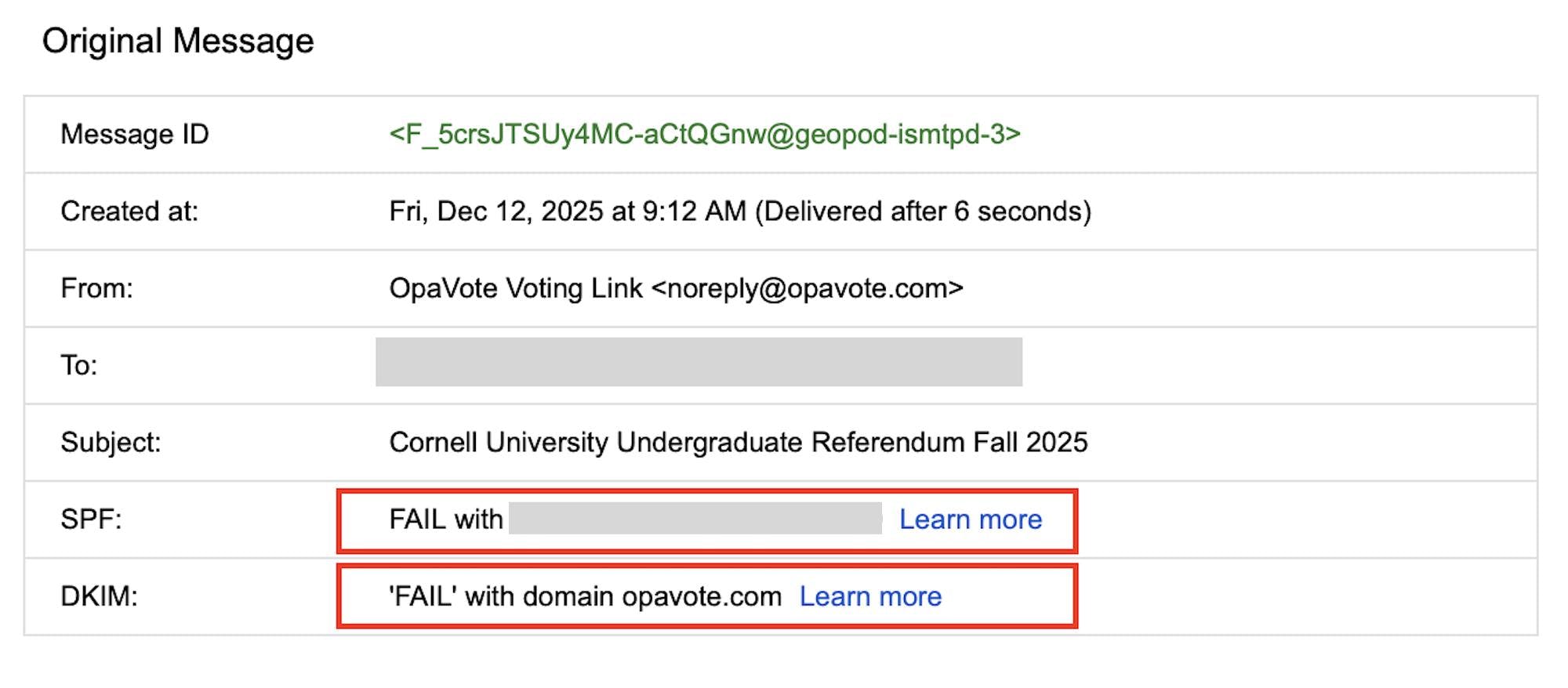
According to Google, messages authenticated by SPF or DKIM are marked by "spf=pass" or "dkim=pass." If it does not show that message authentication has failed. Google adds however that "Messages that aren't authenticated aren't necessarily spam. Sometimes authentication doesn't work for real organizations who send mail to big groups, like messages sent to mailing lists." (Graphic by: Benjamin Leynse)
Following threats of harm made using spoofed Cornell emails, the University accelerated a program this Fall to apply stricter standards for mass email communications. As of Nov. 10, a Cornell IT information page states administrators connected to email addresses that do not meet authentication standards will “receive a direct email notification letting them know what steps to take to avoid an interruption in their ability to deliver email.”
It is unclear who would be responsible for ensuring that the OpaVote email meets Cornell’s authentication requirements. However the Student Assembly Charter states that the Office of the Assemblies is responsible for distributing ballots via email to all undergraduate students, how and when to vote, the referendum question and any pro or con statements submitted.
When asked for a comment about the OpaVote email issues, Director of the Office of the Assemblies Jessica Withers, forwarded an email to The Sun that she sent to Student Assembly members addressing issues about the referendum process on Monday.
“I am reaching out to you to apologize for an Office of the Assemblies’ error that complicated the voting period,” Withers wrote. “I know this mistake has made the Student Assembly the target of claims of voter repression, and for that I am very sorry.”
Withers explained that the Office of the Assemblies “accidentally sent” the informational email that the Student Assembly Charter requires them to send during the promotional period “to the wrong list of students” though added that they “didn’t find out about this mistake until the morning of the voting period.”
It was for this reason that Withers explained she worked with Student Assembly Executive Board leaders to extend the voting period by 24 hours.
However, Withers did not directly address the claim that the referendum ballot was sent to students’ spam folders because the requisite steps to authenticate OpaVote were not taken.
Instead, Withers wrote that “We have been working with campus partners to find a secure and robust voting platform that meets the needs of the Assemblies. Using an outside platform like OpaVote means that systems don’t communicate smoothly.”
However, for Aiden Vallecillo '26, the Assembly's student workers representative and a co-sponsor of the referendum, the impact of the OpaVote issue is one that decreased voter turnout and, as a result, could jeopardize the seriousness with which the President considers the referendum’s outcome.
“Cornell is a campus of social activism. It's a campus where people come and learn to be people who can engage in our society and be civically involved.” Vallecillo said. “The administration is attempting to turn our university into one where you go, you keep your head down, get your education and you leave.”
With the passage of the referendum, the results will be communicated from the Student Assembly to the Office of the President, which has 30 days to formally respond.
Correction, Dec. 18, 9:33 a.m.: The article has been updated to include the correct spelling of Student Assembly President Zora deRham’s ’27 name and to correct Sophia Arnold’s '26 title as the former Chair of the Student Assembly’s Office of Ethics.
Benjamin Leynse is a member of the Class of 2027 in the College of Arts and Sciences. He is Multimedia Editor for the 144th Editorial Board and was news editor for the 143rd Editorial Board, and can be reached at bleynse@cornellsun.com.


