

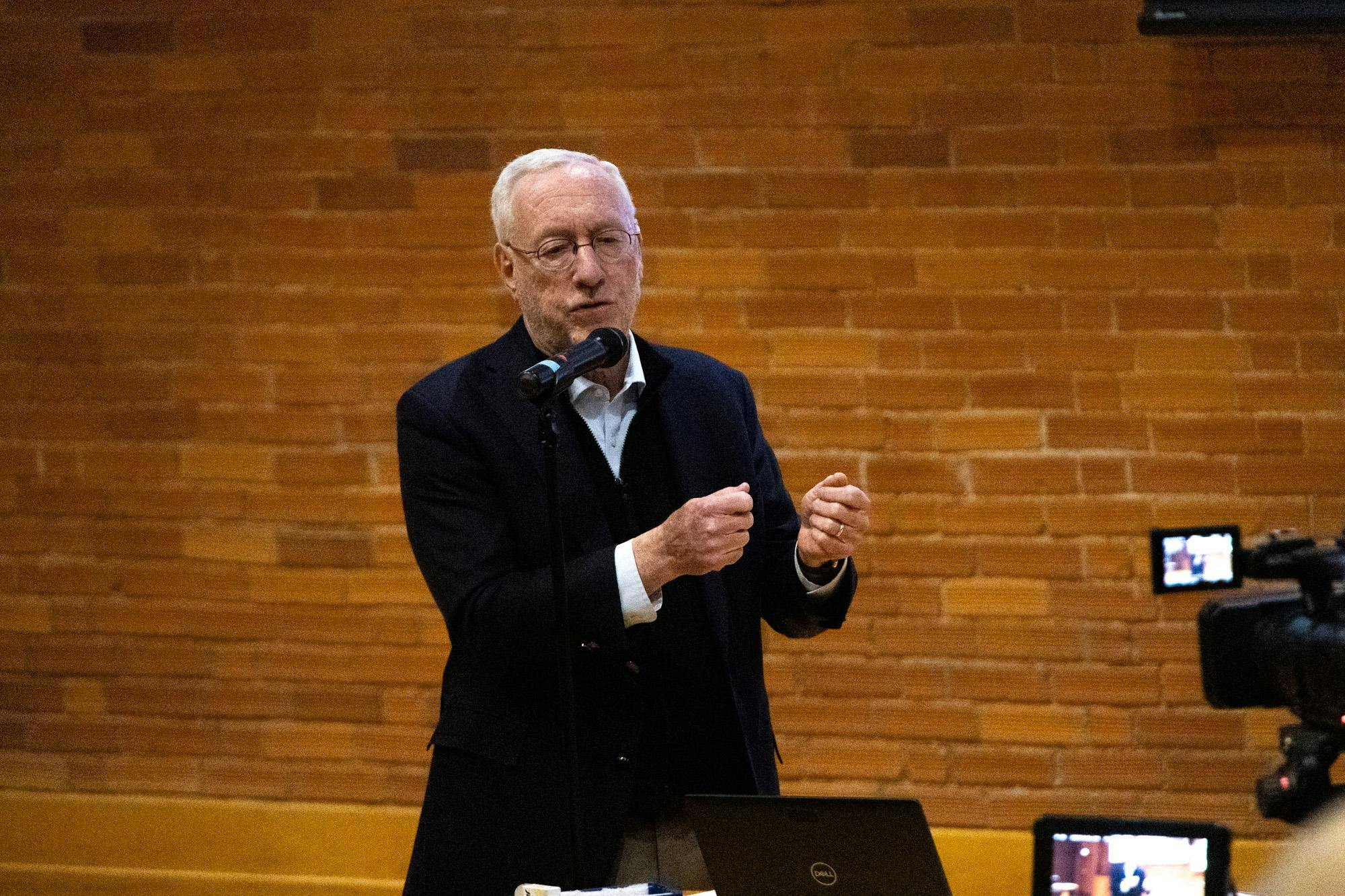
President Michael Kotlikoff addressed the Faculty Senate explaining Cornell’s recent settlement with the Trump administration, and commented on budgetary concerns, a new Code of Conduct and the United Nations Special Rapporteurs’ letter during a Wednesday afternoon meeting.
The meeting, which had over 150 attendees via Zoom and in person, featured an address by Kotlikoff, followed by a question-and-answer period with professors across departments. This address was not a regularly scheduled meeting, according to the Faculty Senate’s website.
Cornell’s Settlement and Agricultural Grants
Kotlikoff told faculty that the grants frozen by the Trump administration, amounting to more than $250 million, were unlocked and that the $30 million in agricultural grants was the University’s idea, rather than the federal government’s.
Describing the funding freeze and subsequent negotiations, Kotlikoff stated that he was “not pleased with the situation.”
“What we were facing was real independent damage to faculty, to faculty careers, to young people’s careers, to graduate studies and [to] post doc careers,” Kotlikoff said. “I believe that given the situation, we achieved the best outcome that would be possible.”
“What we did say was, ‘We're not going to agree to anything that violates our principles,’ and that's why I'm not thrilled by the agreement,” he said.
Specifically on the agricultural grants, Kotlikoff said they were “frankly, [the University’s] suggestion,” because the University “knew that [the Trump administration] was trying to inflict some monetary pain, and the bigger the number, the bigger the headline.”
While half of the $60 million Cornell agreed to pay the federal government will go to the U.S. Treasury, the other half will be administered by Cornell for projects that will “have an impact on farming communities,” said Provost Kavita Bala.
More specifically, Bala said in response to a question by Prof. Todd Schmit, applied economics, that Vice Provost for Research Gary Koretzky would administer the process, along with both an internal and external advisory board. The deans of the College of Agriculture and Life Sciences and the Veterinary College will run the internal advisory board, while the external board will include farmers from across the country.
Bala said that “anyone in our community can apply for grants,” which will then be decided by a faculty committee who will consider the impact and innovation of the grant. She added that the grant applications would be available in early February.
Student Code of Conduct Process
Prof. Chris Schaffer, engineering, questioned Kotlikoff about what Schaffer called a “capricious” process of changing the Student Code of Conduct.
Schaffer asked Kotlikoff if he “would be willing to disband” the Code and Procedures Review Committee, which is currently reviewing the Student Code of Conduct, and instead install a committee similar to the one that produced the controversial Expressive Activity Policy, which restricts protests from noon to 1 p.m. in front of Day Hall.
Kotlikoff, who earlier in the meeting said he was “extraordinarily pleased that we have had demonstrations in front of my office, in front of Day Hall from 12 to 1,” told Schaffer that he “couldn’t commit” to such a change.
In regards to upcoming changes to the Student Code of Conduct, Prof. Richard Bensel, government, asked Kotlikoff if he knew about the Campus Code Committee, which was previously chaired by Bensel. The Campus Code Committee comprises faculty, undergraduate students, graduate students and employees and is also charged with maintaining the Code. Kotlikoff told Bensel that he was “completely unaware” of that committee.
Kotlikoff said that the Code and Procedures Review Committee appointed by Vice President of Student and Campus Life Ryan Lombardi would ultimately decide the language of the new Code, not the Campus Code Committee.
He added that the new Code would be available “by the end of the semester, and I think you'll see it's incremental, not revolutionary.”
In December, students voted overwhelmingly for a referendum that, if accepted by Kotlikoff, would make disciplinary proceedings independent from the University administration again. While Kotlikoff was required by the Student Assembly Charter to approve or reject the referendum by Jan. 17, he has yet to respond.
Budget Concerns
When Senior Research Associate William Katt asked if Cornell would still suffer “from austerity measures” after the settlement, Kotlikoff said that “we really have grown at a rate that is not sustainable,” specifying legal fees, and loans and tuition not being able to cover growing expenses. “We really are at a razor’s edge in terms of our budget.”
“I think we escaped a bullet on the Pell Grants here, but I think that'll be attacked in the future as well,” Kotlikoff said in reference to the Trump administration’s proposal to cut Pell Grant funding. The proposed cuts were shot down by Congress earlier this week.
United Nations Special Rapporteurs Letter
Kotlikoff had a lengthy exchange with Prof. Sandra Babcock, law, regarding a letter five United Nations Special Rapporteurs sent to the University in October, along with four other universities.
The letter expresses concern over the treatment of Momodou Taal, the international Ph.D. student who sued the Trump administration last spring, and graduate student Amandla Thomas-Johnson, who fled the country after he was notified that his immigration status had been terminated by the federal government. Specifically, the letter requested a response from Cornell detailing how the University would safeguard the rights of pro-Palestinian protestors like Taal and Thomas-Johnson, including their right to assembly and free expression.
“I am very sorry that we lost two graduate students from the university," Kotlikoff said to Babcock. “The enforcement issues from the federal government were not actions from the University.”
“[We] took no action against those two individuals that suppressed their ability to articulate their support for individuals in Gaza,” he added. “What we did was take action against individuals who had violated the rights of others.”
He said the University would “certainly” respond to the Oct. 14 U.N. Special Rapporteurs letter.
Zeinab Faraj is a member of the class of 2028 in the College of Arts and Sciences. She is the features editor on the 143rd Editorial Board and was the assistant sports editor of the 143rd Editorial Board. You can reach her at zfaraj@cornellsun.com.
Atticus Johnson is a member of the Class of 2028 in the College of Arts and Sciences. He is a senior writer for the News department and can be reached at ajohnson@cornellsun.com.


