Cornell will increase financial contributions to the Ithaca City School District by 34% over the next five years, starting with a $50,000 increase in the 2025-2026 academic year, as announced at an ICSD school board meeting on Jan. 13.
Cornell will contribute $700,000 to the school district this year, an increase from their planned $650,000 contribution. There will then be a $50,000 per year increase for the first three years, with smaller increases continuing until 2031, when the increase will reach $874,000.
Cornell’s voluntary contributions to ICSD are in lieu of property taxes. As Cornell is a not-for-profit corporation, the University is exempt from property taxes, which would have supported the school district. Therefore, Cornell voluntarily provides funding to the school district, as ICSD relies on local property taxes for around 75% of its operating budget. Cornell’s history of these voluntary contributions to the district dates back to 1975.
ICSD Superintendent Luvelle Brown announced the increase at the Jan. 13 school board meeting, stating that while “nowhere near what we were asking for initially,” the increase was appreciated, especially considering “the external and internal pressures [the University is] facing right now.”
Cornell’s increased contribution comes after the University’s statement released in June 2025 on “profound financial challenges” following federal funding frozen in April 2025, and a subsequent November settlement with the Trump administration to restore the funding, in which Cornell agreed to pay $30 million to the federal government and invest $30 million into agricultural research.
This increase follows a long-time advocacy effort, spearheaded by the Make Cornell Pay Campaign and the Ithaca Teachers Association. These efforts call for increased funding from Cornell, as the ICSD is currently facing declining teacher retention, with only 57% of teachers tenured compared to 85% in 2015.
In an interview with Tompkins Weekly, Nicholas Pemberton, a teacher in the ICSD, spoke about how salaries contribute to this retention problem.
“I live in Owego because I can’t afford to live in Ithaca, and that says a lot,” Pemberton said. “I’ve watched co-workers leave throughout the years and move to another school district and make $8,000 or $10,000 more, and all they have to do is leave Ithaca. They didn’t get any extra education, they haven’t worked any longer — it’s just that they left Ithaca.”
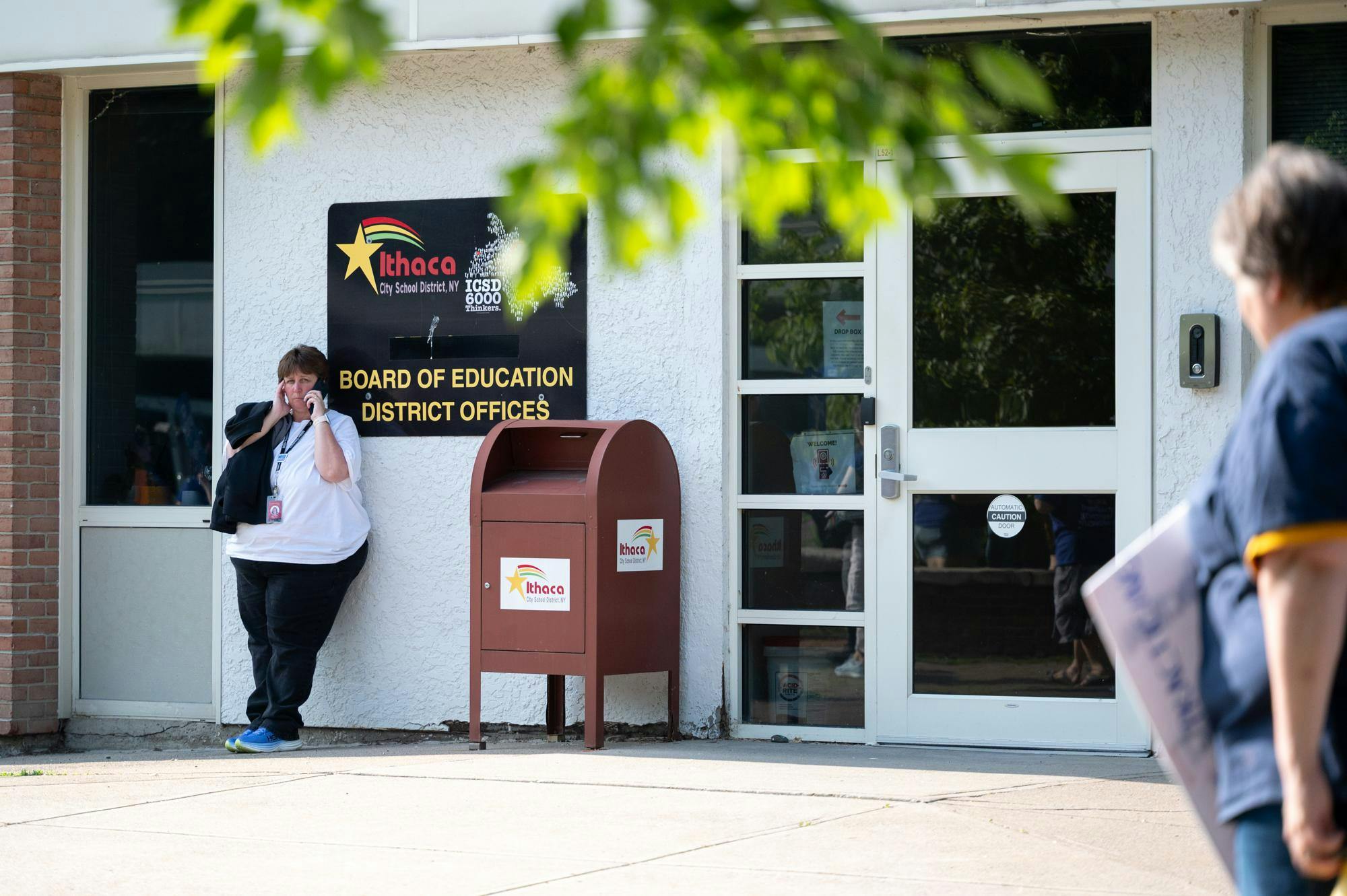
Over 100 teachers rallied outside of the ICSD offices in September to demand a better contract which partly aimed to improve teacher retention.
Many advocates claim that Cornell is not doing enough, suggesting that the University’s current contribution is less than their tax burden would be if they were not exempt. Ithaca Teachers’ Association estimates that if Cornell were to pay property taxes, the university would owe $33 million to the City of Ithaca annually and $46 million to ICSD. Some advocates, such as former ICSD board member Jill Tripp, have urged Cornell to contribute up to $10 million annually.
Many compare Cornell to similar institutions such as Princeton, which contributed $2.75 million to its local school district in 2023. Similarly, Brown contributed $30.2 million in the 2025 fiscal year to the City of Providence, directly supporting economic growth, K-12 education and medical care for residents.
University officials have been responsive to the push for more funds. This is the second time the University has revisited the matter. The University’s initial agreement with ICSD in 2021 promised an annual contribution of $500,000 until 2026. But in 2023, the University increased its annual contribution to $650,000, set to remain in place until 2031. Now, the 2026 agreement has increased this contribution to nearly $900,000 by 2031.
Jennifer Tavares, director of Cornell’s Office of Community Relations, addressed the increase in an email to The Sun.
“This adjustment, along with our continued in-kind support and educational collaborations, underscores our resolve to partner with the district to strengthen educational outcomes for local students and families,” Tavares wrote.
Beyond the monetary increase, the agreement also brings collaboration and community building between ICSD and Cornell. A new Cornell-ICSD Advisory Committee, with Cornell faculty and staff and ICSD teachers and administrators, will meet quarterly to assess existing and new programs. One of these is a dual-credit program, starting in the Fall of 2026, where Ithaca High School students can earn college credits at an affordable rate, from Cornell and ICSD faculty.
Aside from this agreement, Cornell has also invested resources in early childhood education programs to attempt to address the child care scarcity in Tompkins County. The University has additionally supported research collaborations between ICSD, such as the Cornell Brooks School of Public Policy’s assessment of ICSD’s future building and infrastructure needs based on local enrollment projections.
Correction, Jan. 26, 8:48 p.m.: This article has been updated to accurately reflect the percentage that Cornell’s contribution will rise by the 2030-2031 academic year.

Valencia Massaro is a member of the Class of 2029 in the School of Industrial and Labor Relations. She is a staff writer for the News department and can be reached at vmassaro@cornellsun.com.