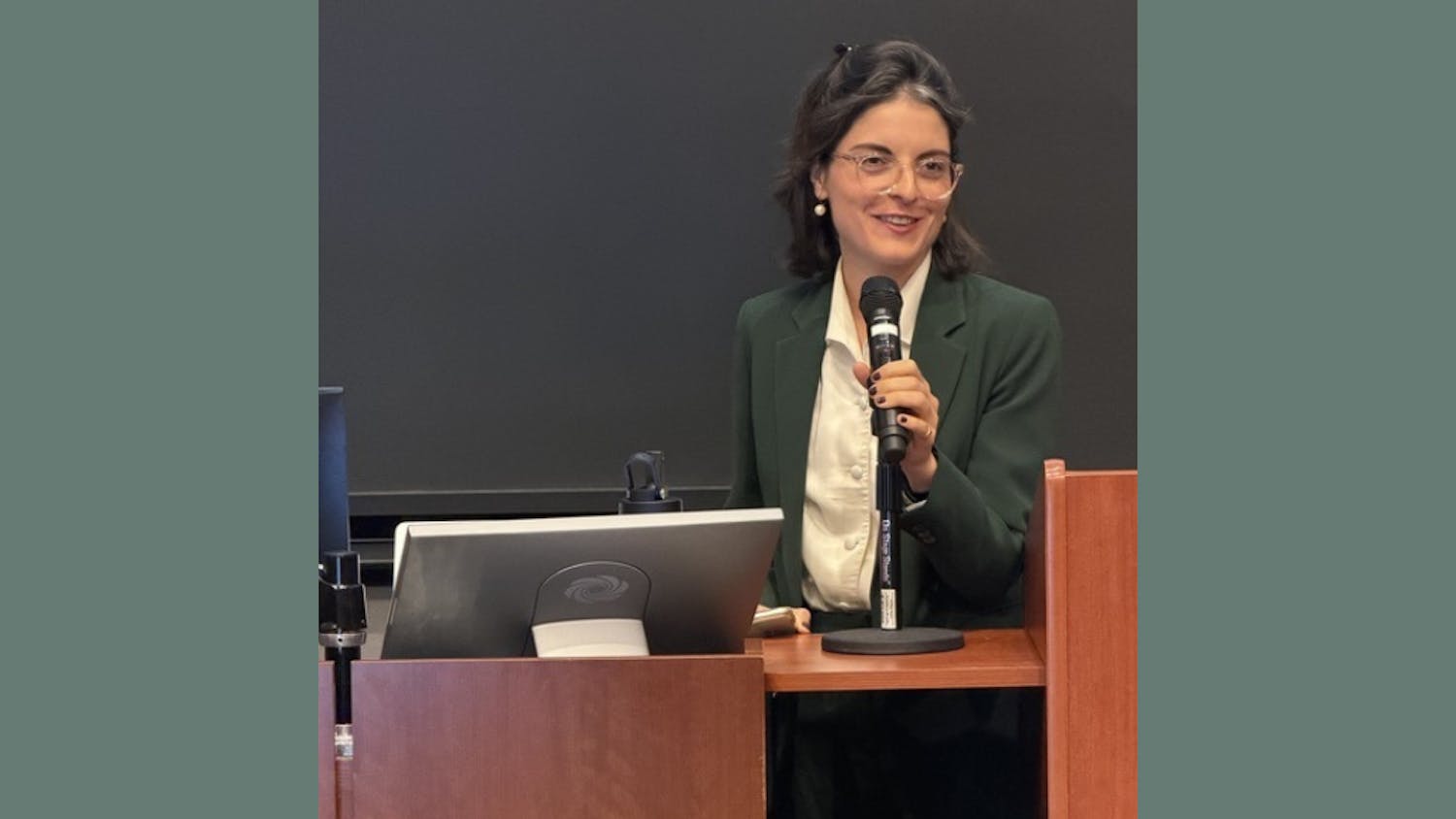
For Prof. Charles Trautmann Ph.D. ’83, psychology, the journey from an engineering education to research on childhood development has been anything but linear. Trautmann draws on his “interdisciplinary” background to study the impact of early experiences on attitudes and behavior towards the natural environment in adulthood.
Before joining the psychology department, Trautmann earned a Ph.D. in Civil Engineering from Cornell, directed a soil research lab and spent twenty-six years as the director of the Sciencenter, a local children’s science museum.
During his time at the Sciencenter, Trautmann developed an interest in education and early childhood development. At the same time, climate change and environmental issues were becoming increasingly salient in public discourse. For Trautmann, whose family fostered his love for the outdoors from an early age through camping trips and Boy Scouts, this became a source of academic curiosity.
“I got very interested in [climate change] from an educational standpoint, and that led me towards psychology,” Trautmann said. “How do people learn about science? How do they learn about the environment? Why do they do the things that they do?”
After retiring from the Sciencenter in 2017, Trautmann earned a fellowship to spend a year studying child development at the Rachel Carson Center in Germany, where he began to formulate a method to examine how experiences in early childhood can affect a person’s environmental behavior in adulthood.
By understanding the activities in childhood that can encourage positive environmental behavior in adults, Trautmann hopes to combat climate change and protect the environment.
“If we find out that [things like] nature camps or forest preschools influenced them as adults, then we could say, ‘OK, those things are important. Let's do more of those,’” Trautmann said. “Look for the factors in early childhood that might influence people as adults, and then figure out how to do more of the things that work.”
Early in the research process, Trautmann discovered that existing methods to study the factors that shape behavior were insufficient to answer his questions. Longitudinal studies, which track individuals from birth into adulthood, require decades to yield results, whereas retrospective studies, which survey adults on their past experiences, rely on unreliable memories.
“If you do it longitudinally … that takes me thirty years, and I don't have that much time,” Trautmann said. “Another way to do it is retrospectively, so we could interview people that are adults and ask them, ‘what were your experiences during preschool, during those first five years of life?’ Nobody can remember that, so that doesn’t work.”
To address these limitations, Trautmann created a novel method that he calls the “Folded Longitudinal” approach. The method surveys parents of adult participants about their children’s behavior in early childhood — including where they grew up, what kind of activities they did, and where they went on vacations — to understand what early childhood factors can contribute to later environmental behavior.
At the same time, the method assesses each adult participant’s carbon footprint, or individual impact on the environment. This is done using a novel index called the “Personal Climate Profile,” developed by Trautmann and a team of Cornell undergraduates, according to Trautmann’s interview with The Sun.
Consisting of eight questions, the PCP considers a person’s number of children, home energy use, air transportation, ground transportation and eating habits — the five most important contributors to an individual’s carbon footprint, according to Trautmann.
According to Trautmann, the PCP addresses limitations of existing carbon footprint assessments, which focus heavily on small habits, such turning off the lights when leaving a room, and overlook more high-impact behaviors, such as home size or energy use.
RJ Ho ’27 has been working with Trautmann over the past year to refine the PCP, including improving the scale’s measures of housing and energy carbon emissions while maintaining its simplicity.
“The Personal Climate Profile is very tricky compared to other indexes or scales, such that we are trying to balance simplicity and precision,” Ho said.
The research group has yet to formally deploy the folded longitudinal method in surveying parents as they must first determine the most efficient way to gather enough responses, according to Trautmann. However, preliminary analyses utilizing the PCP suggest that there is a complex tapestry of factors contributing to a person’s climate footprint in adulthood.
In an ongoing study, Ho is examining the relationship between a person’s attitudes towards the environment and their carbon footprint, measured using the PCP. In a survey of nearly 600 participants, he has found no significant relationship between environmental attitude and carbon footprint. This suggests that a person who is highly concerned about climate change may have similar carbon emissions as a person who is not concerned at all.
For Ho, these results suggest that current approaches to environmental action are not sufficient.
“I think there's a lot of political [approaches] like ‘we need to support the environment, you need to vote for this, you need to do that,’” Ho said. “And while I agree that that would help, I think perhaps more behavioral measures are warranted, like incentives for doing certain things, as opposed to just, ‘you should support this, you should advocate, you should join this club.’”
Over the next year, Trautmann hopes to begin using the PCP in large-scale, folded longitudinal studies of surveying both adults and their parents, with the end goal of understanding the factors that affect individuals’ carbon footprints in adulthood.
“We could be creating this Personal Climate Profile and using that to learn some new things that might have an impact on climate change, which is arguably the most important issue that has ever faced the world,” Trautmann said. “And so I can't just sit back and not do something about it. This is my way of doing something about it.”