This review contains spoilers for Sentimental Value and mentions of depression and suicide.
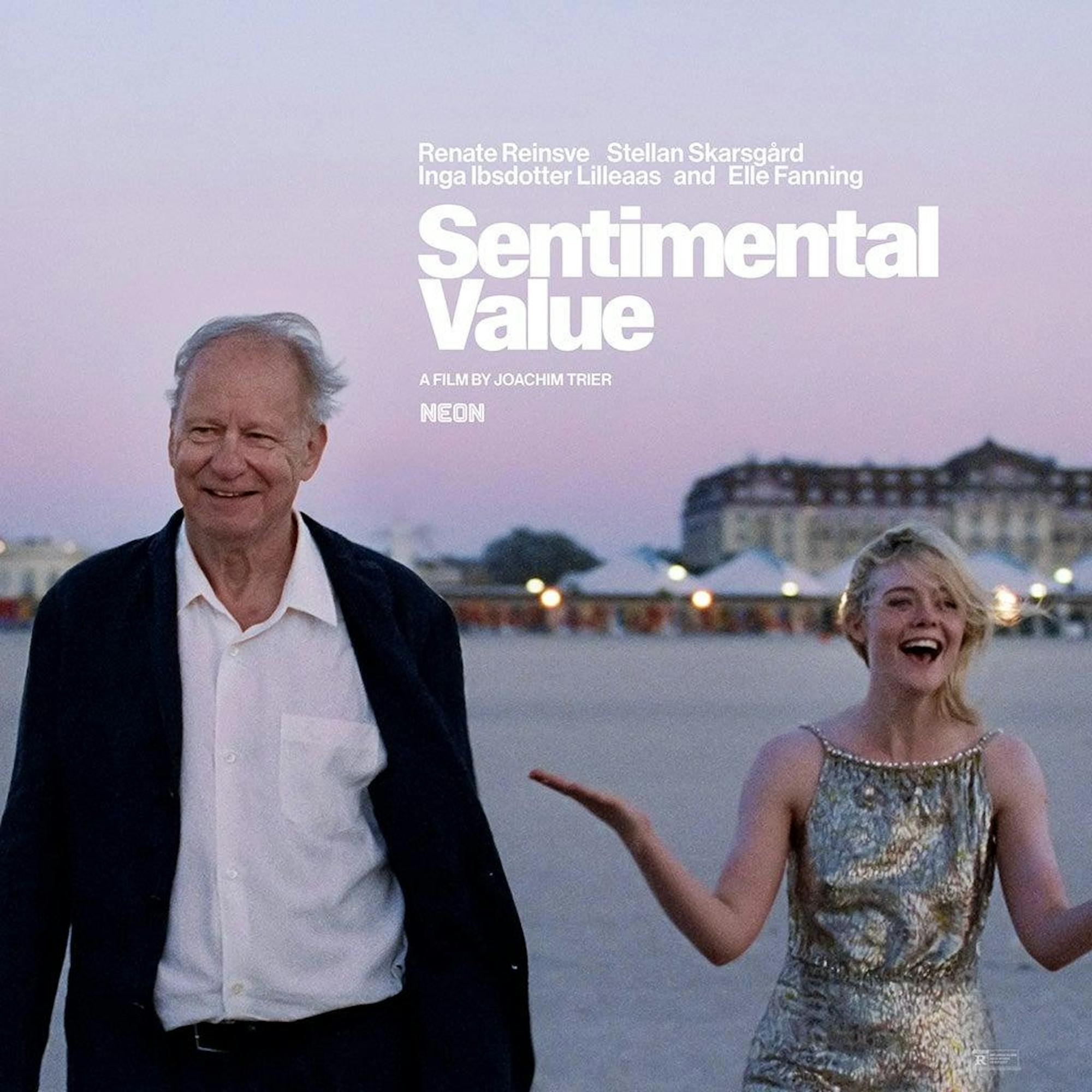
Joachim Trier’s Sentimental Value received nine nominations for this year’s Academy Awards — the most any Norwegian film has received — including Best Picture and four acting nominations. It follows two sisters, Nora (Renate Reinsve) and Agnes (Inga Ibsdotter Lilleaas), as their absent father, the filmmaker Gustav Borg (Stellan Skarsgård), reenters their lives following their mother’s death. Gustav hopes to cast Nora in the main role of his new film. When Nora declines, he hires Rachel Kemp (Elle Fanning), an American actress.
Sentimental Value is an incredibly lonely film. The four main characters flit around each other, all seeking connection and mostly missing each other regardless. I felt this film more than I understood it, which is probably my favorite kind of film since it eludes the simplicity of translation into words; but if I had to reduce it to words, I’d say it grapples with themes of generational traumas and a desperate search for connection and meaning through art.
A centerpiece of the film is the family house, which Agnes presently lives in with her husband and young son Erik. Opening the film, an omniscient narrator reads a sixth-grade Nora’s essay personifying the house. She describes how the house might think and feel about the events in its history and how the house missed Gustav when he left, linking living in the house with the emotional charge and history within its walls.
Gustav’s movie, set to be filmed in the house, follows a mother who kills herself despite having a young son, paralleling the actions of his own mother. Rachel, who plays the mother, asks Gustav why the mother decides to kill herself, which Gustav initially dodges. Ultimately, he says that her question is also the film’s question, which makes it his life’s question.
In a later meeting with Nora, Rachel admits she still doesn’t understand this action. But as Rachel speaks, Nora’s expression implies that she does understand, at least in some way. Nora is struggling — we are introduced to her as she has an anxiety attack backstage and asks to be slapped to realign herself. The effects of her childhood still cling to her and bleed into her actions. Her depression is palpable and familiar — there’s a scene of her being congratulated repeatedly at the reception of one of her performances, and the score drowns out the dialogue as if the world is passing her by and she picks up none of it.
To understand this character — or maybe just why Gustav might write this character — implies understanding the film and him. Perhaps Nora's expression here conveys a sadness for herself and her father, the grief caused by him but also what he might feel. Both Agnes and Nora wonder after reading the script: how does the writing make it seem like Gustav was there when Nora attempted suicide, despite his absence?
Also in this meeting, Rachel confesses her fear of disappointing Gustav to Nora. It feels like Gustav is trying to make Rachel into his daughter. Does he want Nora to play the role? Is the role about Nora? Or is it because if Rachel looks enough like Nora, he can be kinder to Rachel than he ever was to Nora and pretend there’s a reconciliation? Maybe this is why, when Rachel drops the role, he throws a middle finger up to the house and drinks himself to the hospital. When Rachel cries with her hair the color of Nora’s, confessing she is afraid of disappointing Gustav, perhaps he can no longer escape both the hurt he has caused Rachel and the hurt he caused his daughters, which he has been avoiding. All the emotions bleed together and repeat themselves.
Gustav asks Agnes, who acted in one of his films when she was younger, to cast Erik in his film, which she initially refuses. When she was a child, filming with Gustav was wonderful because she could be with him. But then he would disappear. Her desperation to prevent Gustav from hurting Erik the way he hurt her seems like her attempt to end these cycles, maybe similarly to how Nora tried to protect her. When Nora asks how their childhood didn’t mess Agnes up, Agnes points out one major difference in her and Nora’s childhoods that helped her grow up: “I had you … I felt safe.” Did they do this when they were younger, this scene with Agnes’ head tucked under Nora’s chin as they cling to each other? Perhaps their roles are reversed now, as Agnes reassures Nora. Maybe there is a way forward out of these cycles and their residual pain, and maybe Gustav is looking for a way out too.
These seemingly distinct pains in Gustav’s life blur together as he seeks to understand his mother’s death, his parental relationship with Nora and Agnes, his place in the world as an aging filmmaker and perhaps Nora’s depression. Nothing is linear or distinct when it comes to grief, depression, a childhood that haunts you; these aches eat away at your life and become an overwhelming part of yourself. The art he is trying to create seems like a plea: “Please, I am trying to understand you and myself, I am trying to connect with you. I am trying to be better to you moving forward.”
The monologue, the part of the script that seems to imply that Gustav was there with Nora during her suicide attempt, ends with “I want a home.” Maybe this is why the house ends up bleached and emptied, the tiles struck off the walls. Maybe utterly changing it and reconstructing part of it for Gustav’s film, an attempt at reconciliation through art now starring Nora and Erik, is hoping that there will be a better way forward.
Pen Fang is a sophomore in the College of Arts & Sciences. They can be reached at pfang@cornellsun.com
Pen Fang is a member of the Class of 2028 in the College of Arts and Sciences. They are a staff writer for the Arts & Culture department and can be reached at pfang@cornellsun.com.