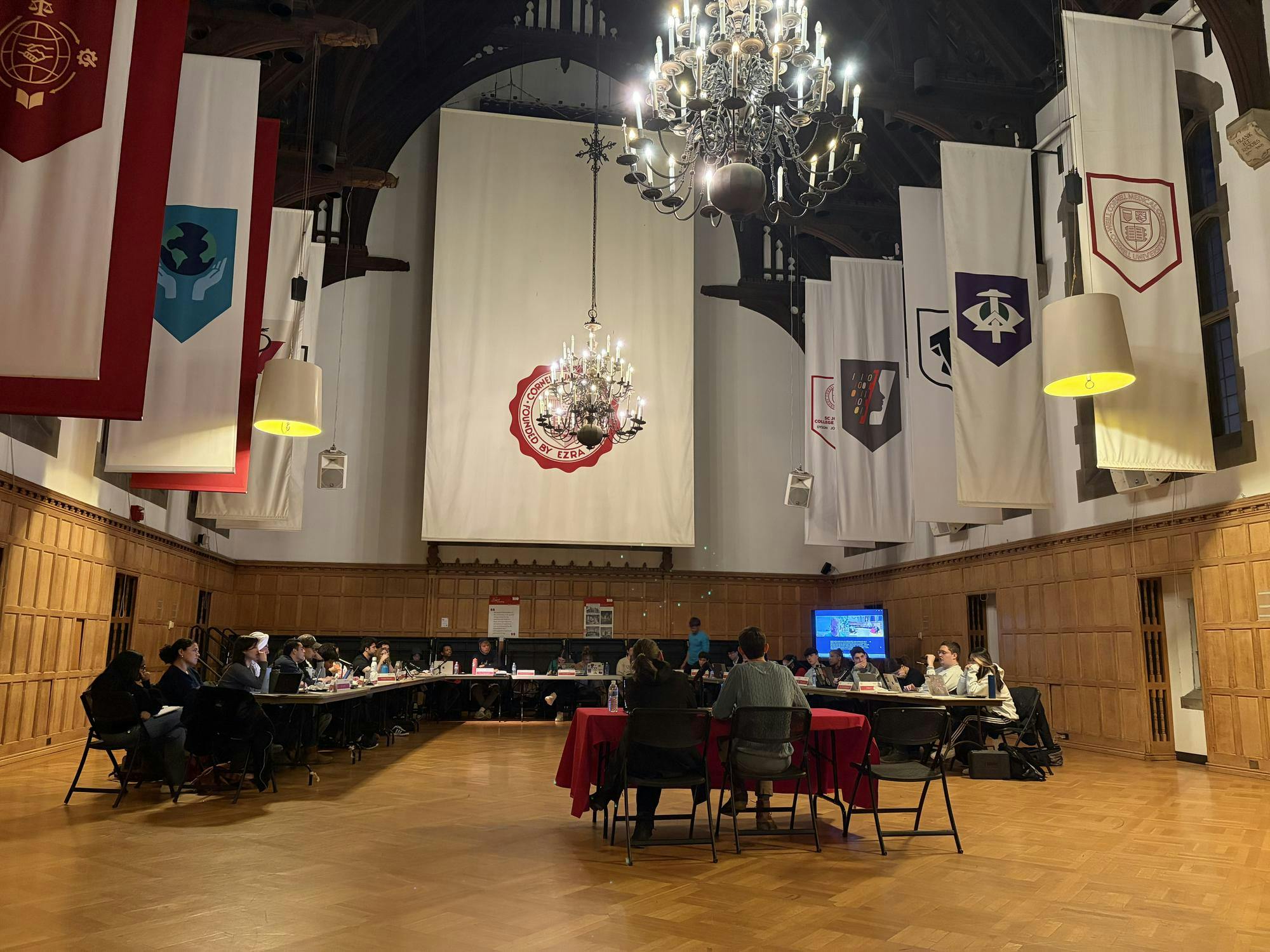
The Student Assembly addressed email technical issues from the Fall 2025 Undergraduate Referendum and held a public comment during their first meeting of the semester on Thursday. While no undergraduate students spoke during the public comment period, members of the Assembly voiced their opinions about the Student Code of Conduct to representatives of the Graduate and Professional Student Assembly, who were in attendance at the meeting.
Undergraduate student voters overwhelmingly voted yes on two referendum questions that proposed an independent University disciplinary system from Cornell’s administration and supporting the reinstatement of a campus-wide code of conduct on Dec. 17.
The Assembly’s discussions focused on students' discontent regarding University enforcement of the code of conduct and the difficulties of students accessing the referendum in their Cornell emails. An issue with OpaVote, a voting platform used to administer the referendum, caused the email to end up in some student’s spam folders.
Members of the Assembly hoped that the public comment would focus on issues with the ballot and start discourse surrounding the referendum, but members of the body pointed out that the meeting was only advertised on the Assembly’s Instagram, which has 710 followers while the current undergraduate student population is 16,128 students.
Admir Cekic ’26, first-generation college students representative, expressed discontent by alleging the Assembly’s lack of outreach to students for the public comment session.
“We should all be ashamed of ourselves,” Cekic said. “We are saying that [this meeting] is a public comment when no one heard about it. We could have easily sent an email to the entire student body so we can make it [the voting process] better in the future.”
GPSA president and graduate student Nicholas Brennan and Jennifer Michael, senior director of student experience in the College of Architecture, Art and Planning, gave a presentation as members of the University’s Code and Procedures Review Committee.
Brennan explained that they would be taking notes throughout the meeting with the aim to “ensure that [students’] voices are heard and your suggestions are brought back to the committee for consideration.”
At the start of the meeting, representatives and attendees were shown a 11-minute long video that provided a description of the Code and its procedures.
The video was met with mixed reactions from representatives, with Cekic describing it as “a propaganda piece” due to what he saw as its inaccuracy in representing the disciplinary process for students. Cekic also critiqued its claim that most Code cases are resolved through the Alternative Dispute Resolution, mentioning a significant increase in punishments including suspensions, non-contact orders and privilege restrictions.
Students then began to voice their concerns, including Hayden Spector ’26, students with disabilities representative, who criticized the disciplinary process’ ineffectiveness in resolving many cases, while describing the process as something which can be “very, very scary for somebody” due to the lack of perceived support.
Several members of the Assembly also expressed distrust in the administration regarding its ability to listen to and represent students.
“Frankly, I’m discouraged,” Max Ehrlich ’26, industrial and labor relations representative, said. “I’m not confident that [the University is] going to listen to you. I’m not confident that your report won’t go to a garbage can in Vice President Lombardi’s office, or if he does give it to President [Michael] Kotlikoff, I’m quite confident that it will go to a garbage can in his office.”
Kotlikoff was required by the Student Assembly Charter to approve or reject the referendum by Jan. 17 but has not responded thus far.
Other Assembly members, including Undergraduate Representative Eeshaan Chaudhuri ’27 and Minority Representative Kennedy Young ’28 communicated their desire for a more diverse representation of the student body when it comes to making these policies.
Chaudhuri expressed that the Code and Procedures Review Committee’s outreach was “important” despite his belief that the Assembly was not a “fair sample” of the student population, citing a need for more community outreach events. Young supported the idea and emphasized a focus on random selection of students to eliminate biases, proposing a jury-duty style of selecting members for events.
Members of the Assembly hoped to speed up the process of reforming the Code, with Chaudhuri criticizing its slow revision process, given that the University has not responded to the December referendum.
Cekic expressed a desire for a complete overhaul of the Code, citing a need to represent Cornell’s founding values more accurately, a sentiment shared by many other representatives.
“I think the current code of conduct harms the Cornell culture and student life here,” Cekic said. “It needs to be changed to more accurately reflect Cornell’s values as Cornell's founding values of being a progressive democratic institution.”
Clarification, Jan. 28, 11:05 a.m.: This article has been updated to accurately reflect the public comment and presentation portions of the Jan. 22 Student Assembly meeting.
Zeinab Faraj is a member of the Class of 2028 in the College of Arts and Sciences and a senior editor on the 144th Editorial Board. She was a features editor and assistant sports editor on the 143rd Editorial Board and can be reached at zfaraj@cornellsun.com.

Everett Chambala is a member of the Class of 2027 in the School of Industrial and Labor Relations. He is a staff writer for the News department and can be reached at echambala@cornellsun.com.

Rajorshi Chatterjee is a member of the Class of 2029 in the College of Agriculture and Life Sciences. He is a contributor for the News department and can be reached at rc978@cornell.edu.