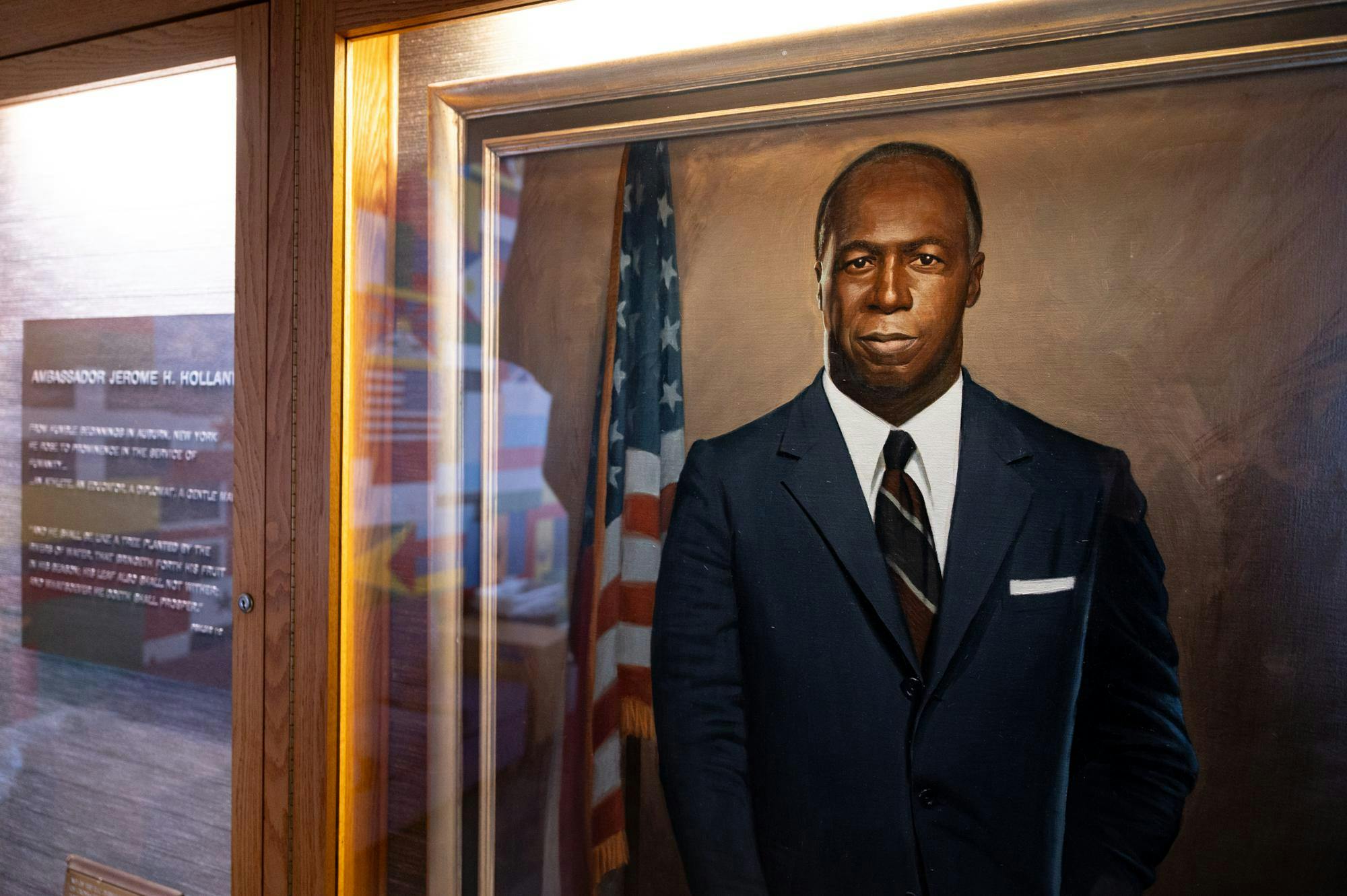
Cornell was founded on the principle of being “an institution where any person can find instruction in any study.” This philosophy laid a foundation that allowed students of all different races, genders and ethnicities to obtain a higher education and become leaders throughout the world.
When it came to Jerome Holland ’39 M.S. ’41, his journey at Cornell did not follow one path — he paved multiple.
As the first African American student to play for the University’s football team, the first African American board member of the New York Stock Exchange and the president of multiple higher education institutions, Holland embodied Cornell’s founding principle. He demonstrated that any student, of any background, can overcome adversity and achieve greatness.
Holland was born on Jan. 9, 1916, in Auburn, New York, the fourth child of Robert Holland Jr. and Viola Bagby. Early in his youth, Holland worked with his father, who was a handyman and gardener. This experience inspired Holland to work hard in school to “avoid continuing such menial work into his adulthood,” according to Carlos Holmes, university historian for Delaware State University.
Holland attended Auburn High School, where he played varsity football for four years while also playing for his school’s basketball team. He lettered in both sports, an achievement reserved for a high school's best athletes.
Photographs of the Auburn High School football team throughout Holland’s time at the school show that he was the only African American on the roster.
Around this time, Holland picked up a nickname that would stick with him for the rest of his life, “Brud.” Holland’s siblings called him “Brudder,” eventually leading to friends and family calling him “Brud.” This nickname is still sometimes substituted in for his first name, including in his profile for the College Football Hall of Fame.
When it came to Holland’s education after high school, Cornell was always bound to be the destination. A longstanding connection to the Tremen family, influential within Cornell affairs at the time, alongside Holland’s elite football ability ensured Holland’s enrollment within the University.
This made Holland the first-ever African American to play for Cornell’s football team.
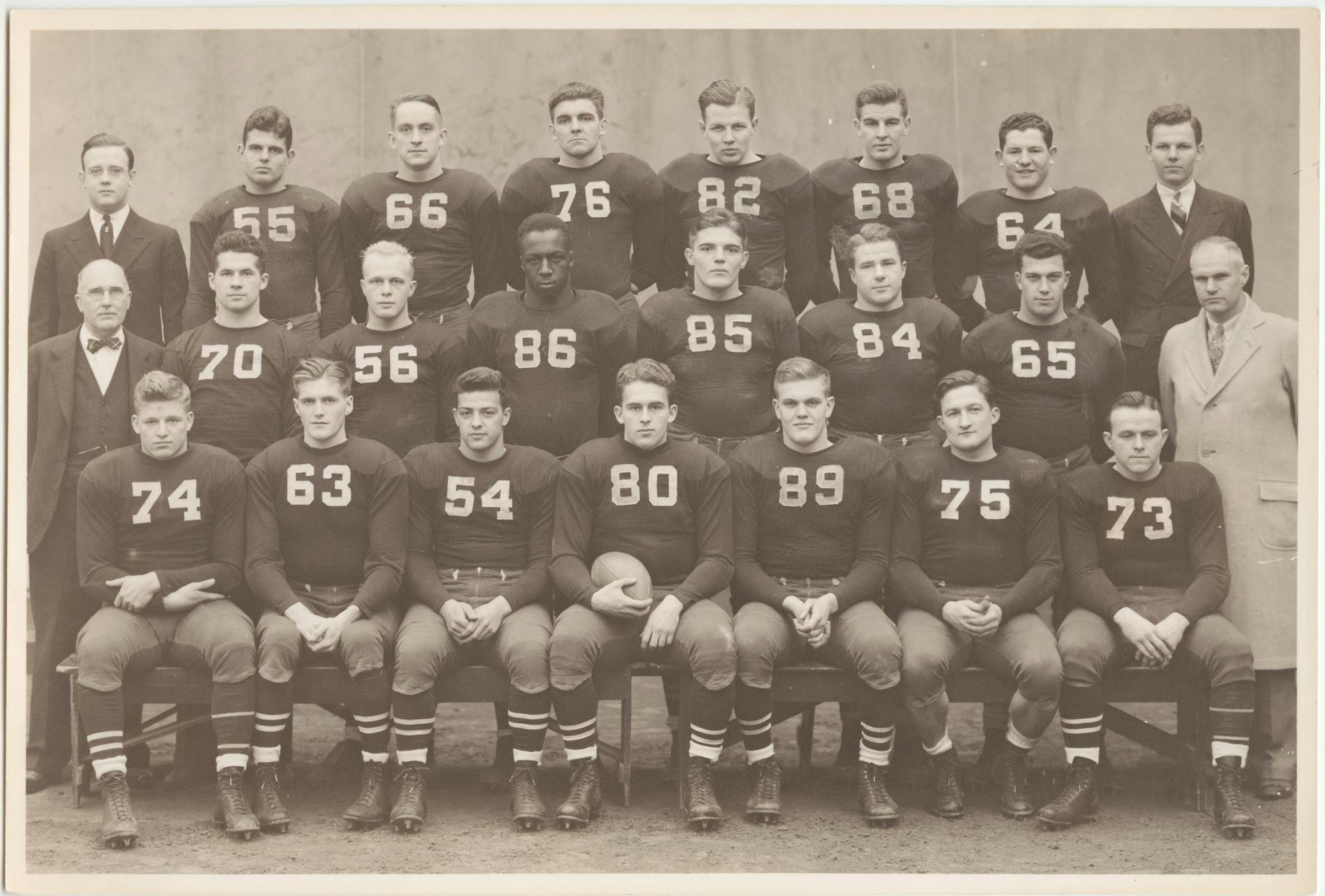
Jerome Holland (#86) was the first African American to play football for Cornell University. (Courtesy of Division of Rare and Manuscript Collections, Cornell University Library)
Holland’s football career at Cornell would be one for the ages. As a three-year varsity starter, he played on both the offensive and defensive units, excelling at both. His play on the field led to him becoming a two-time All-American and First-Team All-Eastern for the 1937 and 1938 seasons.
During the late 1930s, there was little debate who was the best athlete at Cornell. When nominating Holland for All-American status in 1937, The Sun explained how remarkable of a player he was, questioning how he had not received the recognition in years prior.
“A sixty-minute player for two years, Cornell's greatest star last year was shunted from the honor by the brilliant work of several players who have since passed from the scene,” wrote The Sun. “This year as a junior, he has been the outstanding Big Red player — sparkling on the defense and a heavy scorer when he carries the ball.”
While Holland was undoubtedly one of the best players in college football, a career in the NFL was stolen from him due to a 1933 vote by NFL owners that banned black individuals from playing in the NFL.
Though a career in the NFL wasn’t in the cards, Holland’s playing ability did not go unrecognized. He was inducted into the College Football Hall of Fame as a member of the Class of 1965 and into the Cornell University Athletics Hall of Fame’s inaugural class, the Class of 1978.
Holland never let barriers to the NFL stop him from achieving greatness. After finishing his Bachelor of Science in sociology, he immediately enrolled and completed a Master’s of Science, also in sociology, at Cornell. Holland worked various jobs, such as being a social research consultant for a year. for a decade after graduation until deciding to further his education at the University of Pennsylvania, where he earned a Ph.D. in sociology.
Following the conclusion of his education, Holland continued his path in academia, becoming the president of Delaware State College in 1953. At the time of his appointment, Delaware State was struggling, having just lost its accreditation for failing to facilitate “adequate academic structure”, and faced calls for closure by state officials.
Holland took this opportunity and soared. In his seven-year tenure as president, he helped Delaware State reobtain its accreditation and paved the way for a successful and prosperous future.
Increased enrollment, higher-paid tenured faculty, a doubling of the Delaware State’s library materials and a complete overhaul of the campus ensured the college would no longer be in danger of closure. Holland’s tenure at Delaware State gave him a reputation within academia as a top academic administrator within the country.
In 1960, Holland resigned from his position at Delaware State College to accept the position of president at the Hampton Institute (now known as Hampton University). His tenure at Hampton was similar to that of his time at Delaware State, leading the institution through a period of growth and innovation. Holland served in this position for ten years before retiring in 1970.
After Holland retired from the Hampton Institute, he entered the realm of public service. He was named the United States Ambassador to Sweden in the Nixon administration. While his appointment was met with protests and racial remarks from many Swedish citizens, he was undeterred, successfully working the position during the ongoing Vietnam War.
Holland’s achievements did not stop at the end of his ambassadorship. Further breakthroughs included being the first African American to hold a seat on the board of the New York Stock Exchange in 1972, being appointed as the Chairman of the Board of Directors for the Red Cross by President Jimmy Carter in 1979, and holding many more positions in academic and humanitarian organizations.
On Jan. 13, 1985, Holland passed away in New York City at age 69. He had four children, including Joe Holland, who played football for the Red, was inducted to the Cornell University Athletics Hall of Fame in 1990 and was a Republican candidate for New York governor in 2018.
Shortly after Holland’s death, Cornell renamed its International Living Center in his honor. The Holland International Living Center remains today, honoring Holland’s work and dedication to education for all.
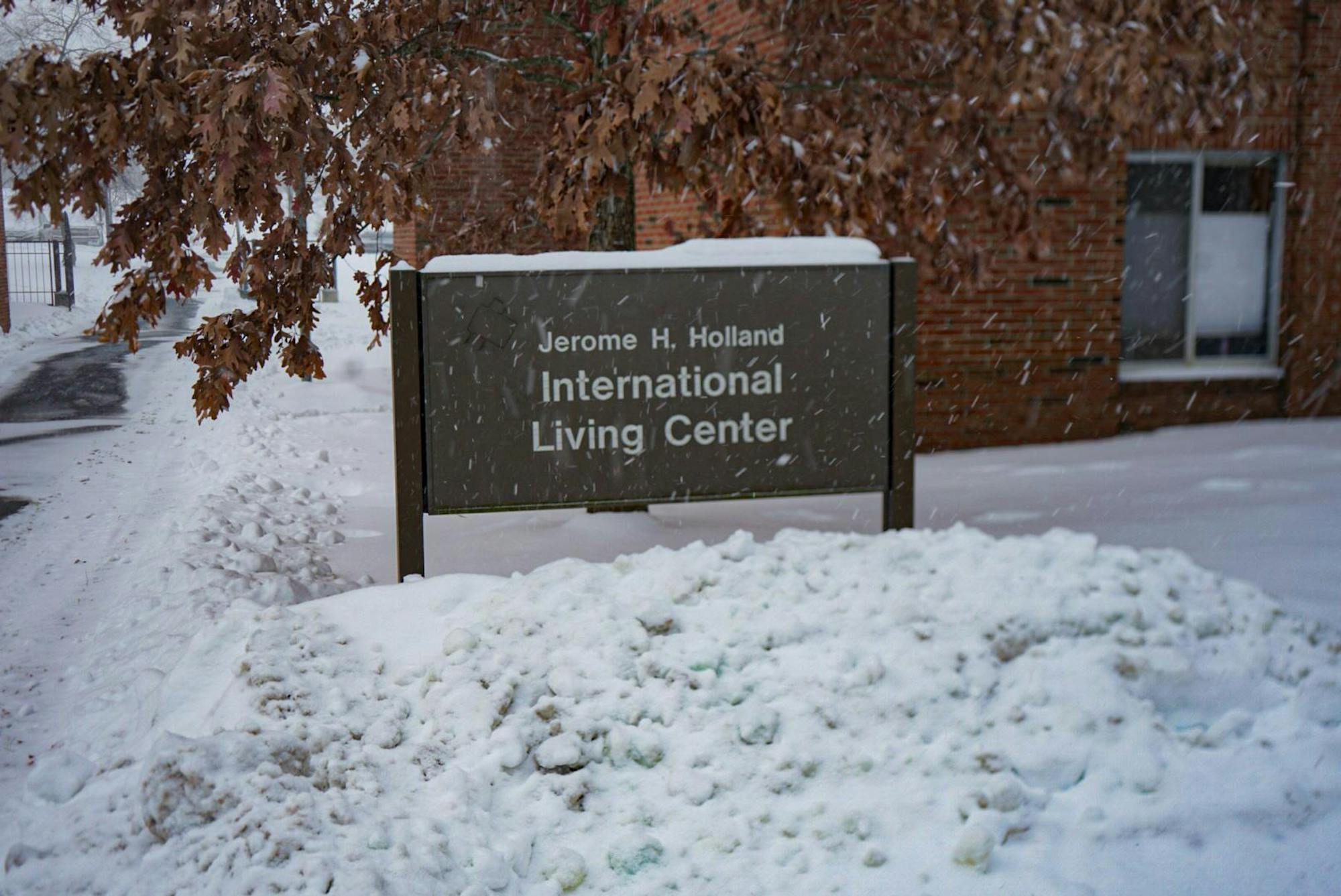
The Entrance to the Holland International Living Center, located on North Campus.
Holland was posthumously presented with the Presidential Medal of Freedom. When presenting the award to Holland’s wife, Laura, President Ronald Regan highlighted Holland’s achievements as a trailblazer and activist throughout his life.
“Dr. Jerome Hartwell Holland, one of 13 children in a small town family in New York State, rose from poverty to become a leading educator, civil rights activist, author and diplomat,” Regan stated. “Dr. Holland dedicated his career to improving the lives of others, particularly his fellow Black Americans, and to working for peace. A man of vigor and wisdom, Dr. Holland led a life of service, the memory of which today serves as an inspiration to millions.”
A plaque in the Holland International Living Center summarizes Holland’s dedication to education and equal opportunity that continues to have an impact on higher education to this day.
“From humble beginnings in Auburn, New York he rose to prominence in the service of humanity… an athlete, an educator, a diplomat, a gentle man,” the plaque reads.
Matthew Leonard is a member of the Class of 2028 in the School of Industrial and Labor Relations. He is the assistant sports editor of the 143rd Editorial Board. He can be reached at mleonard@cornellsun.com.