Aviator glasses. G-1 bomber jacket. White t-shirt. This is the costume for iconic movie character Lieutenant Pete “Maverick” Mitchell from Top Gun, played by Tom Cruise. Besides this outfit, much of what spunky naval aviator Maverick wears has become synonymous with the character. Fans can easily recall his dark green flight suit or the famous helmet with red and white stripes. These costumes shape the character and the audience’s impression of the film, drawing us into a world of discipline, tragedy and high-flying. This is what the new exhibition from the College of Human Ecology, in collaboration with Cornell Cinema, hopes to explore — how military dress has influenced popular culture through its history and evolution.
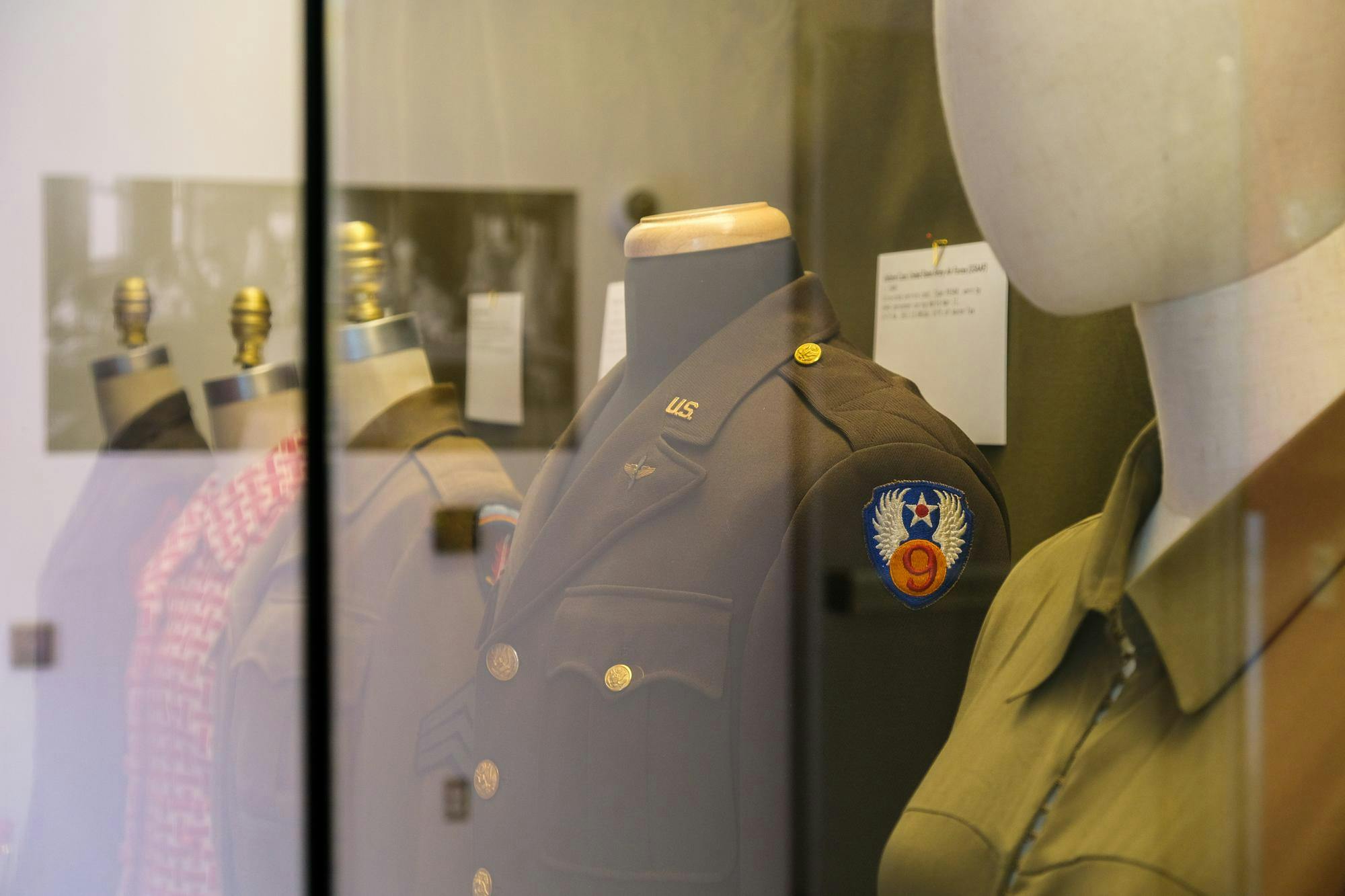
The Fit for Duty exhibit is housed in two locations on Cornell’s campus: the Human Ecology Building and Wortham Museum in Barton Hall. These two places host a plethora of historic military dress while also adding in student creations inspired by the fashion of our armed forces. In the Human Ecology Building, Cornell alumnus John Edward Rupert ’51’s United States Air Force uniform dresses a mannequin; a plaque beside this piece states that Rupert volunteered “for the newly independent U.S. Air Force” after earning his law degree. Placed next to Rupert’s historic uniform is a black denim vest and army green paneled trousers designed by Raquel Coren ’25. This modern outfit, described on its plaque as “merging historical and futuristic aesthetics” while “exploring structured mobility,” highlights how the military dress of past wars is alive today, now serving in a peaceful and educational role. Moving from Rupert’s 1951 uniform to Coren’s 2025 construction, the public gets a sense of the passage of time coupled with the eternal presence of the men and women who preserve our freedom.
Fit for Duty and its study of the past, present and future of military dress does not end in Barton Hall or the Human Ecology Building. In collaboration, Cornell Cinema began their own film series with a showing of Apocalypse Now: The Final Cut. The series will continue throughout the semester and includes a screening of Top Gun, with its classic costuming for Maverick. This collaboration brings to light how military dress in film fulfills its own function. Cornell Cinema’s website notes how Maverick’s glasses and jacket in the film “offer an opportunity to reflect how military fashions permeate everyday life,” which is a major theme of the entire exhibit. Just like how the United States Air Force uniform shaped Coren’s modern design, Maverick’s clothing in Top Gun created waves in popular culture. Today, there are countless websites hawking bomber jackets, aviator glasses and flight suits, all because fans saw Tom Cruise fighting to be in an elite school for the top one percent of pilots, and they wanted to look just like him.
Military dress in popular culture has signaled many different things. In Top Gun, it was something to be revered, an appearance that was sought after for being cool. The Fit for Duty exhibit featured a 1940s lipstick called “Victory Red,” which women wore as “a symbol of courage, morale and national identity.” Oscar-nominated film One Battle After Another features a sinister military character, dressed by costume designer Colleen Atwood. In one interview, Atwood said Colonel Lockjaw’s costume “was supposed to feel very tailored, but not consciously so,” in an effort to give off the impression of stiffness and awkwardness. Yet, all of these creations stem from real military dress. The film Top Gun had Navy technical advisors on site who ensured accuracy. The Victory Red color matched red chevrons on women’s military uniforms. Colleen Atwood, in that same interview, said Lockjaw’s costume had the fit of “the way that [the military] used to tailor their uniforms in another era.”
The College of Human Ecology and Cornell Cinema’s partnership make it clear that military fashion’s form and function have never stopped influencing the movies we watch, the makeup we apply and the clothes we choose to wear. In film, military dress can carry either positive or negative connotations, bringing to mind high-adrenaline action or the violence of war. In fashion, military dress has evolved to become classic colors, like army green or Victory Red, or even ubiquitous patterns such as aloha or camo. The style of the armed forces spans across time and disciplines, entering into our lives when we have war and when we have peace.
Jane Locke is a member of the Class of 2028 in the College of Arts and Sciences. She is a staff writer for the Arts & Culture department and can be reached at jlocke@cornellsun.com.