

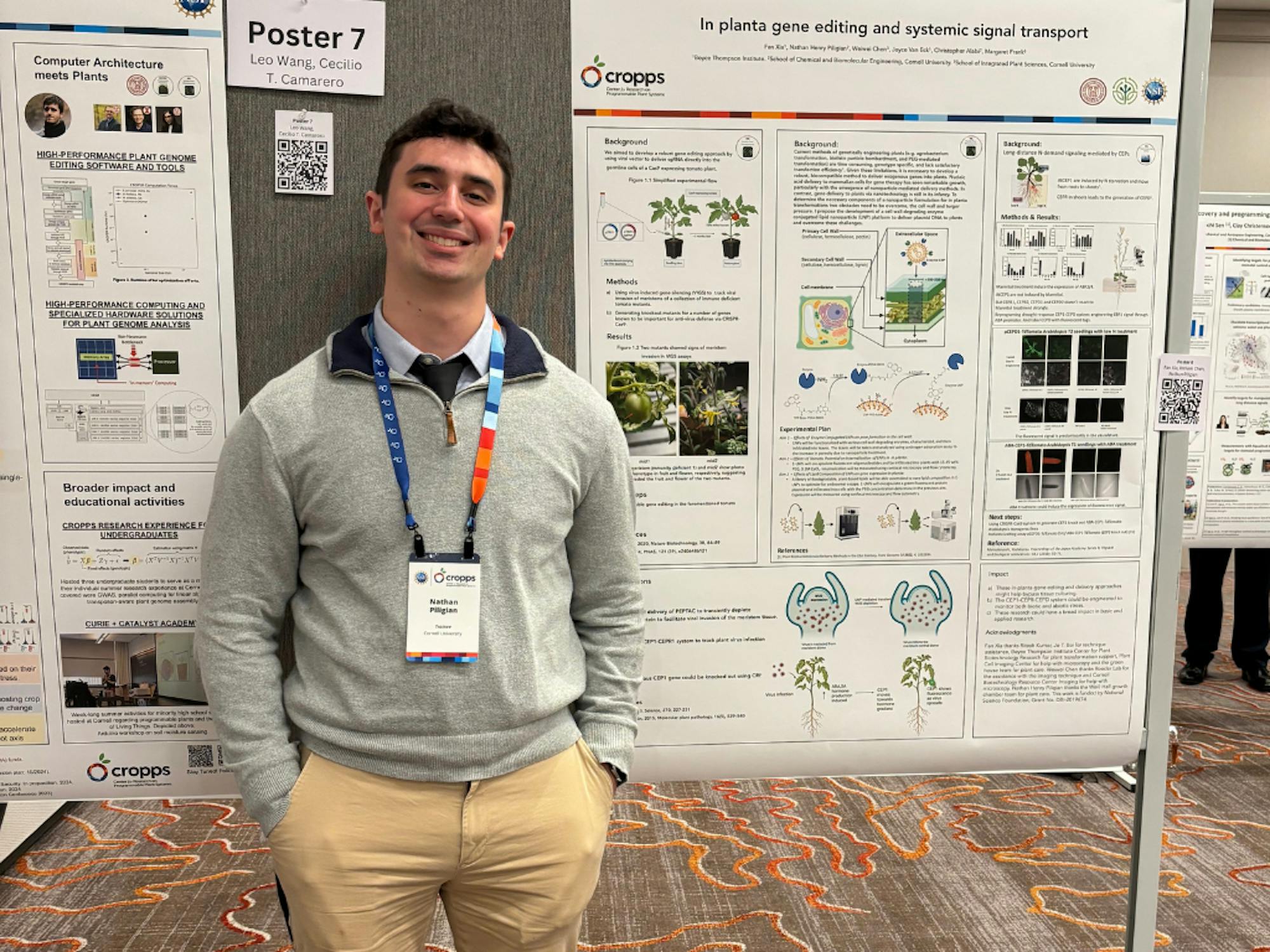
As a Ph.D. candidate in the Smith School of Chemical and Biomolecular Engineering, Nathan Piligian is developing a novel method of delivering genes into plant cells so that they are better adapted to environmental stressors in the Alabi Lab.
The Alabi Lab focuses on engineering systems to deliver drugs into cells. Prof. Christopher Alabi, Chemistry and Chemical Biology, is the lab’s principal investigator.
Piligian’s current project focuses on engineering plants to be more resistant to environmental stressors such as increasing temperatures. This is important because according to the World Bank Group, global food production will need to have a 60 percent increase to accommodate a predicted global population of 10 billion people by 2050.
“There are many benefits we can give plants [like] the ability to resist environmental stressors, such as climate change,” Piligian said. “For example, the Earth is becoming hotter at a rate that plants can’t adapt to. So being able to genetically engineer plants to be more heat resistant, be more drought resistant, is very much desirable — just like how we give people vaccines.”
Common current methods of gene delivery in plants include biolistic particle bombardment, in which millions of DNA-coated metal particles are shot at cells with a gene gun. However, this method has its drawbacks — biolistic particle bombardment results in extensive damage in the transaction process due to the high pressure used to fire nanoparticles into the plant tissue.
Piligian’s research involves developing a nanoparticle delivery method of genes so that there will be no external application of force. Using enzymes, the wall surrounding the cell is degraded, after which fat-soluble nanoparticles are used to deliver the gene. His research should be able to allow gene delivery in many different species of plants because of the compatibility of nanoparticles with different genomes.
Alabi proposed Piligian’s current project, and Piligian expanded on it.
“Nathan really took [the gene delivery project] on and I think in our group, he is quintessential,” Alabi said. “He's someone that takes initiative, and he's able to reach out and get the information where he needs to get it, and it's been a joy to work with him.”
For Piligian, getting to work at the frontier of new genetic engineering technologies is one of the highlights of research.
“I think the most exciting part about this project is that it's a very new space. I'm trying to develop a technology that doesn't exist yet,” Piligian said. “There is a need for this technology, and I think that's very exciting because people would directly benefit from it.”
One application of this technology is to aid scientists in the design of nutrient-rich genetically engineered crops, according to Piligian. This could be important to third-world countries where people struggle with nutrient deficiencies that can lead to diseases like scurvy, rickets and night blindness. Nutrient-rich crops could aid people who struggle to meet typical nutritional requirements, providing them with the ability to have a healthier, more well-rounded diet.
Additionally, Piligian’s technology could also help provide plants the ability to resist environmental stresses such as climate change. The Earth is becoming hotter at a much higher rate than plants can adapt to, so being able to engineer plants to be more heat resistant genetically would be crucial to preventing the loss of crop harvests.
“Our ability to be able to manipulate plant systems ties directly into food security, climate change and a whole bunch of other societal issues. Plants are central to everything that happens on this Earth,” Alabi said. “Being able to communicate with plants and engineer plants…I think is going to be important in feeding our entire population in the future.”
This article is a reupload from February 2025.
Andrea Kim is a Sun Contributor and member of the Class of 2028. She can be reached at ack247@cornell.edu.


