Editor’s note: This article cites several emails with spelling and grammatical errors. These emails are quoted verbatim, with [sic] inserted to indicate that the error belongs to the source.
This article is part of a series on Jeffrey Epstein’s connections to Cornell University. Find the other pieces here.
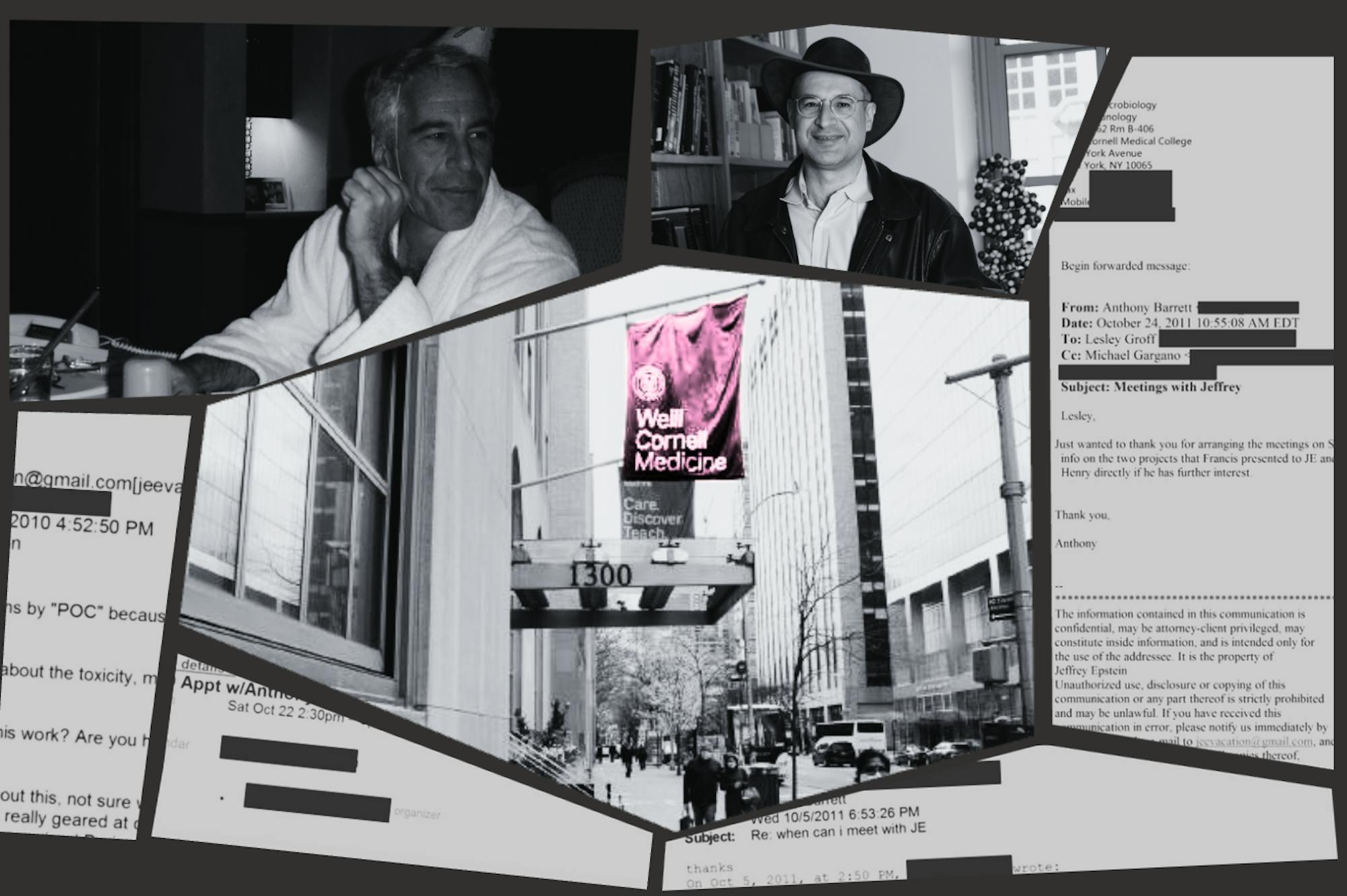
Prof. Francis Barany, microbiology, met with convicted child sex offender and financier Jeffrey Epstein in 2011 to discuss funding Barany’s cancer research, according to files released by the Department of Justice on Jan. 30. Barany, who works for Weill Cornell, later attempted to source funding for Ebola research through Epstein associates over email in 2014.
Both interactions occurred after Epstein was convicted of child prostitution in 2008.
Barany and Epstein were connected by Ossa Properties’ Anthony Barrett, a longtime associate of Epstein whose name appears frequently in the files. Ossa Properties is a real estate management company managed by Epstein’s brother, Mark Epstein, since 1992, according to his LinkedIn profile.
The Sun was unable to determine how Barany and Barrett initially connected.
The first documented interaction regarding Barany’s work found in the Department of Justice’s Epstein Library is from November 2009, when Barrett emailed Epstein asking him to review documents about Coferon Inc., now called BlinkBio, a biotechnology venture launched by Barany and two other scientists. The venture is focused on novel medical technologies for conditions such as cancer.
Epstein responded that “it seems gerat [sic] but the co is run by scientists, not a good sign.”
The next relevant emails come from September 2010, when Barrett and Epstein discussed Barany's prototype medical device, with Barrett telling Epstein it “would be great for you to meet with my friend Dr. Barany sometime.” He said that Epstein would “find him very interesting even [if] you have no interest in the company.”
At the time, Epstein had begun funding scientific research through charities like the Jeffrey Epstein Foundation VI.
Barany did not respond to a request for comment.
When The Sun asked Cornell Media Relations about Barany’s involvement with Epstein, a University spokesperson wrote, “As best as Dr. Barany can recall, when Dr. Barany was launching Coferon, there was one meeting with [Epstein] and other potential funders to present the concept of a microfluid device for detection of cancer mutations. He made no contribution to the research.”
Joi Ito — a venture capitalist, former MIT professor and director of the MIT Media Lab — asked Epstein in 2014 if his “foundation currently fund[s] Harvard or any other ‘more stuffy [t]han MIT" type institutions.’”
Epstein replied, “hasty pudding. harvard, cornell mountsinai?”
In a statement to The Sun, a University spokesperson wrote, “Cornell research administrative offices reviewed our records and could not identify funding from him or his foundation,” and that Cornell “take[s] this issue seriously and will continue our assessment.”
The Sun did not find evidence that Epstein or the Jeffrey Epstein VI Foundation has funded Cornell’s research.
Although an investigation into records by The Sun could find no direct ties between Epstein and Coferon, Barrett referenced recruiting Colin Goddard as the chairman and chief executive officer for the “biotech company” he was “involved with,” in an email sent seven months prior to Epstein and Barany’s meeting.
Barrett's role in Coferon is not immediately apparent. Colin Goddard currently serves as the chairman and CEO of BlinkBio, formerly Coferon, according to Justice Department documents and publicly available filings.
Emails appear to show that Barrett asked Epstein on multiple occasions to meet Barany.
Specifically, Barrett collaborated with Lesley Groff, Epstein’s longtime planner, to facilitate an Oct. 22, 2011, meeting in New York with Barany and Epstein.
On Oct. 18, 2011, Groff wrote to Epstein that “We had told Anthony Barrett you could probably meet his scientist =riend, [sic] Francis (Cornell Scientist) this Sat. Oct. 22nd.”
After the meeting, Barany sent Boris Nikolic — an advisor to both Epstein and Bill Gates — a follow-up email on Oct. 24, writing, “It was a pleasure meeting you on Saturday,” and attaching “confidential documents” about Coferon’s cancer detection work.
Nikolic forwarded the message to Epstein, asking, “How close are you with him?” and “How much helpful should I be?”
Epstein responded “zero” to Nikolic.
Nikolic wrote back that he would “refer to some guy in foundation to provide some follow up (that material was received) but that will be it. That guy needs some attitude adjustment.”
To that, Epstein wrote, “ignore it,.. i dont like him, .[sic]”
Barrett told Groff that she could forward Barany’s information to Henry Jarecki, a psychiatrist and philanthropist also frequently mentioned in the files.
The released files did not include any other emails concerning Barany and Coferon until July 2012, when Barrett emailed Epstein, “We did suffer some dilution in this latest financing round, but all things considered happy to get it done,” attaching Coferon press releases summarizing the technology company’s Series B financing round. Dilution refers to the reduction in a shareholder’s ownership percentage in a company when it issues new shares.
In an October 2014 correspondence, Barany and Prof. Linnie Golightly, clinical medicine, emailed Barrett to ask for help with funding research on the early detection of Ebola, writing, “we have begun designing micro-fabricated devices that wi=l [sic] allow for electronic detection.
Golightly did not respond to a request for comment.
Barany and Golightly ended the email asking, “Would your contacts be able to help us, so in turn we may help protect o=r [sic] country?”
Barrett forwarded the email to Epstein, writing, “I know last time you and Francis did not hit=it [sic] off. Nevertheless he has been successful as a scientist and is really no= a “people’ [sic] person.”
Epstein wrote back, “ill try.”
The 2014 correspondence was the last recorded time available in the released files that The Sun could identify Barany communicating with Epstein’s associates.
The Sun was unable to locate contact information for Groff, Nikolic, Barrett or Jarecki.

Atticus Johnson is a member of the Class of 2028 in the College of Arts and Sciences. He is a senior writer for the News department and can be reached at ajohnson@cornellsun.com.