

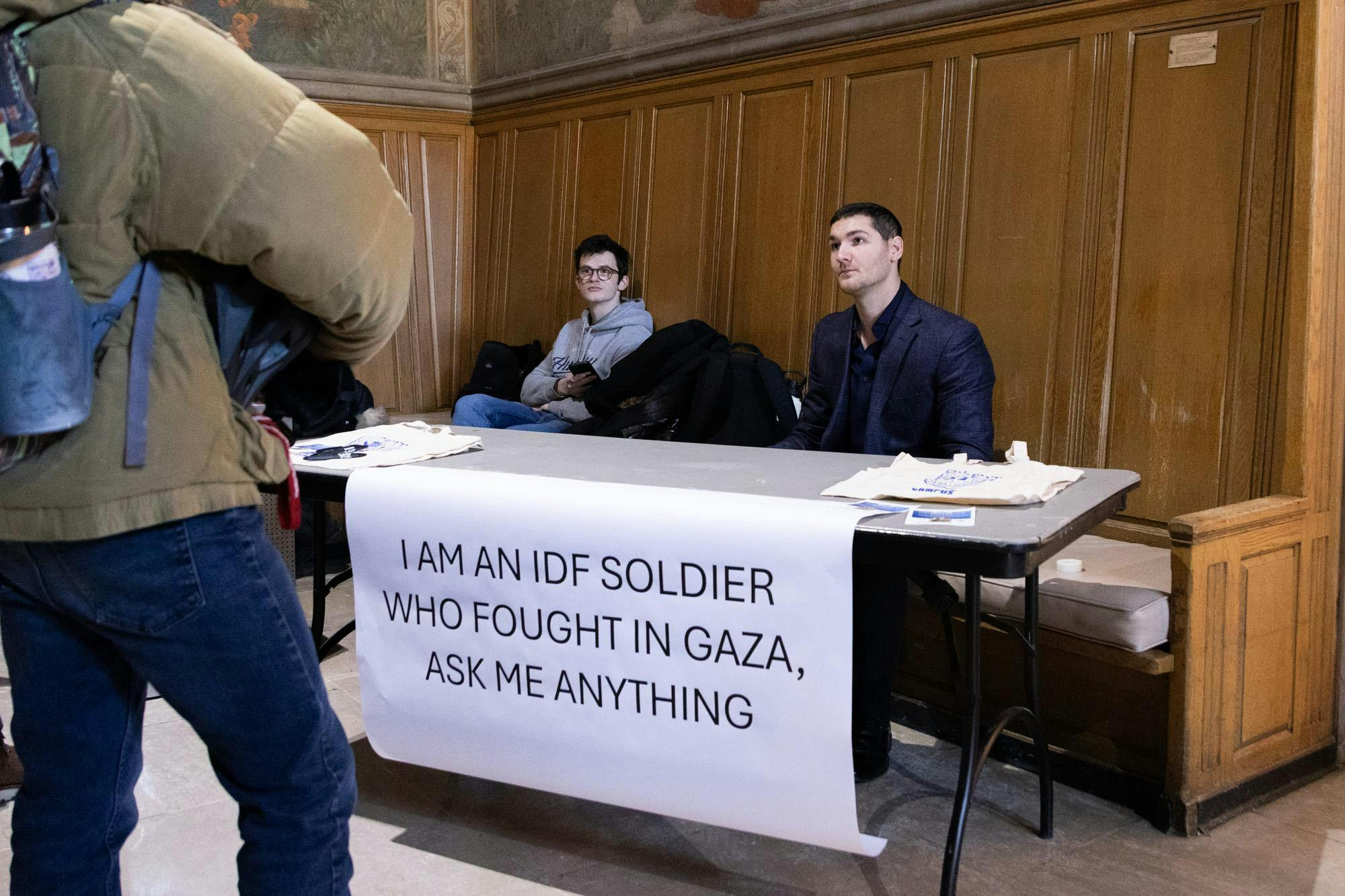
“I am an IDF Soldier Who Fought in Gaza, Ask Me Anything,” read a poster in front of Sam Fried, an American citizen who volunteered to fight in Gaza as a sharpshooter, as he tabled in Willard Straight Hall on Monday afternoon.
Throughout the tabling session, dozens of students circled Fried’s table as he defended Israel’s actions in Gaza and invited students to ask questions and debate various topics relating to the Israel-Hamas war, ranging from genocide, antisemitism and his personal experiences in the Israeli Defense Forces.
Fried’s Q&A session was announced on the Cornellians for Israel’s Instagram story at noon on Monday, minutes before the start of the event. The event was scheduled to end at 1:30 p.m. However, Fried continued for nearly two additional hours.
CFI, a Cornell organization focusing on “Israel advocacy, education, and programming,” according to its Instagram bio, hosted an RSVP-required guest speaker event with Fried a few hours after the Q&A session, where media coverage was not allowed. In contrast, Fried’s tabling was open to anyone passing by.
Originally from Queens, New York, Fried served in the IDF in the army from 2020 to 2022, ultimately ranking as a paratrooper in the 890th battalion, before returning home to pursue a degree in finance at Baruch College. After the Oct. 7, 2023 attacks, he rejoined the IDF reserves as a sharpshooter, because he felt an “obligation to be one of the fighting Jews in history,” he said in an interview with the Jerusalem Post.
CFI’s announcement of Fried’s presence on campus sparked controversy among students.
One student asked Fried whether the war in Gaza could be labeled a genocide.
“If this is, in fact, a genocide, then we are doing a really, really poor job at committing genocide,” Fried responded. “If we are trying to inflict as much harm as possible, we would not go through sending soldiers in and putting my life at risk.”
In an email statement to The Sun sent after the event, Fried wrote that he believes “‘genocide,’ by definition, requires intent.” He added that he feels “there is clearly no intent in this case,” writing that the IDF escorts Palestinians to safety, provides humanitarian aid and drops leaflets informing residents of “safe zones” before strikes.
The war was labeled a genocide on Sept. 16 by the U.N. Independent International Commission of Inquiry on the Occupied Palestinian Territory, who reported that Israel committed four of five genocidal acts against Palestinians according to the 1948 Convention on the Prevention and Punishment of the Crime of Genocide. The report specifically cited Israeli military operations “killing and seriously harming unprecedented numbers of Palestinians; imposing a total siege, including blocking humanitarian aid leading to starvation,” as factors considered in its labeling.
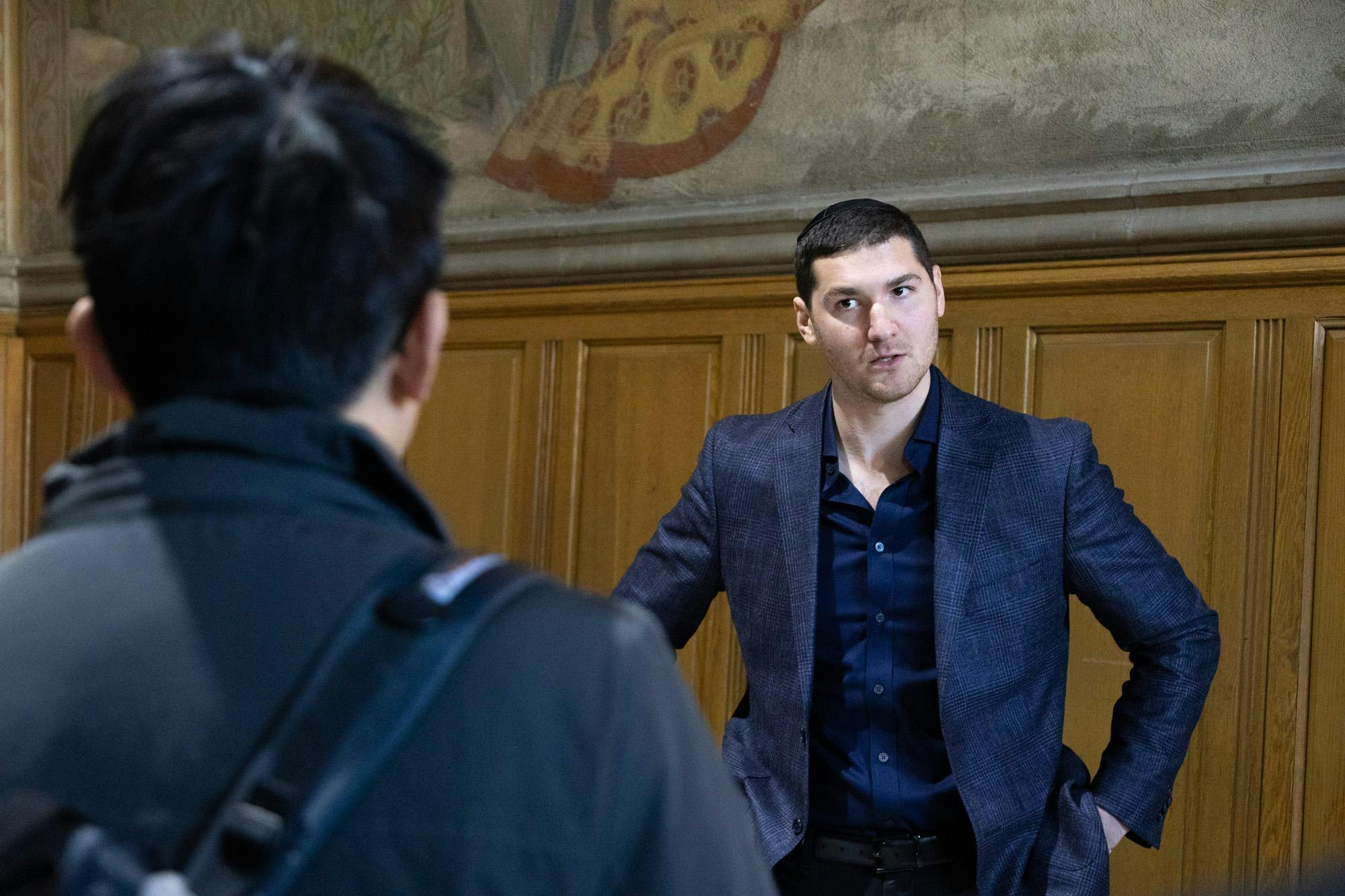
Sam Fried partaking in discourse with a student during his Q&A session.
In numerous instances during the Q&A session, Fried commented on his disdain for Hamas and his belief that Hamas was interfering with achieving peace in the war. Hamas is recognized by the U.S. Department of State as a foreign terrorist organization.
“Hamas is maximizing the amount of people they are trying to get killed,” Fried said in a discussion with a student about the war’s impact on Gazan civilians. “They are incentivized to kill more of their own people, and Israel is doing everything that they can in their defense to protect people.”
One student asked about videos he had seen of Israeli soldiers targeting civilians. Fried claimed those videos were edited, and “obviously propaganda,” explaining that he thinks people should “ask questions” about what they see online.
“I’m a normal person,” Fried continued. “I’m also a commander. I'm also a sharpshooter. I care about lives. I care about innocent Palestinians. I don't think any of you here can look me in the eye and tell me that I murder kids.”
On Oct. 8, the U.N. Children's Fund reported over 64,000 injuries and deaths of children in Gaza since the start of the war, excluding indirect casualties stemming from “preventable illnesses.”
Fried also expressed his views on Hamas and separated the militia from the people of Palestine.
“Even in the tense moments, it's very important for me to stress that I do care about Palestinian lives, whether we don't agree on how we should get to the end of the war, the removal of IDF soldiers in Gaza and the destruction of Hamas,” Fried said. “Ultimately, I care about a future that revolves around our children, our progeny, having peace [and] being absent of hate.”
A large portion of the event involved Fried sharing his personal experience in Gaza. He referenced friends, colleagues and distant family who were directly affected by the war, including a close connection to the Oct. 7 hostage situation.
“This war was brought to us on Oct. 7, [2023], when 1,200 people were murdered and 251 hostages were taken into Gaza,” Fried said. “If it was my choice, I would not want to be in Gaza. If it was my choice, I would not want to be shot at. My two friends who were killed, I do not want them to be dead.”
One student said that Israel could have “put pressure [on Hamas] from the international community” and “gotten a lot of wow factor from people who don't support Israel, by not going in and doing the obvious thing and just going and destroying Hamas.”
“You don’t go into bed with somebody who just murdered your people,” Fried responded. “It shows weakness. It’s not what we do.”
In an email statement to The Sun sent after the event, Fried added that “There is no precedent in history in which after being attacked on sovereign soil at that scale, that a country just sat back and let it go without decisive response. … No other nation in history has or would be expected to [do] such a thing and neither will we.”
The Ministry of Health in Gaza reported that, as of Dec. 11, over 70,000 Palestinians have died since the Oct. 7 attacks and another 170,000 have been injured, according to the U.N. Office for the Coordination of Humanitarian Affairs. According to Israeli officials, around 1,200 Israeli civilians were killed during the Oct. 7 attack, and at least 923 IDF soldiers have died following the attack, as of January 22, 2026, the IDF reported.
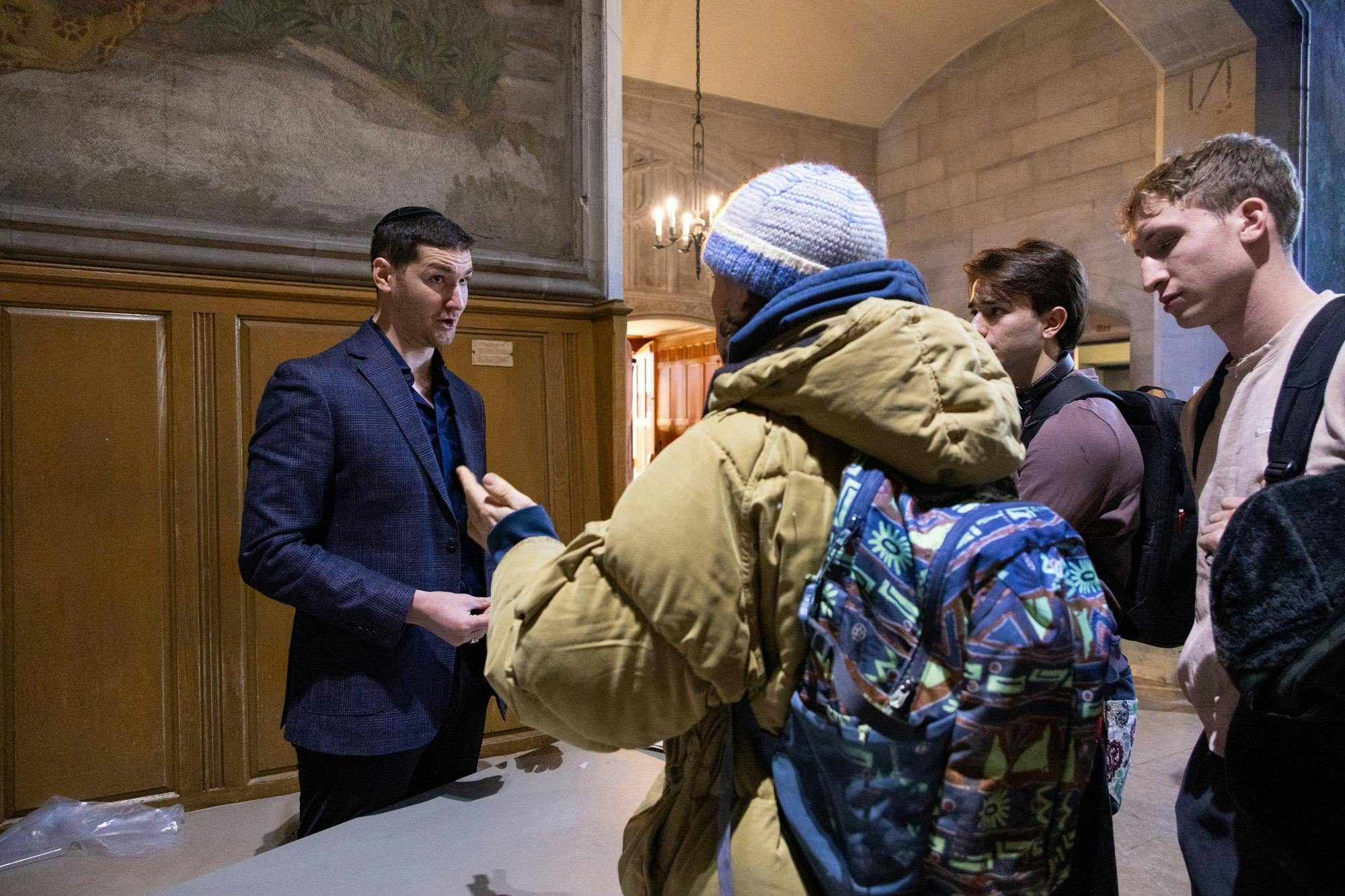
A student argues with Sam Fried in a back-and-forth debate while others look on.
Fried also criticized pro-Palestinian protesters across the world.
“Protests are largely not about [the U.S.’ involvement in the war] — they are about [what they call the] ‘genocide,’” Fried said. “They’re about the intifada revolution, and making a global intifada revolution.”
In an email statement to The Sun sent after the event, Fried added that “‘Intifada,’ in this context—also known as the Second Intifada (2000–2005)—was a period marked by mass suicide bombings across Israel that killed over 1,000 civilians,” and that he defines the “global intifada” that he referenced as the “mass targeting of Jews globally, as we are seeing in real time given the significant increase in antisemitism since the beginning of the war.”
Intifada, an Arabic word translating to “uprising,” comes from the Arabic root word “nafd,” which means “to shake off.” The term has been used to describe Palestinian uprisings in Israel’s occupation of Gaza and the West Bank in the late 20th and early 21st centuries, according to Britannica.
Pro-Palestinian activist groups at Cornell have used the term “intifada” in several protests, chanting “Globalize the Intifada” outside the October Trustee-Council Annual Meeting and “There is only one solution: Intifada revolution” during the protests for Cornell’s divestment from Israel in Spring 2024.
The American Jewish Committee views the term ‘intifada’ as antisemitic. The committee’s Translate Hate dictionary describes the message of the phrase “globalize the intifada” as “encourag[ing] resistance, most prominently in the form of violence, against Israel.” And that the usage of the term “globalize” targets “Jews, Israelis, and institutions that support Israel around the world”.
The University condemned the chant in the 2024 protests in an April 2024 statement, stating that “the protesting group has repeatedly stated that their protest is political and not antisemitic, but these chants belie that claim.”
Throughout the tabling session, Fried commented on his goals for the visit.
“[My goal on campus is to] try to speak to people about what is going on in the war and the overall conflict and how we can achieve peace, and ultimately, to show people that as an IDF soldier, all I care about is peace, promoting peace, and ultimately having the dialogue to get there,” Fried said.
Correction, Feb. 6, 8:00 p.m.: This article has been updated to more accurately reflect Sam Fried’s statements on genocide, countries responding to attacks, pro-Palestinian protestors and intifada.

Coral Platt is a member of the Class of 2029 in the College of Arts and Sciences. She is a news editor for the 144th Editorial Board and can be reached at cplatt@cornellsun.com.

Everett Chambala is a member of the Class of 2027 in the School of Industrial and Labor Relations. He is an assistant news editor for the 144th Editorial Board and can be reached at echambala@cornellsun.com.


