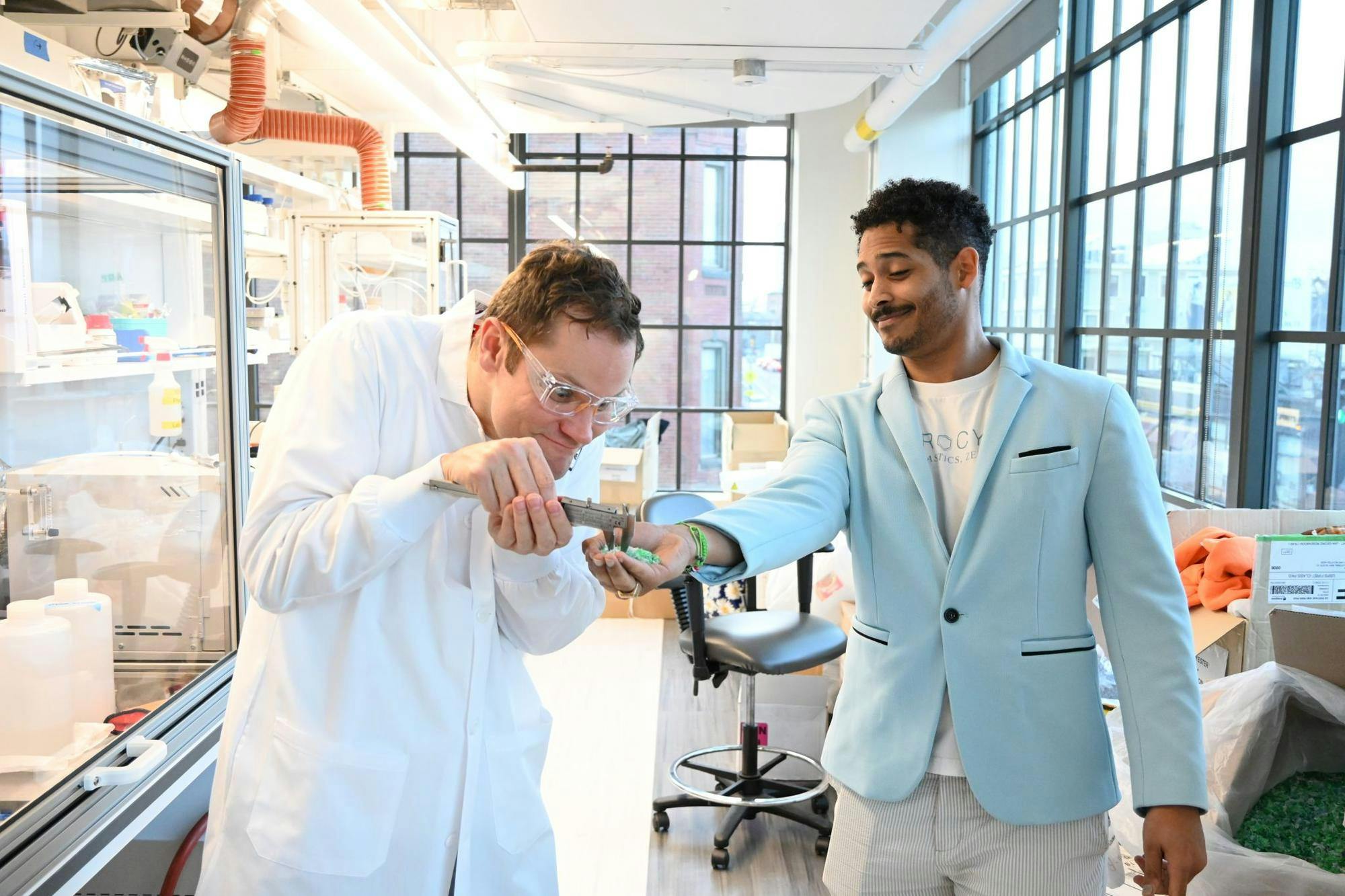
A new kind of entrepreneur, Stwart Peña Feliz ’17, stands poised to shake up the plastics industry. Recognized by Forbes 30 under 30 as a leader in manufacturing and industry, Peña Feliz is on a mission to reduce the more than five million metric tons of plastic polluting our waters every year.
MacroCycle Technologies, co-founded in July 2023 by Peña Feliz and Jan-Georg Rosenboom in Cambridge, Massachusetts, seeks to reduce plastic’s ecological footprint by recycling complex polyethylene terephthalate plastics and textiles at price parity to newly made plastics while achieving zero carbon emissions. However, MacroCycle is also an agent focused on systems reform, and Peña Feliz and Rosenboom are its catalysts, looking to stir up the next plastics revolution.
Currently, it’s estimated that the U.S. recycles only 5% to 6% of its plastic, with 85% of plastic produced today ending up in landfills, oceans and incinerators, even when recycled. As plastics continue to be wasted and decomposed, plastic production may even surpass coal-fired power plants in emissions by the end of the decade.
Textiles alone account for 10% of global greenhouse gas emissions, 20% of global water pollution and 35% of the world’s ocean microplastic pollution. Furthermore, textiles are only one of many plastic-based materials that are wasted due to the labour and energy-intensive process of separating and recycling complex polymer blends. MacroCycle claims to have found the solution.
At Cornell, Peña Feliz majored in chemical engineering with a minor in entrepreneurship. After graduation, he began his career at ExxonMobil, where he oversaw the first recycling unit within the company’s core production system. He went on to complete his master’s in business administration at the Massachusetts Institute of Technology Sloan School of Management in June 2023, where he met co-founder Rosenboom. With funding from the Bill Gates Breakthrough Energy Fellowship, Peña Feliz set off to fulfill his entrepreneurial dreams as chief executive officer of MacroCycle Technologies.
On the scientific frontier, Rosenboom has masterminded a process that forces plastic polymers to bond with each other, forming a new, large ring-like intermediate called a macrocycle, which is then broken down to create longer chains equivalent to high-grade newly made plastic standards.
“Our competitors are breaking down the bonds of the polymer … we instead make new ones, [allowing] us to … bypass old energy-intensive steps that our competitors are required to take,” Peña Feliz said.
By harnessing natural chemical processes, MacroCycle has achieved an 80% reduction in energy consumption compared to traditional methods. According to Peña Feliz, the remaining 20% of energy consumption can also be fully electrified, bringing its emissions close to zero.
Since its founding, MacroCycle has secured over $10 million in funding, scaled from lab to pilot, and is planning to transition to a demo-industrial stage over the next few months to reach a capacity of 1,000 tons of plastic per year. However, for Peña Feliz, plastic pollution is a global problem, and he is “planning to globalize this solution to address this crisis.” At MacroCycle, globalizing begins with a global team whose members already hail from eight different countries.
But technology alone is not enough. As Peña Feliz noted, “it is cheaper today to produce more plastics than to collect and recycle [them].”
While various policies can level the competitive playing field and facilitate sustainable market shifts, MacroCycle identifies federal Extended Producer Responsibility, where producers are held responsible for their product’s end-of-life, as critical in promoting a circular economy and incentivizing sustainable innovation.
Federal EPR programs can increase feedstock collection, enabling plastic recycling at lower input costs so that recycled materials can compete with petrochemical plastics. For example, bottle deposits promote high recycling rates by incurring a small fee per plastic container purchased that is refunded when the container is returned.
Still, Peña Feliz believes MacroCycle must remain independent from fluctuating government policies.
“If we’re able to create a pathway where capitalism cannot ignore our circularity, I think we’ve done our job,” Peña Feliz said.
Peña Feliz believes his personal success lies in “continuing to learn and make an impact.”
Peña Feliz encourages students to take as many physical education classes as possible (he took 15), to have fun, to work hard and to learn as much as possible at Cornell.
“If you force yourself to be innovative, you might end up unhappy, [but when] you see the opportunity come up, take advantage of it, and don’t let go,” Peña Feliz said.