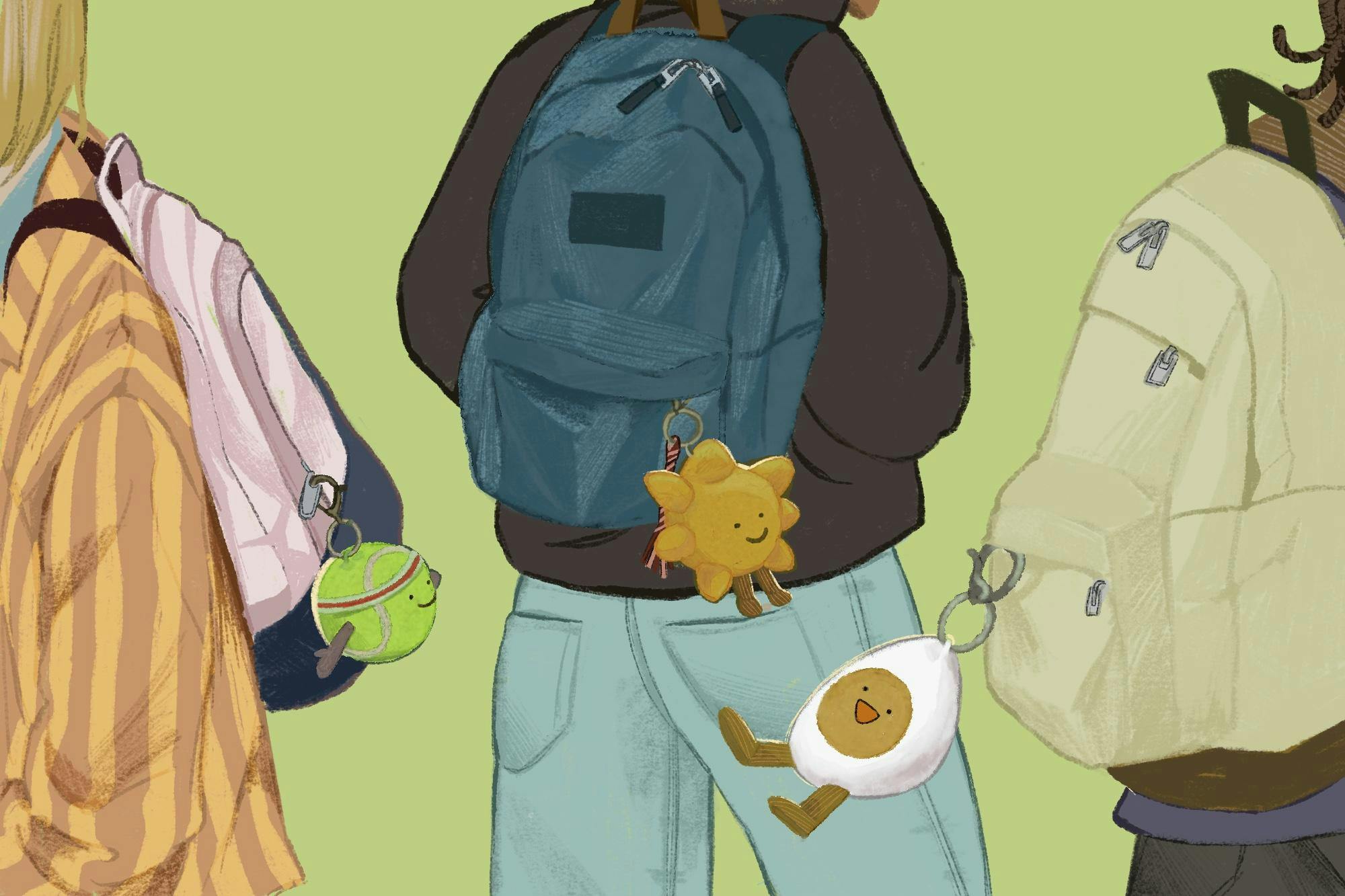
Walking on the way to class, you watch the growing sea of backpacks in front of you. You see the sway of keychains, the clinking of metal trinkets jolting you awake from your early morning drowsiness. Some people have gift shop souvenirs; others have stuffed animals that brush together in silence. You think the stuffed beige bunny on the backpack in front of you is cute. Then you spot another on the bag beside it. It only takes one more identical bunny for you to realize that this is more than just a coincidence.
After winter break, the crowd of Jellycats on campus has only seemed to grow. Even before, it was rare to go a whole day without seeing one. With the vast array of designs and characters in the Jellycat catalog, ranging from fluffy bunnies to funny baguettes, the friendly stuffed animals offer endless options. Their prices are just as wide-ranging, starting at $15 and going up to $100. But what exactly makes Jellycats so popular among Cornell students, and do these reasons justify the hefty price?
The Design
One of the most recognizable aspects of Jellycats is their simple design. While other popular stuffed toy brands, such as the Beanie Boos, are appealing because of their large, sparkling eyes and saturated colours, Jellycats stick with the motto that less is more. Apart from a few exceptions, the faces of most Jellycats are nothing more than two black dots for eyes and a curved line for a smile, and the colours are light and subdued. Take, for example, the Jellycat Amusables Happy Boiled Egg. As a result, the stuffed animals exude a feeling of serenity in their simplicity.
Even so, is this design choice the only attribute that makes Jellycats unique? Sophia Shi ’28, an avid collector of Jellycats, says, “The Jellycats’ simple expression makes them especially superior to other stuffed animals in terms of uniqueness.”
Heidi Yu ’28, another advocate for Jellycats, describes their simplicity as something that “adds not only to their distinctiveness but also highlights their adorableness.”
While these comments on Jellycats may not be necessarily incorrect, the simplicity of a Jellycat can be found in many other stuffed animals, which can be bought at a fraction of the price at stores like Target and Walmart. Instead of buying Jellycat’s 4-inch Thimble Turtle for $33, Target offers a simple and substantially larger turtle plush for only $10.
Additionally, their simplicity treads the line between minimalist and boring, as most Jellycats share the same expression. When you have a shelf full of Jellycats, it becomes apparent how emotionless they are. It’s worth thinking twice before spending extra money on a Jellycat that looks extra boring.
The Material Quality
The ‘superior quality’ of Jellycats is one of the main reasons people buy them. Their exteriors are made from soft polyester, while the interiors are filled with polyester fibers and plastic pellets to give the toys weight and stability. The polyester plush fabric closely mimics the texture of real fur. Shi attests to the quality of Jellycats, “The texture and material are far softer than any other stuffed animal I have had before.” She describes the fabric as of “exceptionally high quality,” which substantially increases how “huggable” she considers them to be.
All this being said, these materials are not uncommon in stuffed animal creation. While the company uses “premium quality fabrics” made by “specialist fabric mills,” the primary material they use to create Jellycats is polyester. Synthetic polyester plush is one of the most common outer fabrics for soft toys as it provides a substantial degree of durability, is easy to wash and is considered to be hypoallergenic. The inside polyester fibrils that give Jellycats a soothing, weighted feel are also found in most stuffed animals. Though the quality of its material may be somewhat higher than other stuffed animal brands, the fundamental material that Jellycats are made of isn’t unique among its peers. In that regard, I believe that the slight boost in quality is not enough to justify paying over $30 for a stuffed toy the size of a palm.
The Availability
A clear feature of the Jellycat catalog is its sheer variety of stuffed animals. While it has typical plush designs such as teddy bears, bunnies and cows, it also offers stuffed animal forms of common objects. From hard-boiled eggs to crescent moons, Jellycats seem to have an option for everyone.
Around Cornell, it isn’t hard to find places selling Jellycats. Alphabet Soup, a toy store located in Downtown Ithaca, is where many Cornell students indulge their Jellycat impulses. The store offers a sizable selection of rotating Jellycats at high prices reflecting those listed on the official Jellycat website. Still, the accessibility and variety of Jellycats in the Ithaca area don’t necessarily set them apart from their competitors. Stuffed animals shaped like random objects are very common in the plush toy market, and with Alphabet Soup’s rotating Jellycat catalog, there is no guarantee the specific Jellycat you’re looking for will be in stock. Unless there’s a Jellycat that’s personally desirable to someone, it's debatable whether the brand’s variety and high price bar can be seen as worth it.
Jellycats have certainly cemented themselves as the most popular choice for stuffed animals and plush keychains on campus — attributed to their simplistic design, material quality and availability around Ithaca. While these traits hold some truth to them, Jellycat’s steep price tag doesn’t justify the ‘uniqueness’ Jellycat devotees claim they have, when there are cheaper alternative options available.
Stefanie Chen is a sophomore in the College of Human Ecology. She can be reached at sc3363@cornell.edu.
Stefanie Chen is a sophomore in the College of Human Ecology. She is a staff writer for the Lifestyle department and can be reached at schen@cornellsun.com.