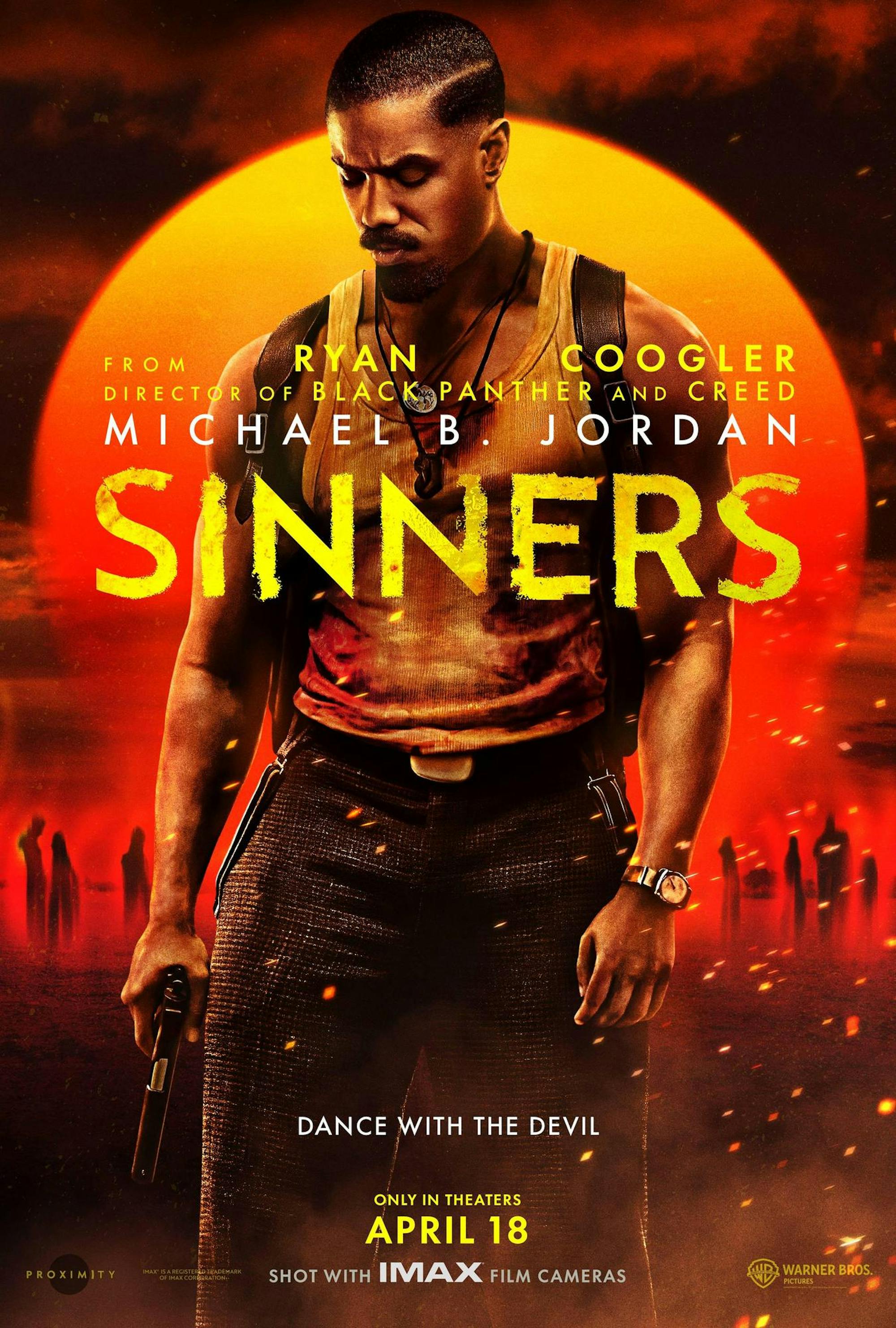
Though it hasn’t even been a full year since the release of Ryan Coogler’s Sinners, the film has already established itself as a modern American classic. Sinners was the most successful film not tied to existing intellectual property at the domestic box office, grossing almost $300 million in the United States alone. Additionally, the movie received a record-breaking 16 Oscar nominations, being nominated for all but one (Best Actress) of the categories it could have competed in. In honor of Black History Month and the film's resounding success, it is worth exploring the themes that make Sinners such a powerful work. Spoilers ahead!
Set in rural Mississippi in the 1930s, Sinners centers on twin brothers Smoke and Stack as they return to their hometown to open a nightclub for the local Black community. They soon discover, however, that a multitude of terrifying forces threaten their goal. These forces powerfully represent many of the most present dangers to Black existence and culture throughout American history.
The Ku Klux Klan acts as one of the most straightforward symbols in the movie. The infamous domestic terrorist organization has intimidated and brutalized Black communities (among other immigrant and minority groups) since the Reconstruction era. Violent hate groups like the KKK have sought to eradicate Black people and their influence in society, utilizing methods like voter intimidation, lynching and massacres of entire communities. Many of these groups moved online in the early 2000s, which has led their dangerous philosophies to be felt today in the rhetoric of many political figures, massive far-right protests and racially-targeted mass shootings.
Vampirism, the central antagonistic force throughout Sinners, represents the more quiet avenues of cultural destruction: appropriation and assimilation. Black culture has long occupied a complicated place in American culture as a result of widespread racism. Many of the most ‘American’ art forms and genres (blues, jazz, rock and roll, soul, funk, rap, etc.) were pioneered by Black musicians. Because of the systemic racism that has pervaded the United States, however, early Black genre pioneers did not receive proper recognition for their work. Instead, white artists took from the work of Black artists and were catapulted to commercial fame (think Benny Goodman, Elvis Presley and Eminem). Additionally, Black artists would often have to shed certain aspects of their identity and art in order to gain popular appeal. Members of mainstream white society would simply not acknowledge the quality of Black art until it was served in a way that was palatable to its sensibilities. As Delta Slim (Delroy Lindo) says in Sinners, “See, white folks, they like the blues just fine … they just don't like the people who make it.”
Symbolizing this historical pattern, Remmick (the main vampire depicted in the film) and his infected followers are drawn to Smoke and Stack’s juke joint when he hears the beautiful blues music being performed inside. He initially tries to enter the club by presenting his group as kind, unprejudiced music-lovers. This mirrors the tactics often used by cultural appropriators; such individuals would enter black spaces as friends before capitalizing on Black art with little credit given to its originators. When entering the joint proves unsuccessful, he employs a different approach later on. Remmick outwardly acknowledges his identity as a vampire, but tries to lure the remaining survivors into joining him by offering protection and immortality. Here, Remmick’s offer symbolizes the troubling process of cultural assimilation. One of the only ways early black artists could gain acceptance and profitability was by selling out parts of their identity and craft to white record companies and managers. Similarly, Remmick offers success that is contingent on loss of control that will come for his victims as they are assimilated into his hive mind.
But Coogler deepens his depictions of appropriation and assimilation in the film in a very interesting way: Remmick, though a clear villain throughout the film, is also implied to be a victim of cultural assimilation and appropriation. Remmick is depicted as an Irish man who experienced brutal repression by British forces in his home country. He seeks to fill the void created by the destruction of Irish community and culture by taking black culture for his own, but in the process he ends up attempting to recreate the same style of oppression that he experienced in the first place. In America, many immigrant groups shed aspects of their cultural identity to gain acceptance as ‘white.’ Most Black people, on the other hand, fundamentally unable to become ‘white’ due to deep social and institutional barriers, formed and held on to a rich cultural heritage that combined elements from African, Caribbean and European traditions.
The enduring power of Black culture as a persistent tool for transcending oppression is exemplified in Sinners’ most famous scene. As guitarist Sammie Moore (Miles Caton) performs, artists from diverse genres throughout history enter the space alongside those dancing. By contributing to a beautiful history and creating meaningful music, Sammie achieves a kind of immortality for himself and those around him — immortality not contingent on giving up his mind and soul to vampirism.
Matthew Rentezelas is a sophomore in the College of Arts and Sciences. He can be reached at mmr255@cornell.edu.
Matthew Rentezelas is a member of the Class of 2028 in the College of Arts and Sciences. He is an assistant arts editor for the 144th Editorial Board and can be reached at mrentezelas@cornellsun.com.