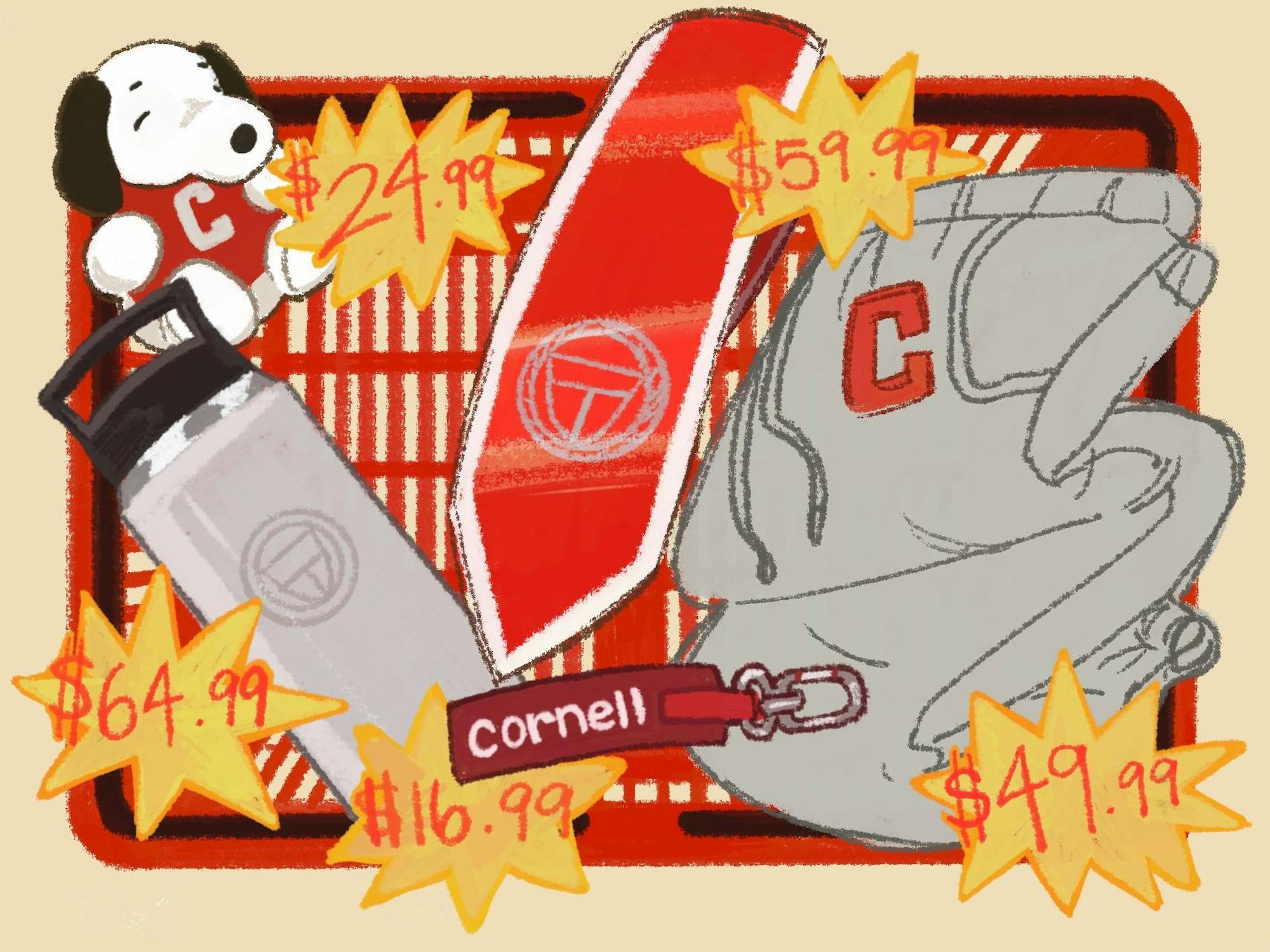
I am a certified sucker. I purchased a $17 pencil case from The Cornell Store, and for what? Was it just because it had the Cornell University logo emblazoned on the front? Looking through Amazon, I see rows and rows of generic options for a fraction of the price. I know I am not alone in getting sticker shock from The Cornell Store: $80 hoodies, $50 paperweights, plushies that go up to $100. It is no secret that Cornell’s price markup for the brand alone is insane. It is difficult not to pause and consider how a logo alone can justify prices that feel unreasonable for what you’re actually buying.
I understand the appeal of school pride, and as someone who owns plenty of Cornell-branded merchandise myself, I can get behind the excitement of finding something fun in the store and feeling the urge to buy it. It increases my sense of belonging and reflects an important part of who I am, with Cornell being a meaningful aspect of my identity. However, upon stepping back for a moment, I felt the need to ask myself what is really at play here. Merch is not just a marker of what school you go to — it also reflects the pressures of fitting in, signaling status and solidifying one’s identity in a new environment. This can become especially problematic when such pricey merchandise is not accessible to all students. Nevertheless, it still functions as a silent indicator of who can afford the merch in the first place — which, while not the intent — is a consequence of hefty price tags.
From a financial standpoint, this craze also nudges students toward more expensive choices. This is not to say you should ditch your Cornell hoodies, but rather to think more critically. Do I really need that? I have been to countless events throughout the past year that hand out free notebooks, pens, water bottles and other items. Despite that, consumer culture and the pressure to keep up with other students feels rampant at Cornell. I have caught myself noticing the merch other students are carrying and immediately wanting it for myself. Then I return to the store, look at the price tag, and feel dismayed all over again. I am still learning this myself, but separating wants from needs is going to make your wallet a lot happier in the long run. As simple as that advice is, it’s one that many struggle to follow.
Another reason to be more price-conscious is all of the unforeseen costs that accumulate while at school. For example, somebody threw away my toiletries bag after I left it in the bathroom one night, leading to my emergency run to The Cornell Store the following day. Items like that may not cost that much individually, but the small purchases can add up quickly. When those unexpected expenses are stacked on top of tens of thousands of dollars in tuition and housing, a $25 Cornell t-shirt starts to feel less harmless and more like money quietly slipping away from you without your notice. It is not a good feeling, and it has been hard to come to terms with some of the decisions I have made in impulsive moments.
I will admit that there is also a bit of a showboating culture here at Cornell. Whether it is announcing your placements in clubs, bragging about how productive you are or making sure that everyone knows you are two standard deviations above the median, there is a constant undercurrent of comparison. I think a lot of that trickles down into our own spending habits as students. Buying merch becomes another way to reinforce that you belong here — that you are a part of the ‘Cornell club.’ I am not immune to this myself. Just a few weeks ago, I bought a Cornell backpack from the online store, setting me back $70. Would I say that this is the best $70 I have ever spent? Probably not. Temptation really is around every corner, especially when you are surrounded by people wearing the very things you’ve been trying to talk yourself out of buying.
I initially set out to write about overpriced Cornell merchandise, but the real issue of The Cornell Store’s prices are much broader than hoodies and hats. I think there is a larger conversation to be had when more everyday essentials are being marked up, rather than just themed goods. You have the choice to purchase phone cases and charms, but toiletries are non-negotiable.
Necessities like toothpaste, shampoo, cold medicine and school supplies are all available in one of the most central and convenient locations on campus. The underlying issue is that many of these items are significantly marked up, and students have limited alternatives. Unlike many college towns, Cornell’s campus does not have a CVS or similar drugstore within walking distance. For students without cars, especially first-years living on North Campus, The Cornell Store becomes the default option for essentials. When the prices of everyday essentials are marked up in a place meant to be convenient, it ends up taking advantage of students who have no other options.
It feels like I am giving advice just as much as I am reminding myself to actually follow it. I am by no means perfect, but my relationship to school pride, consumer culture and compulsivity is steadily improving. School pride should not be tied to how much you spend. Paying more attention to that, and focusing less on buying unnecessary merch has made me feel more at ease and less caught up in trying to show that I belong.
Pride can show up in other ways anyway — showing up to programming led by the residence hall teams, cheering at sporting events and games or simply taking the time to build community and be there for one another. Pride is not always loud or performative — it is also found in the small, consistent acts. I encourage everyone to find pride in the little things that Cornell has to offer instead of basing value on a price tag.
Sahil Raut is a junior in the School of Industrial and Labor Relations. He can be reached at ssr247@cornell.edu.