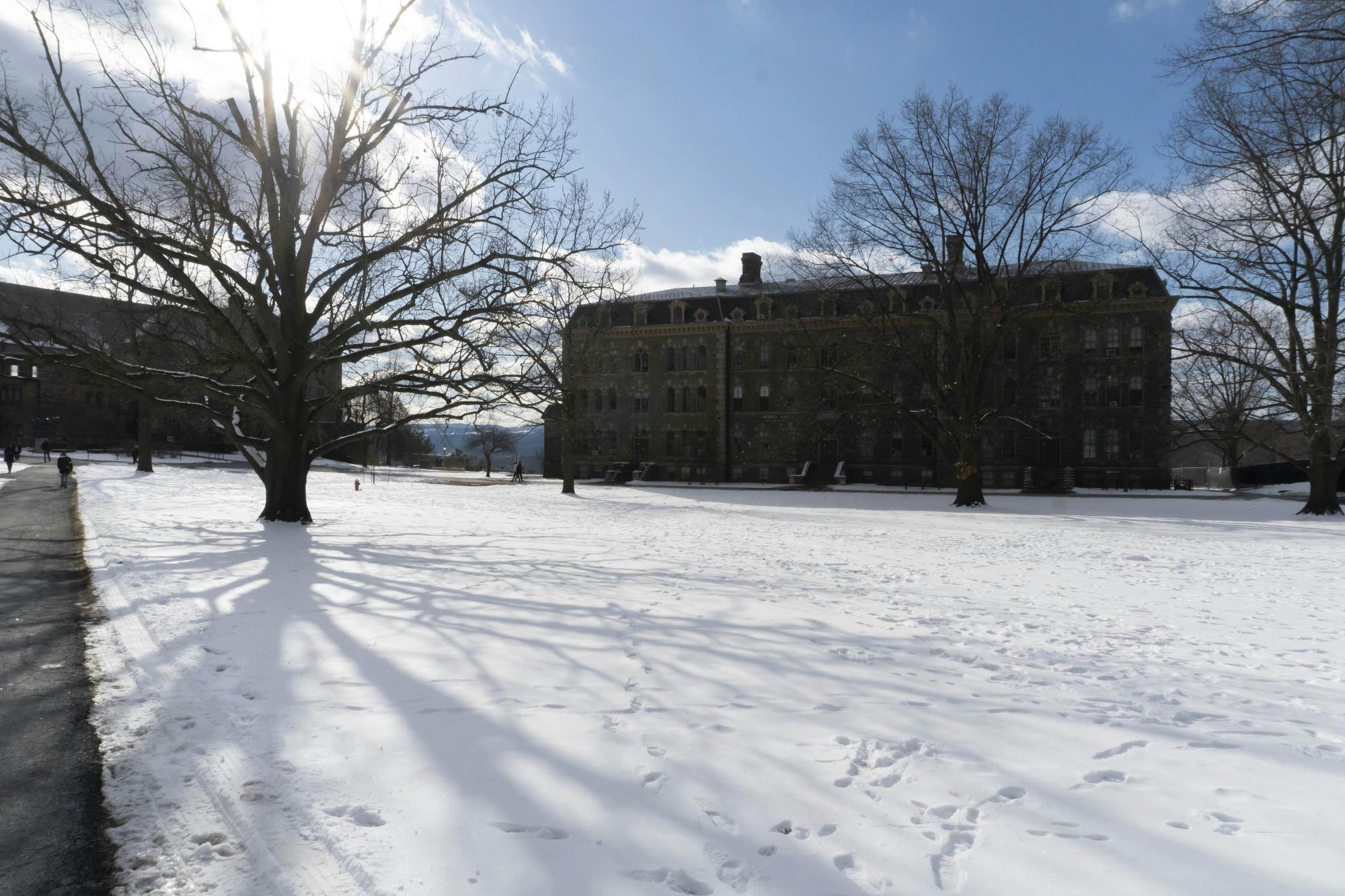
Cornell experienced up to 14 inches of snow amid Winter Storm Fern, which touched down in Tompkins County on Feb. 1 and lasted until Feb. 2. The National Weather Service issued hazardous weather alerts for the area due to the extreme weather.
The storm shut down daily routines in Ithaca and across New York state. Gov. Kathy Hochul announced a state of emergency for New York state on Friday, ahead of the storm, while the City of Ithaca declared a state of emergency effective at 6 p.m. on Sunday and closed city facilities all-day Monday.
Ithaca students and residents felt the storm’s effects directly. The Ithaca City School District was closed on Monday, while Cornell closed its campus until noon and Ithaca College operated virtually. TCAT also announced that services would be delayed until 10 a.m., Jan. 26, due to “poor road conditions.” Several thousand New York State Electric & Gas customers lost power, and all service has been restored at this point.
While the storm’s immediate effects have passed, some experts claim that its long-term implications are only beginning to unfold. In particular, researchers argue that atmospheric and meteorological data show that climate change intensified the storm’s severity, raising urgent questions about the intensity of future storms.
Climatologist Samantha Borisoff from the Northeast Regional Climate Center at Cornell reported on the storm and its impact on services in the Northeast.
“The greatest snowfall totals were generally around 24 inches, particularly in southwestern Pennsylvania, eastern New York, and New England,” Borisoff wrote. “Snowfall totals for January 25 to 26 ranked among the four greatest two-day totals for January at Boston and Worcester, MA, and Bridgeport and Hartford, CT.”
The storm, given the unofficial name Winter Storm Fern by The Weather Channel, spanned over 2,000 miles from Arizona to New England. Over 30 states were under a NWS watch, warning or advisory on Saturday, and 24 states declared an emergency at the time of the snowstorm. Based on current numbers, the death toll of the storm stands at 85 people throughout the U.S.. Causes of death include hypothermia, sledding accidents and other accidents relating to the snowstorm.
AccuWeather, a weather forecaster, predicted damages to exceed $100 billion. "This winter storm will shut it all down, and its effects will be widespread, impacting 200 million people in the United States,” AccuWeather’s Chief Meteorologist Jonathan Porter said in a Friday report, according to Newsweek.
Winter Storm Fern developed in part from an upper-level low — a closed and circulating whirlpool of cold air — off the California and Mexico coast on Jan. 22. The storm then moved inland over southwestern Texas. This low-pressure system — an area of the atmosphere where air pressure is lower than surrounding areas — met and interacted with a large mass of cold air that escaped from the Arctic. This caused the storm to rapidly intensify, reaching the Northeast on Jan. 25, where it transitioned into a nor'easter — a cyclone storm with heavy snowfall that forms when warm air from the Atlantic Ocean meets cold air over land.
Cornell climatologist Jessica Spaccio, Earth and atmospheric sciences, explained to The Sun why Winter Storm Fern was so unique.
“It’s not unusual to have storm systems in the South, but the extent and extremeness of the cold was,” Spaccio said.
The surge of Arctic air that entered North America was likely caused by sudden warming in the stratosphere, the layer of atmosphere between 11 and 50 kilometers above sea level. The polar vortex is a ribbon of high-altitude, fast-moving air that circles the Arctic region. When the stratosphere warms rapidly, the polar vortex can weaken and elongate, creating a jet stream that spills southward into North America.
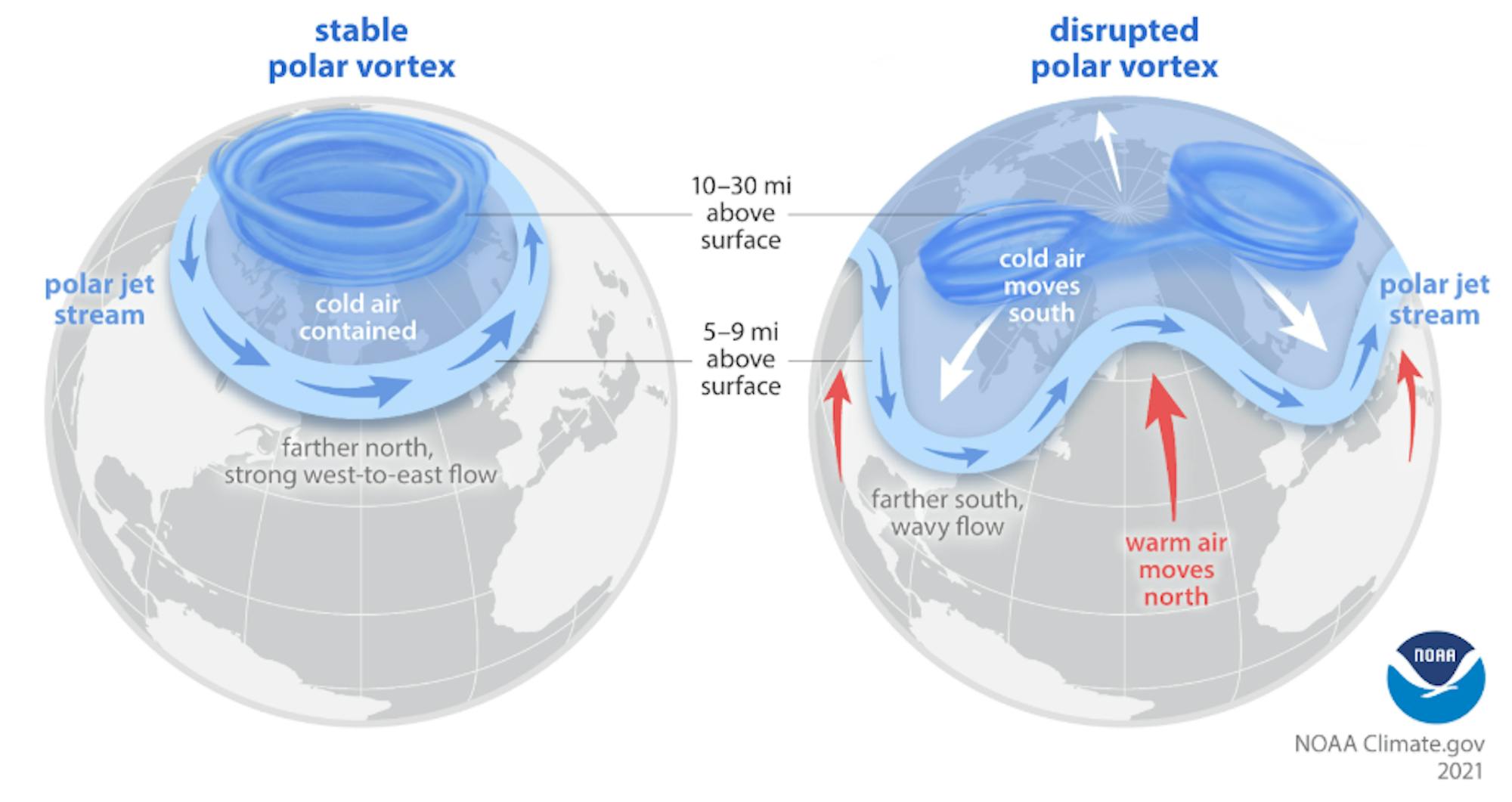
Warming atmospheric temperatures can lead to more precipitation as warmer air can hold more moisture, fueling snowstorms such as Fern. The moist air from the Gulf of Mexico and Pacific Ocean collided with the Arctic cold caused by the stretched polar vortex, leading to the extreme snow in January.
“Overall, we do expect [the amount of] snowfall to decrease going into the future,” Spaccio said. “That said, weather can be complicated."
Spaccio said that a warming atmosphere can also create heavier snowstorms in the short term due to lake effect snow. This phenomenon is caused by cold air passing over warm waters, causing large clouds to form. As the clouds move downwind of the lake, they form a narrow band that produces two to three inches of snow per hour or more.
As lake waters warm and delay ice cover, lake effect snow is expected to increase. However, as winters continue to warm, lake-effect snow will decrease overall as precipitation falls as rain instead of snow.
Spaccio elaborated on the effects of climate change on winter precipitation.
“Our atmosphere is warmer than it used to be, so we are dealing with different possible conditions every day,” Spaccio said. “There's still ongoing research into how it's affecting our winter precipitation.”
Studies show that extreme precipitation in the U.S. has already increased. The Northeast is experiencing a 50% or greater increase in heavy precipitation, and models predict a 2 to 5% increase in winter precipitation per degree of warming.
Winter Storm Fern was an attestation that climate change does not merely increase global atmospheric temperatures — extreme weather events will become increasingly volatile.
“This storm was forecast well in advance, giving folks time to prepare,” she said. “Research and funding must continue for the best forecasts and understanding of current and future storm events.”
Following the storm, forecasts predict that Ithaca should expect less snowfall but colder temperatures.
Andrea Kim is a Sun Contributor and member of the Class of 2028. She can be reached at ack247@cornell.edu.