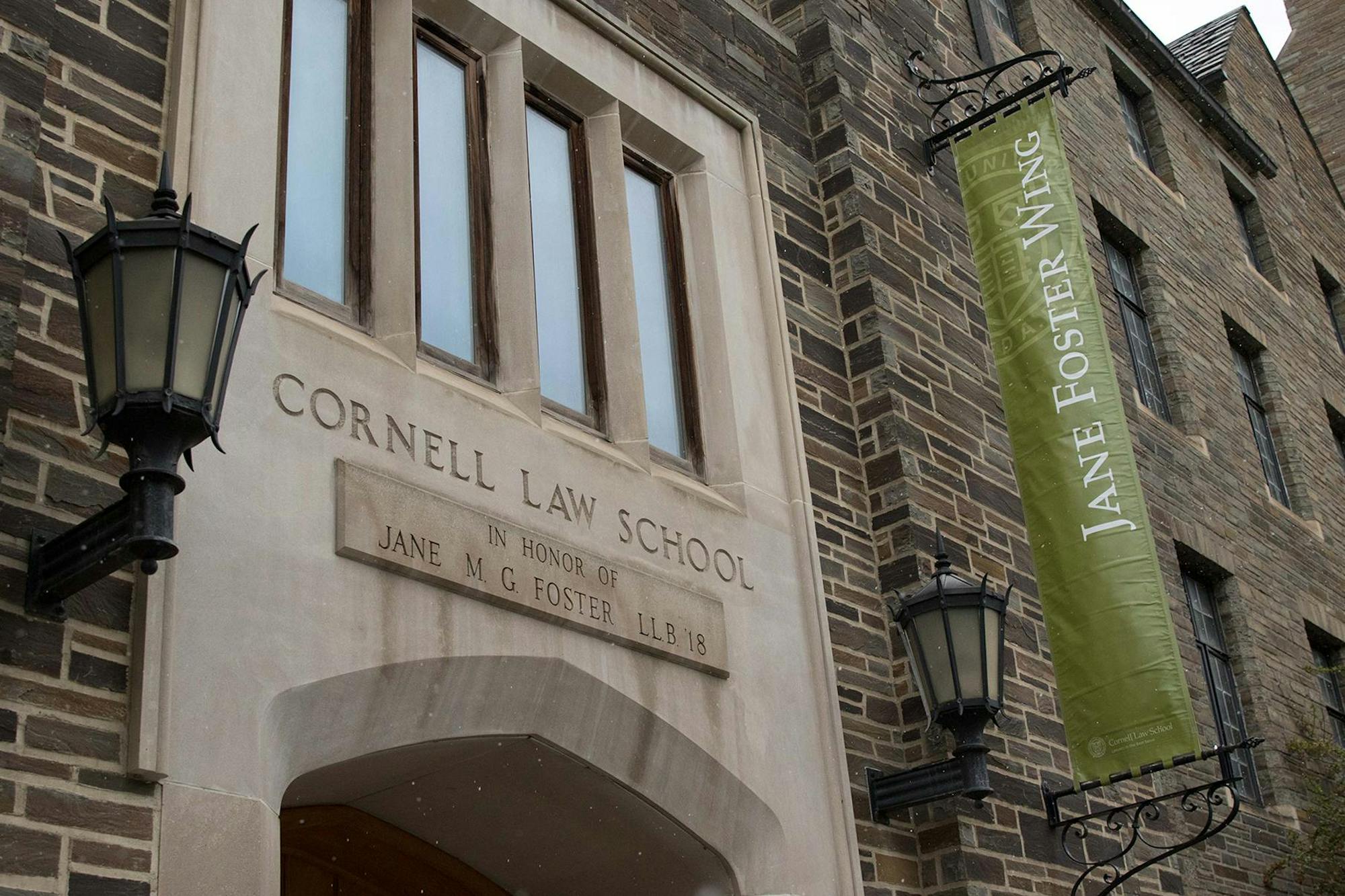
Weill Cornell dermatologist Monib Zirvi Ph.D. ’96 M.D. ’00 asked the U.S. Supreme Court on Jan. 23 to take up his claim accusing prominent law firm Akin Gump of malpractice. Zirvi alleges that the firm misled him on his intellectual property rights during the firm’s representation of Cornell in a 2010 suit, Cornell v. Illumina, where Zirvi was a witness.
Intellectual property rights refer to the right of someone to own something they created, representing original human thought.
Zirvi’s petition, filed in January but docketed by the Supreme Court on Feb. 6, alleges that attorneys at Akin Gump, including Matthew Pearson and Angela Verrecchio, had knowledge of but did not use key pieces of evidence for Zirvi and did not properly counsel Zirvi on his right to have his name on a patent and royalties for his work on DNA sequencing called ZipCodes during Illumina.
DNA sequencing is a laboratory process used to determine the exact order of nucleotide bases within DNA molecules.
The pieces of evidence, Illumina documents that referenced ZipCode patents with Zirvi and other co-inventors’ names on them, were left unused by his lawyers, Zirvi said. Zirvi later obtained the document through a freedom of information request to the Securities and Exchange Commission, according to the petition.
“It’s like a prize fight going on between two major fighters, and the person who has the stronger position doesn’t win because he throws the fight,” Zirvi said.
In Illumina, settled in 2017, Cornell accused the sequencing company of patent infringement on ZipCode technology partially developed by Zirvi in the 1990s while at Cornell. The technology sped DNA sequencing up by organizing proteins, according to Zirvi.
ZipCoding was commercialized by Illumina, a DNA sequencing company, and Thermo Fisher, a medical instrument firm, and is used in 23andMe tests, DNA forensic testing and methylation testing. The revenue from these inventions is in the “billions,” Zirvi said to The Sun.
He added that the documents were known to Akin Gump, but that he did not discover its existence until after litigation in Illumina. Additionally, he said that Akin Gump attorneys told him during Illumina proceedings that he should not hire an outside counsel, as all “interests are aligned” between Thermo Fisher, Cornell and Zirvi, who were all plaintiffs suing Illumina at the time, but later told Zirvi they had no professional obligation to him.
As one of the inventors of the technology, Zirvi was a witness in Illumina and spent “hundreds of hours preparing,” according to his Supreme Court petition, and exchanged “hundreds of emails,” with attorneys, Zirvi said to The Sun.
Zirvi’s petition claims that while he did not officially hire Akin Gump attorneys in Illumina, “their statements and conduct led him to believe that they were representing him personally,” including memos from 2016 and 2017 that were sent to Zirvi and other ZipCode developers titled “ATTORNEY CLIENT PRIVILEGED,” according to his petition.
“For all intents and purposes, [Matthew Pearson] was my attorney,” Zirvi said to The Sun.
Akin Gump did not respond to a request for comment.
Zirvi’s current suit, originally filed in 2023, was previously dismissed by the U.S. District Court for the District of New Jersey in April 2024 and the Third Circuit Court of Appeals in October.
The New Jersey District Court ruled against Zirvi in April 2024, writing that “Zirvi’s complaint fails to plead the existence of an attorney-client relationship between himself and any of those Defendants or to even plead facts sufficient for an assumption by Zirvi that the Attorney Defendants represented his interests.”
Zirvi previously filed a similar suit in 2018, which was dismissed in 2020, accusing Illumina of conspiring to steal his DNA technology trade secrets. The current suit is related to intellectual property claim against Illumina, but specifically focuses on the malpractice claim against Akin Gump. Malpractice claims accuse professionals of breaching their duties to a client, often deemed synonymous to professional negligence.
The current suit was rejected by the Third Circuit Court of Appeals on the grounds that Zirvi should have amended his 2018 suit against Illumina and Thermo Fisher to include malpractice claims under the doctrine of res judicata, which bars plaintiffs from suing twice for the same claim after a judgement has been reached.
After appeal, the circuit court then ruled that Zirvi’s claims should instead have been bundled into one complaint, though Zirvi argues that he was not aware of Akin Gump’s alleged malpractice until after the 2018 litigation was ongoing.
The Third Circuit decision was a “more extreme position,” University of Buffalo law professor Christine Bartholomew, who specializes in procedural law, wrote in a statement to The Sun. Other circuit courts may tend towards utilizing an operative complaint rule, meaning that the amended version of a complaint takes precedence.
“When there are such splits [between appellate courts], it is not uncommon for SCOTUS to weigh in to help settle or clarify the issue,” Bartholomew wrote. However, Zirvi’s case may not be “the kind of broad legal question the Court prefers to resolve,” Bartholomew added.
Even if Zirvi’s case is taken up by the Supreme Court, “it would be unusual,” for the Circuit Court’s ruling to be overturned, Prof. James Grimmelmann, law, wrote in a statement to The Sun.
“The Third Circuit rejected his appeal in a ‘nonprecedential’ opinion, which appeals courts use when they think that a case does not present difficult or important issues,” Grimmelmann wrote.
Though it is a longshot that the Supreme Court, which takes about only 1% of around 8,000 cases filed per term, will decide to take up Zirvi’s case, Zirvi said he wants “at least credit, for what I did [at Cornell] as a student,” especially because “most of our major innovations in America over the years have come from universities.”
A University spokesperson declined to comment
Correction, Feb. 18, 10:13 a.m.: A previous version of the article misstated the amount of writ petitions the Supreme Court takes per year. The correct number is 8,000, not 80,000.

Atticus Johnson is a member of the Class of 2028 in the College of Arts and Sciences. He is the off-campus news editor for the 144th board.