


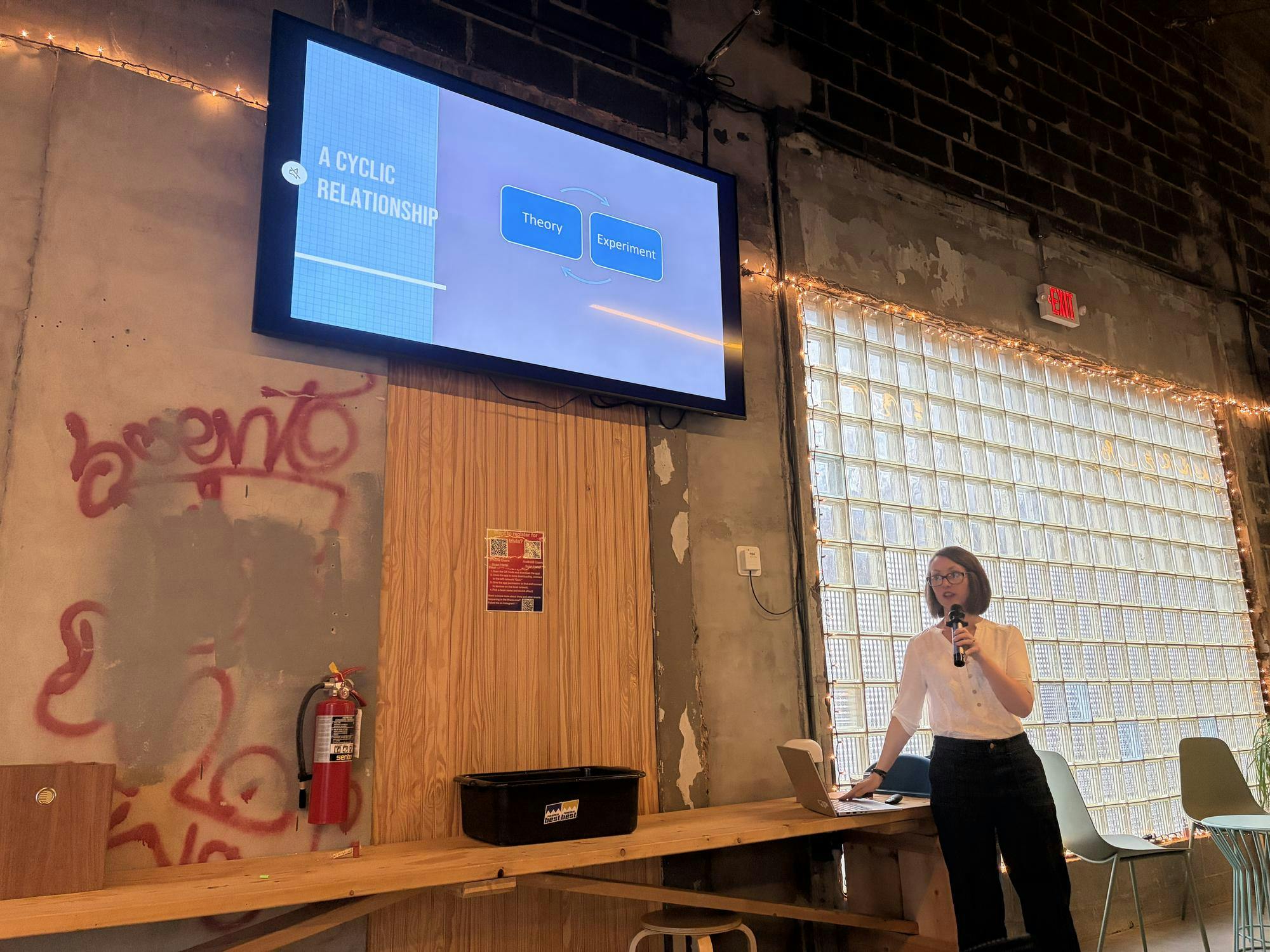
Students and Ithaca locals gathered on Sunday evening to grab drinks and learn about physics at Physics on Tap, a public event series organized by the Cornell Society of Physics Students that brings research from Cornell physics faculty to a public audience every semester.
Hosted at Personal Best Brewery in downtown Ithaca, Sunday’s installment of Physics on Tap featured Prof. Natasha Holmes, physics, who spoke about introducing uncertainty, fostering critical thinking skills and other educational values in undergraduate physics courses.
Holmes researches education practices by deploying novel methods and assessing student performance in introductory physics labs, such as PHYS 1110: “Introduction to Experimental Physics,” in which students typically explore class content through hands-on experiments.
“I hope that [this event is] meaningful to just have some sort of touchpoint with the community and the folks here locally,” Holmes said in an interview with The Sun. “And maybe hopefully get them thinking a little bit about what's happening up on the hill and why we're doing what we're doing.”
Rohan Joshi ’28 is a member of SPS and the main organizer of Physics on Tap. Joshi was inspired by Astronomy on Tap at Cornell, a similar public event series created by astronomy graduate students, and Science on Tap, an international movement bringing research talks to bars and breweries around the world.
SPS hosted the first installment of Physics on Tap in Fall 2025 and hopes to continue hosting one to two events per semester, Joshi said.
Holmes kicked off her talk by inviting the audience to share their thoughts on whether physics is objective or subjective.
Holmes explained that, according to research from her lab, undergraduate students in introductory physics courses are nearly evenly split on whether they agree with the objective stance that any object has a true, definite position, or the subjective stance that objects never have a true, definite position.
In contrast, upper-level undergraduates and experts tend to agree that physics is subjective and that everything is uncertain. Indeed, at the cutting edge of research, physicists can even have wildly different interpretations of subjects like quantum mechanics and their implications.
Despite this, we are often led to believe in media or school textbooks that there is a single, confirmable answer — a “true value” — to a physics question, Holmes explained.
“The idea of true values and true models is really just throughout our curriculum,” she said.
In one study, students in introductory physics labs at various universities were tasked with experimentally determining whether the period of a pendulum — the time required for one full swing — depends on the angle at which the pendulum is released. To test this, students had to take multiple measurements at different angles of release and determine whether the angle affected the period.
Holmes and the other researchers examined video recordings and written notes of students in the class. They found that many students came into the lab already knowing the classic, oversimplified answer to this question — that the period of a pendulum does not depend on the angle of release. Instead of taking an exploratory stance, they went in with the expectation of confirming a theory they already knew.
These students exhibited what Holmes calls “questionable research practices” — subjective interpretation, unjustified interpretation, purpose and data manipulation. As a result, they missed an important caveat: contrary to what students are often taught, the pendulum’s angle does have an effect on its period.
“I think that the idea of confirmation in teaching labs is particularly problematic,” Holmes said. “But I do think that there is a bigger issue about … wide reliance on this sort of canonical knowledge and truths, and that also is problematic.”
Holmes explained that her research has focused on developing “confirmation remedies” designed to incorporate uncertainty, disagreement and ambiguity into lab courses. These remedies include favoring critical thinking skills over objective facts and open-ended investigation over confirmation of a known theory, as well as repeated measurements to show that a “true value” is actually the convergence of many values.
In the case of the pendulum lab, the researchers found that students who received these types of “remedies” showed more sophisticated reasoning when considering their results and were more likely to make improvements to their experimental methods. Holmes referenced one student who realized, at the end of the lab, “Oh! I probably shouldn’t be doing experiments with bias going in.”
Holmes wrapped up the talk by discussing the implications of her research on setting learning priorities as educators, especially as generative AI becomes more widely used in education.
“I think Gen-AI these days necessitates changing these learning priorities, and if this wasn't urgent before, I think it's urgent now,” she said.
Emma Linscomb ’27, president of SPS, attended the event and emphasized the importance of public-facing science initiatives such as Physics on Tap.
“It was just really cool to be able to take stuff off campus and give professors who have really interesting research a platform to talk to,” Linscomb said. “You can reach a really cool audience of people who are not necessarily expecting to hear a science talk, but might be touched by something in it.”


