This story is part of The Sun’s 2026 NCAA Hockey Tournament Supplement. To view the rest of the supplement, click here.
The NCAA announces its regional locations for the NCAA Tournament far in advance. For a long while, the 2026 locations have been predetermined: Albany, New York; Worcester, Massachusetts; Sioux Falls, South Dakota; and Loveland, Colorado.
So when Cornell began to win games — lots of them, with 22 to its name heading into the tournament — some began theorizing where the Red might wind up.
Albany seemed to be the no-brainer. If the chips fell as they would, and Cornell had a feasible path to the Capital Region, why not send it there? After all, it would certainly solve a recent issue the NCAA has had in Albany: attendance.
But when Selection Sunday in the hockey world was all said and done, Cornell — at 11th in the NCAA percentage index — was headed to Loveland for a date with Denver (5th) in the regional semifinal.
The Pioneers are the hosts in Loveland, meaning they’ve been guaranteed a placement in their home state. The NCAA Tournament considers two central factors when determining the field: host teams must be placed where they are hosting, and intra-conference matchups must be avoided.
That left the official bracket as follows:
Albany
(1) Michigan vs. (4) Bentley
(2) Minnesota-Duluth vs. (3) Penn State
Sioux Falls
(1) North Dakota vs. (4) Merrimack
(2) Providence vs. (3) Quinnipiac
Worcester
(1) Michigan State vs. (4) Connecticut
(2) Dartmouth vs. (3) Wisconsin
Loveland
(1) Western Michigan vs. (4) Minnesota State
(2) Denver vs. (3) Cornell
Thus, the Red is heading to Loveland, which is about 50 miles north of Denver.
Confusing? Well, not really, when it’s broken down.
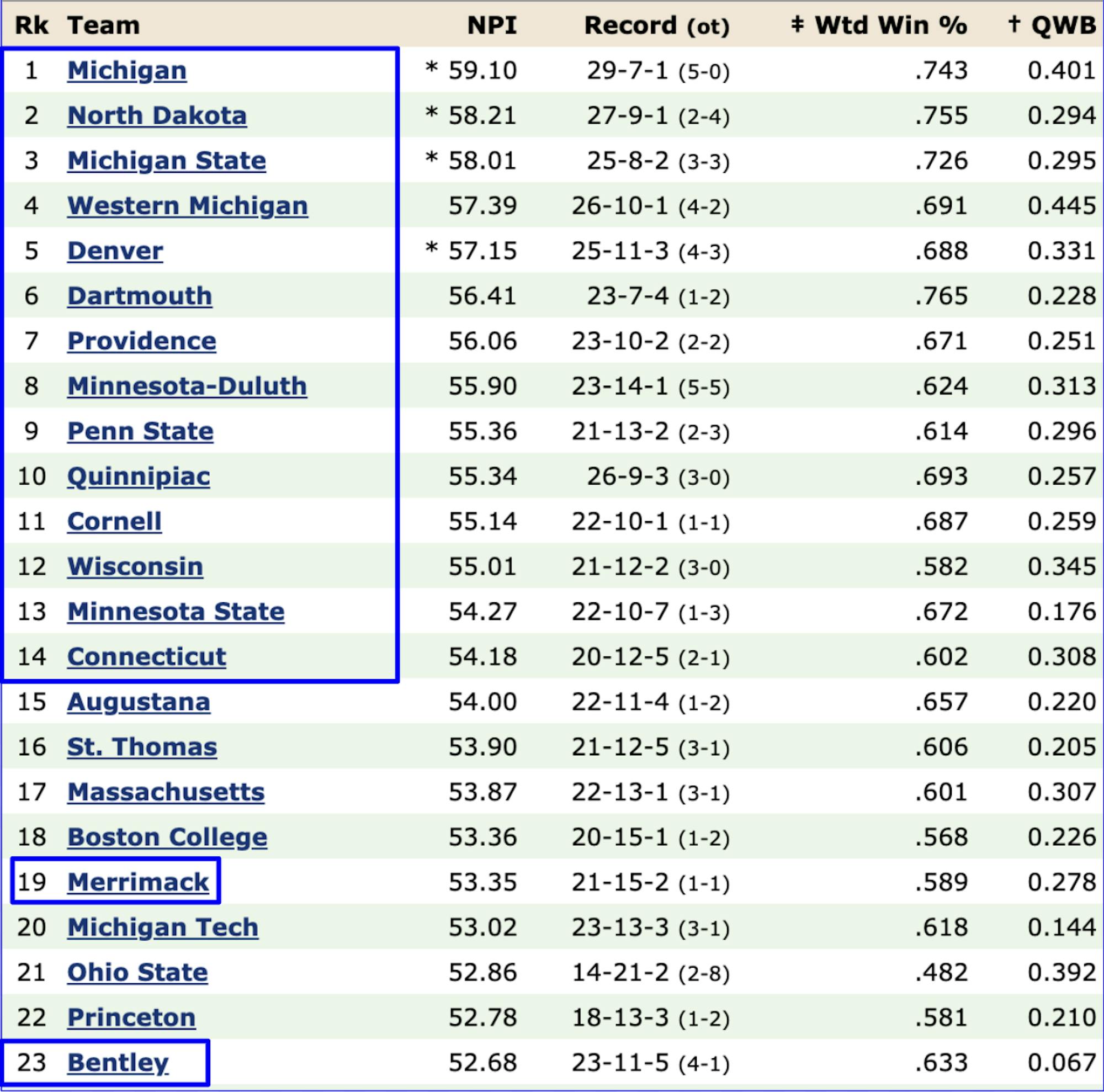
The field’s conference tournament winners — Michigan (Big 10), Denver (NCHC), Dartmouth (ECAC), Minnesota State (CCHA), Merrimack (Hockey East) and Bentley (AHA) all received automatic bids for the NCAA Tournament.
The at-large bids were then awarded to North Dakota, Michigan State, Western Michigan, Providence, Minnesota-Duluth, Penn State, Quinnipiac, Cornell, Wisconsin and Connecticut.
Then, seeds are awarded: the top four teams in the NPI earn No. 1 seeds, teams in 5th-8th receive No. 2 seeds, 9th-12th get No. 3 seeds, and the last four teams in receive No. 4 seeds.
So, without any teams, here is how the bracket seeding works out:
Region 1
(1) vs. (16)
(8) vs. (9)
Region 2
(2) vs. (15)
(7) vs. (10)
Region 3
(3) vs. (14)
(6) vs. (11)
Region 4
(4) vs. (13)
(5) vs. (12)
And now, with teams and locations (with the No. 1 seeds primarily determining location, aside from host Denver staying in Loveland) …
Albany
(1) Michigan vs. (16) Bentley
(8) Minnesota-Duluth vs. (9) Penn State
Sioux Falls
(2) North Dakota vs. (15) Merrimack
(7) Providence vs. (10) Quinnipiac
Worcester
(3) Michigan State vs. (14) Connecticut
(6) Dartmouth vs. (11) Cornell
Loveland
(4) Western Michigan vs. (13) Minnesota State
(5) Denver vs. (12) Wisconsin
There’s no tinkering in the bracket above, but the main issue is that Dartmouth and Cornell are pitted against one another in the Worcester regional semifinal — an intra-conference matchup, and therefore not allowed. Therefore, the committee must switch some things around.
Dartmouth also can’t play Quinnipiac, another three-seed, so its potential opponents are Penn State and Wisconsin. With Wisconsin (12th) just behind Cornell (11th) in NPI, so flipping them makes the most sense and preserves the integrity of the bracket. That’s what the committee ultimately did.
But this is also where things get wonky — or, they could have, if the committee really wanted to draw attendance to each regional. But in this day and age, TV ratings are vastly important — that’s what’s rakes in the money for the NCAA, maybe even more than the people in seats.
Because when you look around the bracket, questions about attendance arise. For instance, if North Dakota is upset in the regional semifinal by Merrimack (although improbable), how many tickets will be sold for a regional final featuring two eastern teams (Merrimack would play the winner of Providence vs. Quinnipiac)?
One plausible solution to that would be swapping the Minnesota-Duluth/Penn State matchup with the Providence/Quinnipiac game, moving those two eastern teams to Albany and introducing a western team to Sioux Falls. But that disrupts the way the bracket naturally falls — when the NCAA can make just as much from TV as it can from attendance, preserving the integrity of the bracket and instead focusing on staggered puck drops during prime-time viewing becomes the focus.
Some Cornell fans have expressed how the Red not being in Albany feels like a missed opportunity. But when you look at all the moves the committee would have had to make — sending Cornell to Albany to play Minnesota-Duluth, Wisconsin to Loveland to play Denver, and Penn State to Worcester to play Dartmouth — it starts to shift teams from their original positions in the NPI.
The differences in the NPI are insignificant, especially among all of the three-seeds. For instance, the first three-seed, Penn State (9th), has an NPI of 55.36, while the last three-seed, Wisconsin (12th), sits at 55.01 — a mere 0.35 difference. As written by Alan Wodon, managing editor of College Hockey News:
“I'd have no problem with it. All of the 3 seeds are really close in NPI. There's no tangible difference between them. I've said for decades at this point that the Committee should feel free to move those teams around as logic dictates, rather than be beholden to a strict ordering based on minuscule numerical differences of a system with arbitrary weighting mechanisms.”
– Adam Wodon
But at the end of the day, bracket integrity wins. Cornell is in Loveland because that’s how the numbers fell.
Cornell will take on Denver in the NCAA regional semifinal at 6 p.m. EST on Friday. The game will be available to stream on ESPN+.
Jane McNally is a senior editor on the 143rd editorial board and was the sports editor on the 142nd editorial board. She is a member of the Class of 2026 in the College of Agriculture and Life Sciences. You can follow her on X @JaneMcNally_ and reach her at jmcnally@cornellsun.com.