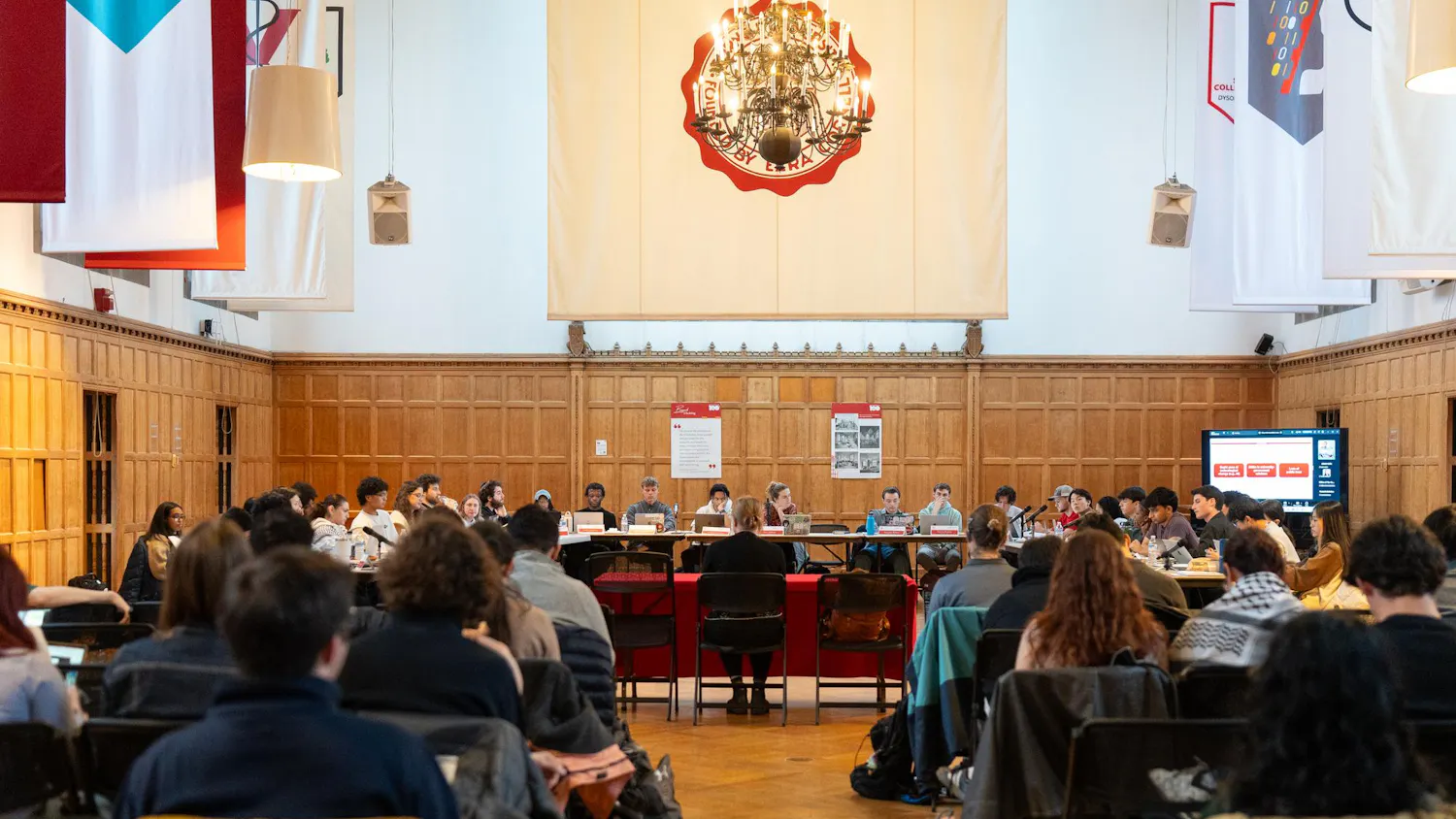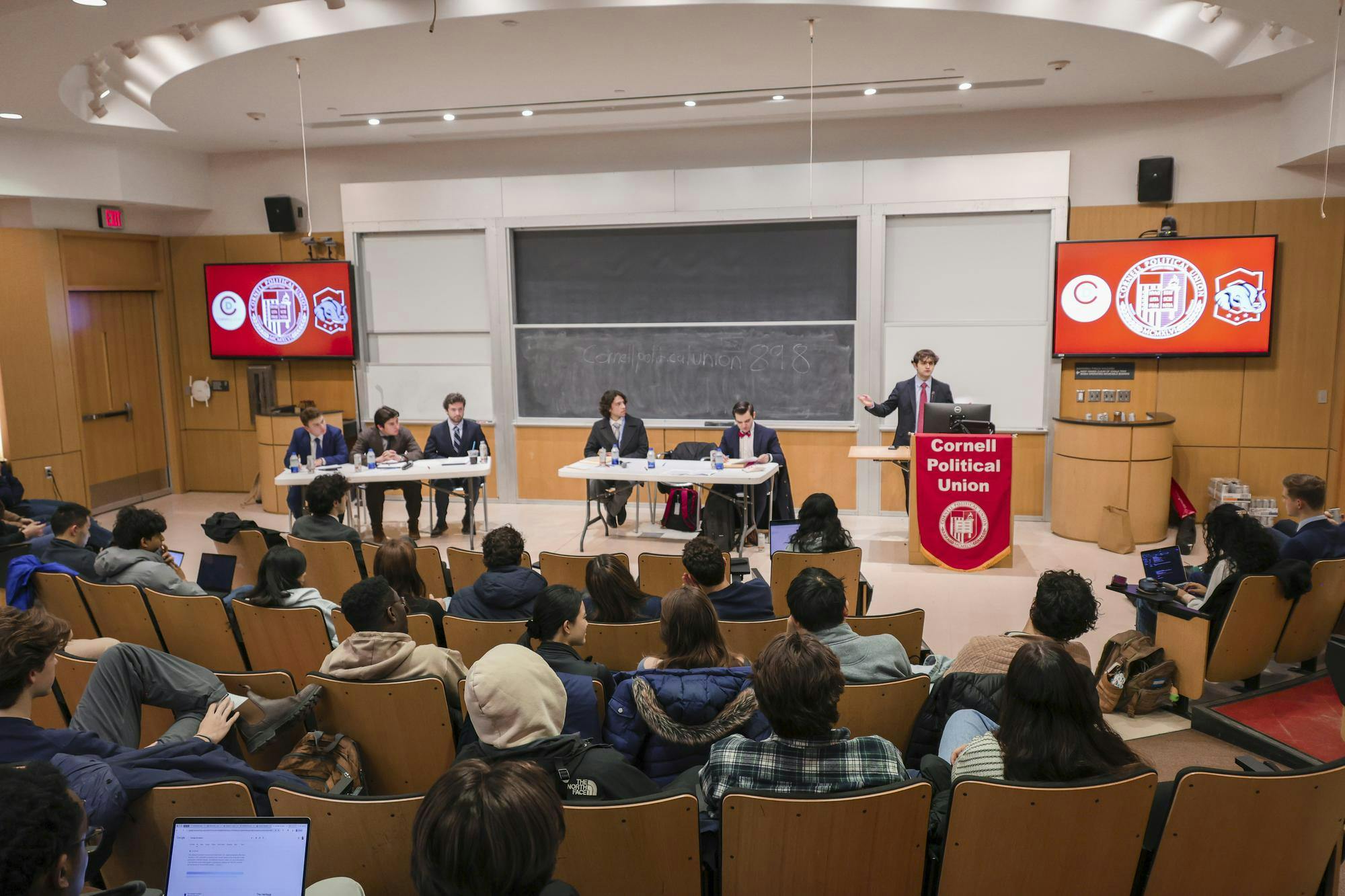
The Cornell Political Union hosted the inaugural Cornell Democrat-Republican Debate on Monday night, opening doors to a public audience. The debate featured two separate resolutions regarding the University’s role in political controversies and universal voter identification laws.
CPU President Cole Laudenslager ’27 started the event and introduced the two resolutions to the audience.
“Our mission is to highlight varied perspectives, showing that while we have disagreements, we can debate them in a respectful and constructive manner,” Laudenslager said.
CPU is a debate society dedicated to open discourse around political topics. Founded in 1946, it serves as one of Cornell’s oldest political organizations, providing a nonpartisan forum for students to engage with political and social issues.
The debate was promoted on Instagram as a joint post between CPU, Cornell Democrats and Cornell Republicans with the caption “Two parties. Two resolutions. One stage.”
Following his introduction of the resolutions, Laudenslager went on to introduce President of Cornell Democrats Saad Razzak ’26 and President of Cornell Republicans Max Whalen ’26. Razzak and Whalen served as moderators for the event, keeping time and steering discussion between speakers on both sides.
Whalen highlighted the significance of having an organized debate take place, especially amid a campus climate that can often feel otherwise polarizing and divisive.
“College campuses are often described as very divided spaces, but tonight reflects something better — a willingness to engage, to listen and to disagree, thoughtfully,” Whalen said.
The first debate resolution was “the University should abstain from political controversies." The Cornell Republicans agreed with the proposition while the Cornell Democrats took the opposition.
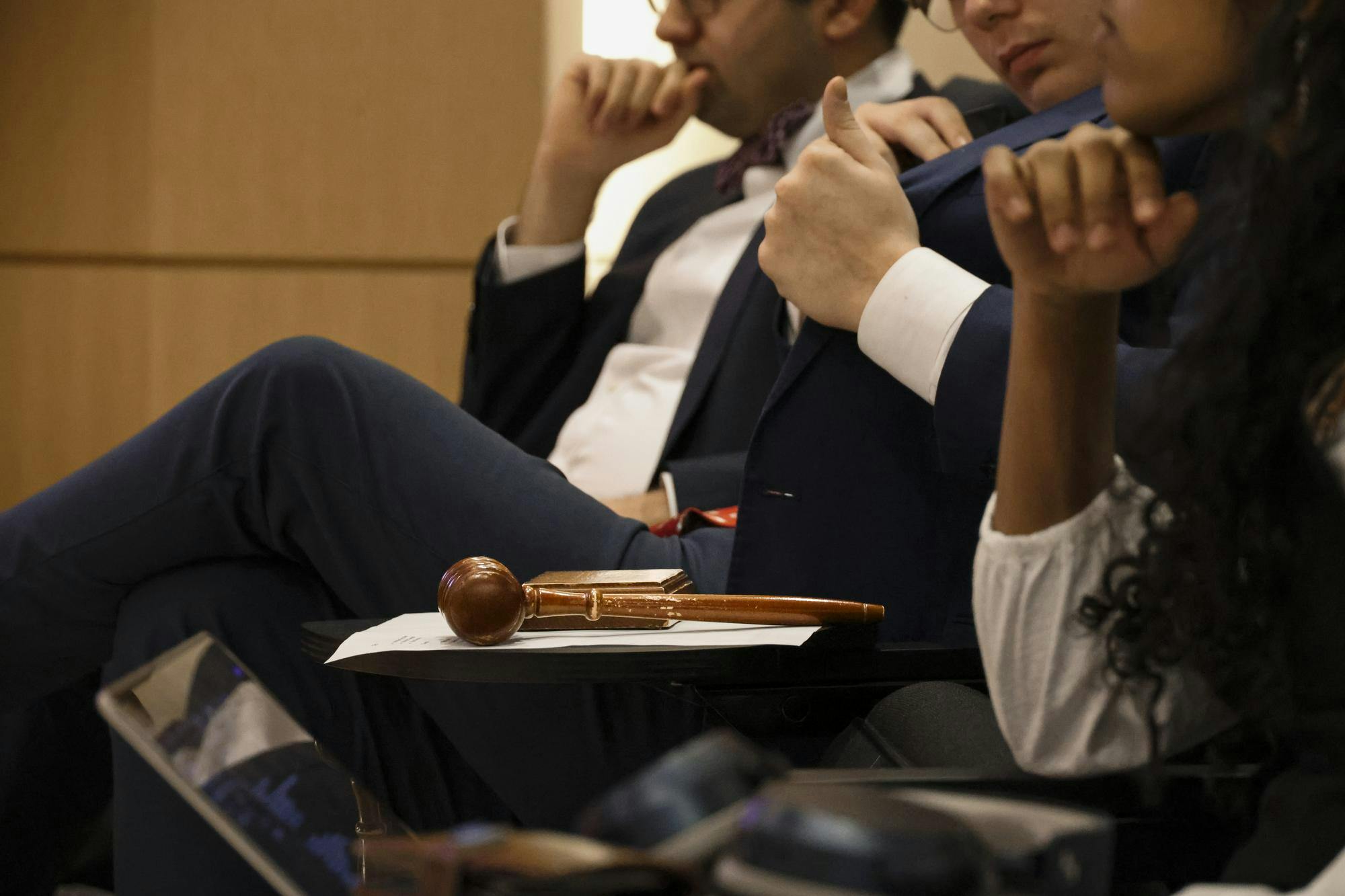
Each side’s speaker had five minutes to make their remarks with an intermediary three minutes open to questions from the opposition. At the conclusion of each resolution, a poll was held for the audience to vote on who made a better argument.
Nick Gonzalez ’27, vice president of operations for Cornell Republicans, opened the debate by emphasizing the meaning of abstain. “Abstaining from political controversies is not the same as never commenting on them,” he said.
Gonzalez stated that this resolution was provoked by the Presidential Task Force on Institutional Voice releasing its final recommendations in February. The official report supported the idea of “institutional restraint,” stating that the president and provost “should not convey intolerance to other views” and should not “crowd out other voices within the University from voicing dissent.”
Gonzalez argued that people would not personally trust President Michael Kotlikoff to comment on national and international political controversies on the students behalf. Additionally, Gonzalez stated that those who rely on Cornell for tenure, funding or education would feel pressured to “conform to the conclusions and beliefs of the University.”
Representing the Cornell Democrats, Spencer Krenk ’29 stated that the University should weigh into “any issue that is directly relevant to the students well being,” emphasizing the duty of the University to “protect their students.”
Krenk referenced the Immigration and Customs Enforcement arrest of a Columbia student from her dormitory on Feb. 26 as an example of a relevant issue. He continued to argue that “universities are fundamentally political institutions,” citing the University’s 2025 record-high federal lobbying expenditures, and ending with the notion that “if we are going to allow our university to support politics, we should also allow them to criticize it when it is actively hurting students.”
Following Krenk’s remarks, Yosef Herrera ’29 from Cornell Republicans said that when University leadership takes public political stances, “it can make students feel as if they are in conflict with the very institution they attend.”
After exchanges between Democratic speaker Brayden Handwerger ’27 and Republican speaker Benedict Segrest ’28, Vice President of Cornell Democrats Max Ehrlich ’26 concluded the debate with his argument that institutions like Cornell are inherently political.
“There is nothing more political than saying that we want to be a pluralistic university that supports diverse views, and that supports free inquiry,” Ehrlich said.
After the debate, an audience poll asked which side presented the rhetorically and defensively superior argument. 56% selected the Republican side, while 44% selected the Democratic side.
The second debate topic focused on the idea of implementing universal voter ID laws.
Arguing against voter ID requirements, Ehrlich, representing the Democrats, said that voter ID laws “make it harder for folks to vote for no reason, to solve no problem, to do absolutely nothing but make it so less people go to the polls.”
Gonzalez, speaking for the Cornell Republicans, defended voter ID as a preventative measure. He argued that a “successful democracy” must “reduce the margin of error in close elections” and “prevent post-election instability.”
Democrats in the debate argued that voter ID requirements have not historically been framed as necessary and suggested that the renewed emphasis is politically motivated.
“Fewer individuals would turn to the polls.That is not good for democracy,” Handwerger said.
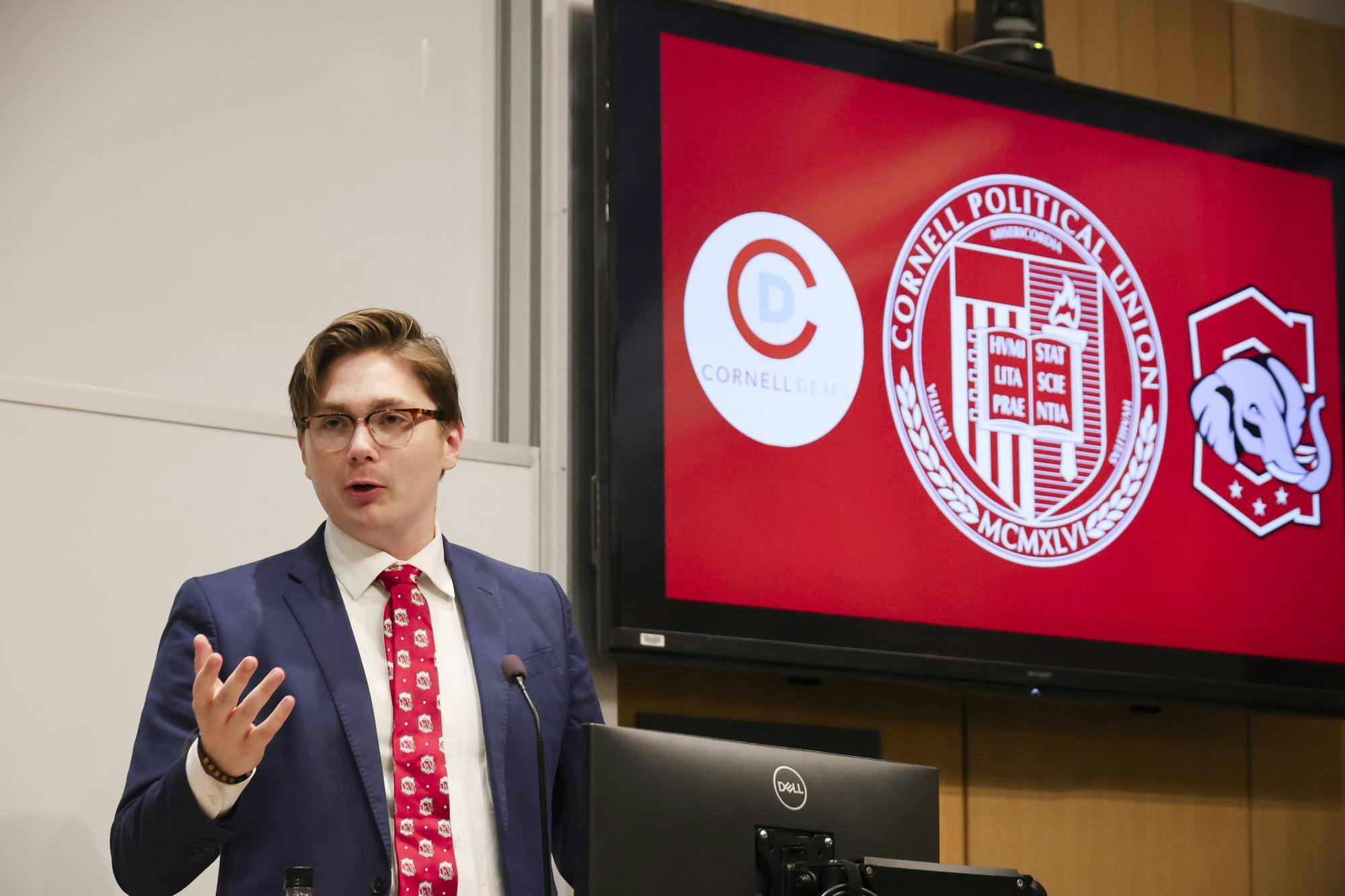
Herrera responded that voter ID laws do not actually reduce voter turnout, citing data from states with identification requirements to argue that participation rates remain stable under such laws.
“If you want to protect democracy, you want to make sure that the elections are done correctly,” Herrera said.
In the second audience poll of the night, 52% voted for the Democratic opposition as the superior argument, while 48% voted for the Republican proposition side.
After the debate, Laudenslager, Gonzalez and Ehrlich reflected on the event during interviews with The Sun.
Laudenslager expressed hope that the event would continue in the future. “In the title [of the event], we put ‘inaugural.’ Hopefully that implies that there's years and years to come in this tradition,” he said.
Gonzalez recalled that his strongest argument for the Republicans was the idea that universities should be about the pursuit of knowledge rather than the pursuit of a political agenda.
“I think that's really foundational for objectivity as the mission for any educational institution,” Gonzalez said.
Ehrlich believed that just having the debate itself was more important than the outcome of it.
“I think in the current political climate, people are cynical about the idea of democracy,” he said. “[The debate] was about convincing people that this is worth doing. It's worth talking to people you disagree with.”
Correction, March 5, 12:36 p.m.: A previous version of this article incorrectly spelled Max Ehrlich's name.

Svetlana Gupta is a member of the Class of 2029 in the College of Engineering. She is a contributor for the News department and can be reached at sg2622@cornell.edu.